

Birds don’t just make noise for fun; their diverse vocalizations are a complex form of communication vital for their survival and social lives. From warning calls about predators to sweet songs attracting mates and coordinated chirps keeping flocks together, understanding why birds talk reveals a rich world of avian language essential for finding food, raising young, and defending territory.
Birds are all around us, filling our days with their delightful chirps, melodious songs, and sometimes even raucous squawks. If you’ve ever stopped to truly listen, you might have wondered: “Why do birds talk?” Is it just random noise, or is there a deeper meaning to their seemingly endless chatter?
The truth is, bird vocalizations are anything but random. They are a sophisticated language, a vital tool for survival, reproduction, and social interaction in the avian world. Understanding why birds talk opens up a fascinating window into their lives, revealing complex communication strategies that are as intricate as any human language. So, let’s dive into the amazing world of bird communication and uncover the many reasons behind their captivating conversations.
Key Takeaways
- Survival Instincts: Bird vocalizations are primarily for survival, acting as alarm calls to warn of predators, signals to locate food, and methods to maintain group cohesion.
- Mating & Reproduction: Elaborate birdsongs are crucial for attracting mates, establishing breeding territories, and ensuring successful reproduction by signaling health and fitness.
- Territorial Defense: Birds use distinct calls and songs to mark and defend their territories from rivals, reducing physical conflict and asserting dominance.
- Social Bonding & Coordination: Flocks use various calls to stay connected, coordinate movements, share information about resources, and engage in cooperative behaviors.
- Parental Care & Development: Parents communicate with their chicks to guide them and request food, while chicks vocalize their needs, fostering strong family bonds.
- Learning & Adaptability: Many bird species learn their songs and calls, often developing regional dialects or mimicking other species, showcasing their cognitive abilities and adaptability.
- Environmental Factors: The timing, volume, and complexity of bird “talk” can be influenced by environmental factors like time of day, weather, and the presence of humans or other animals.
Quick Answers to Common Questions
What is the main reason why birds talk?
The main reason birds talk is for communication, which is crucial for their survival, reproduction, and social interactions within their environment.
Do all birds sing?
No, not all birds sing. While most birds produce various calls, true “song” – complex, often musical vocalizations used for mating and territory – is primarily associated with a group called songbirds (oscine passerines).
Can birds understand human speech?
While some birds, particularly parrots, can mimic human speech, they don’t understand it in the same way humans do. They learn to associate specific sounds with actions or contexts rather than comprehending the meaning of the words themselves.
What is the difference between a bird call and a bird song?
Bird calls are typically shorter, simpler vocalizations used for immediate communication like alarm, contact, or begging. Bird songs are usually longer, more complex, and musical, primarily used for attracting mates and defending territory.
How do birds make sounds?
Birds make sounds using a specialized vocal organ called the syrinx, located at the base of their trachea. Its vibrating membranes and muscular control allow them to produce a wide range of pitches, volumes, and complex sounds.
📑 Table of Contents
- The Language of Survival: More Than Just Pretty Songs
- Building a Family: Communication in the Nest
- The Social Network: Birds Connecting with Each Other
- Learning and Adapting: The Cleverness of Birdsong
- The Science Behind the Chirps: How Birds “Talk”
- How You Can Listen and Understand (Practical Tips)
- Conclusion
The Language of Survival: More Than Just Pretty Songs
When we hear a bird singing, we often think of beauty and peace. But beneath the surface, many of these “songs” are powerful messages, crucial for a bird’s very existence. Birds use their voices for a wide array of survival-related tasks, from alerting friends to danger to claiming their patch of the world.
Warning! Danger Ahead! (Alarm Calls)
Imagine you’re foraging for tasty seeds, completely engrossed, when suddenly you hear a sharp, piercing sound. That’s an alarm call! Birds are incredibly vigilant creatures, always on the lookout for predators like hawks, cats, or even snakes. When a bird spots a threat, it often issues a distinct alarm call, instantly alerting other birds in the vicinity. These calls are often short, high-pitched, and difficult to pinpoint, making it hard for a predator to locate the caller. Different predators might even elicit different types of alarm calls, allowing other birds to understand the specific threat and react accordingly – perhaps by freezing, flying into dense cover, or mobbing the predator as a group. It’s a true neighborhood watch system in the sky!
“Come Here, Darling!” (Mating and Courtship)
One of the most well-known reasons why birds talk is for reproduction. Think of the robin singing its heart out at dawn, or the elaborate musical phrases of a mockingbird. These aren’t just for our enjoyment; they are powerful advertisements to potential mates. Male birds, in particular, use complex songs to show off their health, fitness, and genetic quality. A strong, varied song might signal that the male is experienced, well-fed, and has a good territory – all very attractive qualities to a female.
Females, in turn, use these vocal cues to choose the best mate, ensuring their offspring inherit good genes and have a strong provider. Once a pair has formed, they might also use softer calls to maintain their bond, coordinate nesting duties, and communicate during the incubation period.
“This is MY Territory!” (Territorial Claims)
Ever notice how a bird seems to sing from the same branch every day? That bird is likely marking its territory. Birds need space to find food, build a nest, and raise their young without competition. By singing loudly and consistently from perches around their chosen area, they’re essentially putting up a “No Trespassing” sign for other birds of the same species.
These territorial songs are a way to avoid direct conflict. A male bird might listen to a rival’s song and, based on its strength and location, decide whether to challenge the intruder or move on. It’s a brilliant, energy-efficient way to defend resources without having to fight every single time. Sometimes, if a rival gets too close, the songs might intensify, becoming more aggressive and serving as a final warning before a physical confrontation.
Building a Family: Communication in the Nest
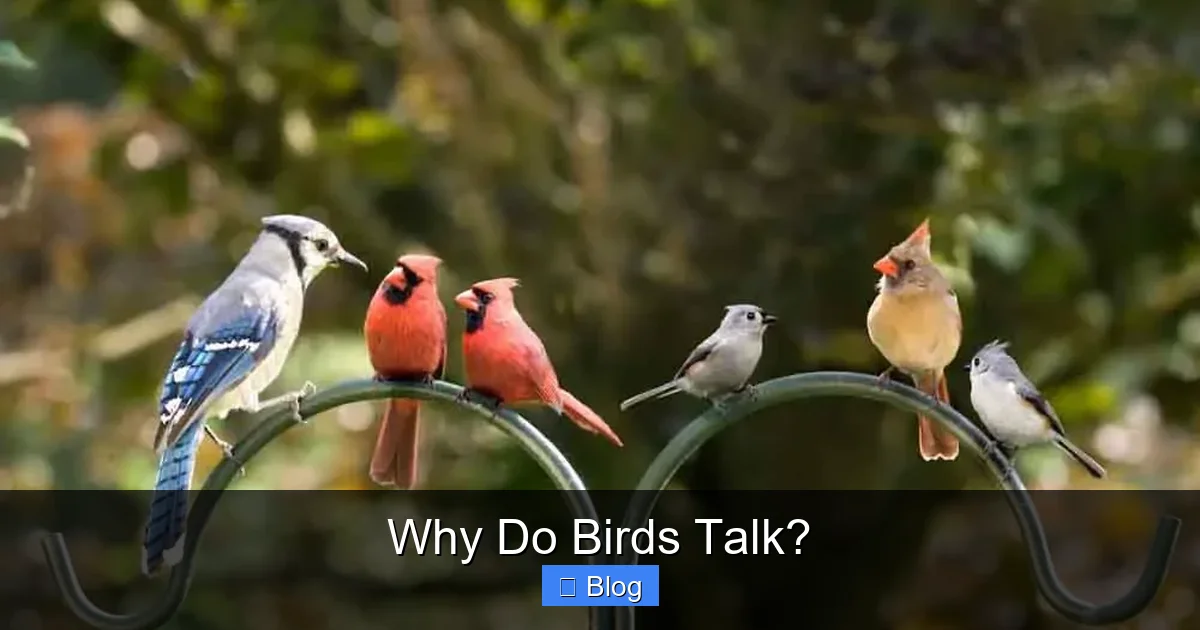
Visual guide about Why Do Birds Talk?
Image source: weknowbirds.com
Bird communication extends deeply into family life, ensuring the survival and successful rearing of their offspring. From the moment chicks hatch, their world is filled with vocal interactions.
Chicks Crying for Food
Newborn chicks are helpless and entirely dependent on their parents. Their primary form of communication is begging calls. These calls are often high-pitched peeping or chirping sounds, and their intensity usually increases with hunger. A chorus of hungry chicks motivates parents to constantly search for food.
Interestingly, parents can often recognize the specific calls of their own chicks, even in a noisy nest with many other young. This helps ensure that the food they bring back goes to their own offspring, optimizing their reproductive efforts.
Parents Guiding Their Young
As chicks grow, parental communication becomes more complex. Parents might use specific calls to encourage their young to fledge (leave the nest) or to guide them to food sources once they’re out in the world. They also use warning calls to teach their fledglings about potential dangers. These subtle vocal lessons are crucial for teaching young birds the ropes of survival, preparing them for an independent life. It’s like a bird parenting manual, delivered through chirps and calls!
The Social Network: Birds Connecting with Each Other
Many birds live in groups, whether small family units or large, mixed-species flocks. In these social settings, communication is key to maintaining cohesion and sharing vital information.
Keeping the Flock Together
Think of a flock of geese flying in formation, or a group of sparrows foraging together. They’re constantly making contact calls – soft, consistent chirps or peeps that help them stay aware of each other’s presence. These calls are especially important in dense vegetation, at night, or during migration, when visual cues might be limited. They prevent individuals from getting lost and help maintain the group’s structure, offering safety in numbers.
Sharing Food Sources
“Hey everyone, I found the good stuff!” Birds often use specific calls to announce the discovery of a plentiful food source. This can be particularly beneficial for species that forage in groups, allowing them to exploit resources more efficiently. A raven, for example, might call loudly after finding a large carcass, attracting others to help break it apart. This cooperative communication strengthens the flock and ensures more individuals benefit.
Group Defense Strategies
Beyond individual alarm calls, some species engage in mobbing behavior – ganging up on a predator. This often starts with specific vocalizations that rally other birds to the cause. By making a lot of noise and flying around the predator, they can often drive it away, protecting the entire group. This coordinated communication shows just how advanced bird social structures can be.
Learning and Adapting: The Cleverness of Birdsong
Not all bird “talk” is innate. Many species, especially songbirds, learn their vocalizations, which adds another layer of complexity to the question of why birds talk.
Mimicry: The Copycats of the Avian World
Some birds are incredible mimics. Mockingbirds, starlings, and parrots are famous for their ability to imitate the sounds of other birds, animals, and even human speech or artificial noises. Why do they do it? For some, like the Northern Mockingbird, a larger repertoire of songs (including imitated ones) can be a sign of a more experienced and capable male, making him more attractive to females. For parrots, mimicry might play a role in social bonding within their complex flocks, allowing them to integrate and communicate effectively with their group. It’s a remarkable display of vocal learning and intelligence!
Regional Dialects: Birds Have Accents Too!
Just like humans have different accents depending on where they live, many bird species exhibit regional dialects in their songs. A sparrow’s song in one valley might have subtle differences from a sparrow’s song in a neighboring valley. These variations arise from learning, as young birds learn songs from their parents and local adults. Dialects can help birds recognize members of their own local population, potentially strengthening social bonds and reducing interbreeding with individuals from distant, less-adapted populations.
Learning New Tunes: A Lifetime Skill
For many songbirds, song learning isn’t a one-time event in youth. Some species continue to refine and add to their repertoire throughout their lives. This ongoing learning can be influenced by social interactions, environmental changes, and even the “fashion” of songs in their local area. It highlights the dynamic and adaptable nature of bird communication, proving that their “talk” is not static but evolves over time.
The Science Behind the Chirps: How Birds “Talk”
To truly understand why birds talk, it’s helpful to know a little about the biological mechanisms that allow them to produce such an astounding range of sounds.
Syrinx: The Bird’s Voice Box
Unlike humans who use a larynx, birds possess a specialized vocal organ called the *syrinx*. Located at the bottom of the trachea where it branches into the bronchi, the syrinx is an incredibly efficient and versatile instrument. Many birds have two vibrating membranes in their syrinx, allowing them to produce two independent sounds simultaneously! This is why a single bird can sometimes sound like it’s singing a duet, creating complex harmonies and unique vocal textures that would be impossible with a human voice box. The precise control over air sacs and muscles around the syrinx enables birds to vary pitch, volume, and rhythm with incredible precision.
Brainpower for Birdsong
Producing and understanding complex vocalizations requires significant brainpower. Birds have specialized brain regions dedicated to song learning, production, and recognition. These neural pathways are often more developed in species that learn their songs, like oscine songbirds. Studies have shown that these brain areas are plastic, meaning they can change and adapt over time, especially during periods of intense song learning or during breeding season when song production is at its peak. This sophisticated neural architecture underscores the importance of vocal communication in their lives.
Different Types of Vocalizations (Calls vs. Songs)
While we often use “chirps” and “songs” interchangeably, ornithologists generally make a distinction. *Songs* are typically longer, more complex, and often musical vocalizations, primarily used for attracting mates and defending territory. They are mostly produced by males, especially during the breeding season. *Calls*, on the other hand, are usually shorter, simpler vocalizations used for a variety of purposes: alarm, contact, begging, warning, flight, and so on. Both calls and songs are integral to understanding why birds talk, as they serve different, yet equally vital, communication functions.
How You Can Listen and Understand (Practical Tips)
Now that you know the depth of avian communication, you might be eager to start deciphering it yourself. Here are some tips to help you better understand why birds talk in your own backyard or local park.
Start with Common Birds
Don’t try to identify every single bird by its call at once. Begin by focusing on a few common species in your area, like robins, sparrows, or cardinals. Learn their most frequent songs and calls. Once you’re familiar with these, you can gradually expand your knowledge.
Learn the Context
Context is everything! Pay attention to *when* and *where* a bird is vocalizing. Is it singing loudly from a high perch at dawn? Probably a territorial or mating song. Is it making short, sharp chirps when a hawk flies overhead? Likely an alarm call. Is a flock making soft, consistent sounds as they forage? Contact calls. Observing the bird’s behavior and surroundings will give you huge clues about the meaning of its “talk.”
Use Technology (Apps, Guides)
There are many excellent resources available today to help you learn bird calls. Smartphone apps like Merlin Bird ID by Cornell Lab of Ornithology can identify birds by their sounds in real-time. Field guides often include descriptions or even QR codes for audio samples of calls and songs. Websites like Xeno-canto offer vast databases of bird vocalizations from around the world. These tools can be invaluable in your journey to understand why birds talk.
Be Patient and Observant
Learning bird language takes time and practice. Spend consistent time outdoors, listening patiently and observing carefully. The more you listen, the more patterns you’ll begin to notice, and the richer your understanding of the avian world will become.
Conclusion
The question “Why do birds talk?” leads us down a fascinating path into the intricate world of avian life. From the urgent cries of alarm to the sweet melodies of courtship, every chirp, tweet, and squawk serves a purpose. Birds communicate to survive, to find mates, to protect their young, and to navigate their complex social worlds.
Their vocalizations are not just pretty sounds; they are a sophisticated language, a testament to their intelligence and adaptability. By taking the time to listen and learn, we gain a deeper appreciation for the feathered inhabitants of our planet and the rich, hidden conversations that fill our skies and forests every day. So next time you hear a bird, pause, listen closely, and marvel at the wisdom encoded in its voice.
🎥 Related Video: Talking Parrot Interacts Adorably With Owner
📺 The Pet Collective
We need a movie about this friendship IMMEDIATELY!!! #Shorts #Funny #Cute #Birds #BirdWatching For the spoiling, …
Frequently Asked Questions
Why do birds sing more at dawn?
Birds often sing most vigorously at dawn, a phenomenon known as the “dawn chorus,” primarily to attract mates and defend their territory. The low light conditions make it harder for predators to spot them, and sounds carry better in the cooler, still air, making it an optimal time for vocal advertising.
Do birds have different “languages” for different species?
Yes, different bird species have their own distinct sets of calls and songs that are generally specific to their kind. While some calls, like general alarm calls, might be understood across species, their detailed communication is unique to each species.
Can female birds sing?
While male birds are more renowned for their elaborate songs, female birds of many species do sing. In some cases, their songs might be softer, less frequent, or used for different purposes, such as maintaining pair bonds or defending territories alongside their mates.
How do young birds learn to talk?
Young birds, particularly songbirds, learn to talk by listening to and imitating adult birds of their species. This learning period, often involving a “subsong” phase similar to human babbling, allows them to refine their vocalizations into adult songs and calls.
Do birds communicate with gestures or body language?
Absolutely! While vocalizations are primary, birds also communicate extensively through visual displays and body language. This includes feather postures, wing movements, head bobbing, and intricate dances, all of which convey messages about aggression, courtship, or submission.
Why do some birds mimic other sounds?
Some birds mimic other sounds, including those of other species or even human noises, for various reasons. For some, a larger and more varied song repertoire (including mimicked sounds) can signal greater fitness and experience, making them more attractive to mates. For others, it might play a role in social bonding or camouflage.