
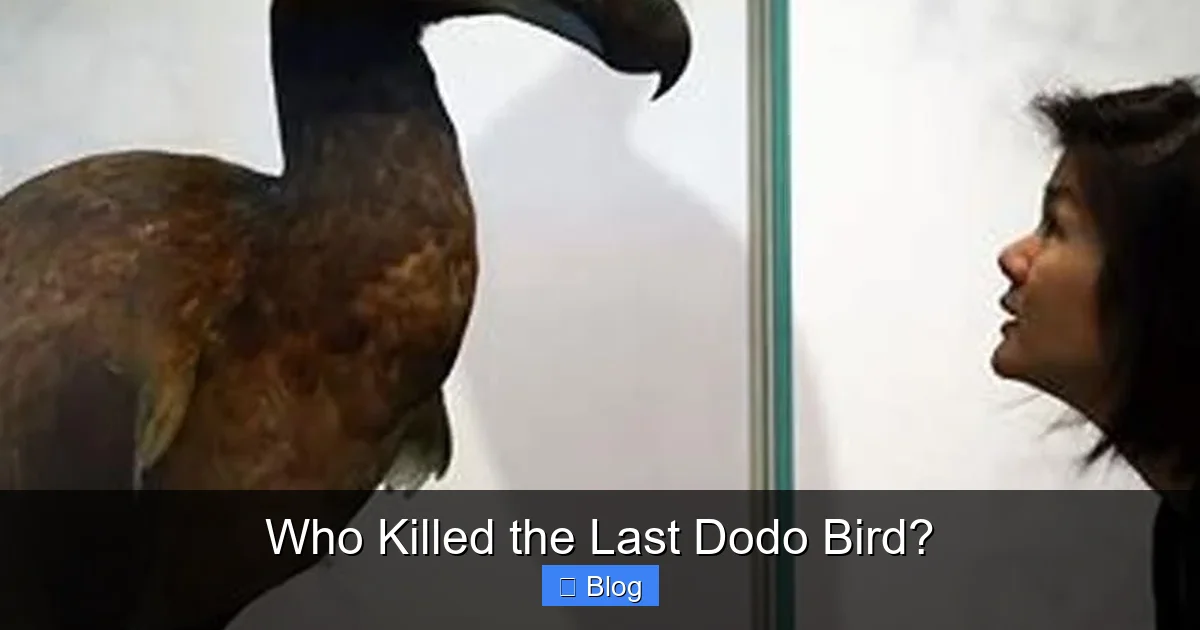
The extinction of the dodo bird isn’t a simple tale of direct human hunting. While humans arrived on Mauritius, bringing drastic changes, the true killers were a combination of invasive species like rats, pigs, and macaques, alongside massive habitat destruction. The dodo, unprepared for these new threats, vanished rapidly, leaving behind a powerful symbol of ecological vulnerability and human impact.
Who Killed the Last Dodo Bird?
Imagine a creature so iconic, so unique, that its very name became synonymous with extinction. That, my friends, is the dodo bird. This fascinating, flightless bird, native only to the island of Mauritius, vanished from the face of the Earth centuries ago, leaving behind a mystery that has captivated imaginations ever since. We often picture humans with clubs, relentlessly hunting these gentle giants into oblivion, a tragic, straightforward tale of conquest. But is that truly the full story?
The question “Who Killed the Last Dodo Bird?” isn’t as simple as pointing a finger at a single culprit. It’s a complex ecological whodunit, a cautionary tale woven with threads of human ignorance, unintended consequences, and the delicate balance of nature. For years, the dodo has been a potent symbol of human-induced extinction, a stark reminder of our capacity to alter the natural world profoundly. But to truly understand its demise, we must dig deeper than the popular myth. We must travel back in time to an untouched paradise and witness the fateful collision of two worlds.
So, let’s embark on this journey. Let’s peel back the layers of misconception and uncover the real chain of events that led to the dodo’s disappearance. By examining the facts, we can understand not just who killed the last dodo bird, but also the invaluable lessons its tragic story holds for biodiversity and conservation efforts today. Get ready to challenge your assumptions and discover the nuanced truth behind one of history’s most famous extinctions.
Key Takeaways
- No Single Killer: The dodo’s extinction was not due to a single person or event, but a complex interplay of factors initiated by human arrival.
- Invasive Species Were Primary Culprits: Rats, pigs, and macaques, introduced by European sailors, preyed heavily on the dodo’s eggs and chicks, which were laid on the ground.
- Habitat Destruction Played a Major Role: Extensive logging and clearing of forests for human settlements and agriculture destroyed the dodo’s food sources and nesting grounds.
- Dodos Were Unprepared for Predators: Having evolved on an isolated, predator-free island, dodos were fearless of humans and newly introduced animals, making them incredibly vulnerable.
- Human Consumption Was Minimal: While some dodos were hunted, their meat was often described as unpalatable, meaning direct human hunting was not the primary cause of their disappearance.
- Rapid Extinction: The dodo went from first human contact to extinction in less than 70 years, highlighting the swift and devastating impact of new ecological pressures.
- A Cautionary Tale: The dodo serves as a powerful symbol and early warning about the fragility of island ecosystems and the far-reaching consequences of human activity on biodiversity.
Quick Answers to Common Questions
Who discovered the dodo bird?
The dodo bird was first documented by Dutch sailors who landed on Mauritius in 1598, led by Admiral Jacob Cornelisz van Neck.
What did the dodo bird look like?
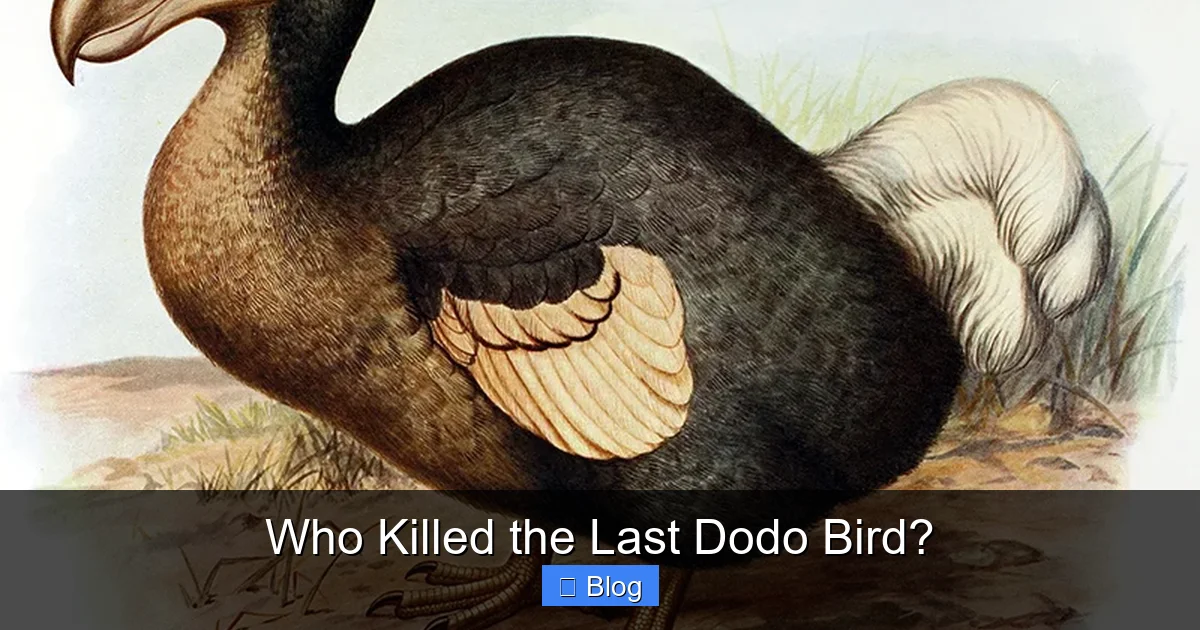
The dodo was a large, flightless bird, roughly one meter tall, weighing between 10-18 kg, with grayish-blue plumage, a large head, a hooked beak, and small, vestigial wings.
Where did the dodo bird live?
The dodo bird was endemic to the island of Mauritius, a volcanic island in the Indian Ocean, and was found nowhere else in the world.
How long did it take for the dodo to go extinct after human arrival?
The dodo went extinct remarkably quickly, within less than 70 years of human arrival on Mauritius, with the last widely accepted sighting occurring in 1662.
Is the dodo related to pigeons?
Yes, genetic studies have confirmed that the dodo bird is a relative of pigeons and doves, with its closest living relative being the Nicobar pigeon.
📑 Table of Contents
The Dodo’s Eden: Mauritius Before Humans
Before humans set foot on its shores, Mauritius was a true island paradise, a vibrant green jewel in the Indian Ocean. This volcanic island, untouched by large mammalian predators for millions of years, fostered a unique ecosystem where life flourished in ways unseen elsewhere. And at the heart of this Eden lived the remarkable dodo.
An Island Paradise Unprepared
Mauritius was a world apart. Its isolation meant that the animals evolving there did so without the constant threat of ground predators common on continents. This lack of natural enemies led to unique evolutionary adaptations. Many species, including the dodo, lost the ability to fly. Why expend precious energy on flight when there’s no need to escape? The dodo’s large size and flightlessness were perfectly suited to its tranquil environment, where food was plentiful and danger non-existent.
Imagine a bird that had never known fear. That’s essentially what the dodo was. It didn’t view any other creature as a threat, a trait that would prove fatal upon the arrival of new inhabitants. This ecological naivety highlights the fragility of isolated island ecosystems when exposed to external pressures. They are like beautifully complex, bespoke machines designed for a specific environment, utterly unprepared for disruptive foreign elements.
The Dodo’s Lifestyle
The dodo, scientifically known as Raphus cucullatus, was a fascinating creature. Standing about a meter (3.3 feet) tall and weighing around 10-18 kg (22-40 lbs), it was a pigeon relative that had grown plump and grounded. Its diet consisted mainly of fallen fruit, seeds, nuts, and perhaps small invertebrates found on the forest floor. The abundant fruit of the tambalacoque tree, for instance, is often linked to the dodo, with theories suggesting the tree’s seeds needed to pass through the dodo’s digestive system to germinate.
Dodos nested on the ground, laying a single large egg, a common strategy for species in safe environments with low predation risk. The parents would guard their precious egg and chick, but without the need for camouflage or swift escape. Their slow, waddling gait and trusting nature were perfectly adapted to their safe haven. They simply had no concept of danger, a crucial detail in understanding who killed the last dodo bird. Their existence was a testament to how life adapts to its surroundings – a lesson that would soon turn tragic.
The Arrival: Dutch Mariners and a New World Order
Visual guide about Who Killed the Last Dodo Bird?
Image source: yenra.com
The serene existence of the dodo and its unique island home came to an abrupt end with the arrival of humans. In 1598, Dutch sailors, led by Admiral Jacob Cornelisz van Neck, landed on Mauritius, claiming the island and forever altering its destiny. This wasn’t just the arrival of people; it was the arrival of a completely different ecosystem, carried on the ships’ decks.
First Contact and Initial Impressions
When the Dutch sailors first encountered the dodo, they were undoubtedly bewildered. Here was a large, awkward bird that showed no fear, allowing itself to be approached and easily caught. They named it “dodo,” which some believe comes from the Dutch word “dodoor” (sluggard) or “dodaars” (fat-arse), or perhaps from a Portuguese word “doudo” (fool or crazy). Regardless of the exact origin, the names reflect the bird’s seemingly unintelligent and trusting nature, a trait born of its evolutionary history, not a lack of wit.
Early reports and illustrations of the dodo, often exaggerated or based on second-hand accounts, sometimes depicted them as ungainly and clumsy. However, modern scientific understanding suggests they were well-adapted to their environment and likely more graceful than caricatures imply. But their innocence in the face of humans sealed their fate.
The Myth of the Hunted Dodo
Popular culture often portrays sailors gleefully clubbing dodos into extinction, filling their ship’s larders with dodo meat. While sailors certainly did hunt dodos, and they were easy to catch, the reality of their consumption isn’t quite so dramatic. The meat was often described as tough and unpalatable, earning them names like “walghvogel” or “disgusting bird” by the Dutch. Sailors preferred readily available fish, local pigs, and giant tortoises for food.
So, while direct hunting did contribute to their decline to some extent, it’s highly unlikely that widespread human slaughter was the primary answer to who killed the last dodo bird. A few dodos might have been taken for novelty or as fresh meat when other options were scarce, but they weren’t the main course. The real tragedy unfolded due to more insidious, indirect factors that began with the very presence of humans on the island.
The True Culprits: Indirect Human Impact
If direct hunting wasn’t the main driver, then who killed the last dodo bird? The answer lies in the profound ecological disruption brought by human colonization. It wasn’t just the sailors themselves, but the entire biological baggage they brought with them that proved catastrophic for the dodo.
The Unintended Invasion: Rats, Pigs, and Macaques
This is arguably the most significant chapter in the dodo’s extinction story. European ships didn’t just carry people; they carried an array of non-native animals that quickly escaped and established populations on Mauritius. Among these were domestic pigs, macaques (long-tailed monkeys), and, most devastatingly, rats.
These invasive species were foreign to Mauritius’s ecosystem and utterly devastating to the dodo. The dodo, remember, laid a single egg on the ground, a safe strategy when there are no egg-eaters around. But pigs, macaques, and rats are voracious omnivores. They discovered the dodo’s nests with ease, devouring eggs and helpless chicks. Dodo parents, having no defense against such predators, were powerless to protect their offspring. A single rat could destroy an entire generation of dodos, and with many rats, pigs, and monkeys spreading across the island, the dodo’s reproductive success plummeted to zero. This relentless, ongoing predation on eggs and young was a far more potent killer than any sailor’s club.
Habitat Destruction: Felling the Forests
Simultaneously, the arrival of humans brought widespread habitat destruction. The Dutch established settlements, cultivated crops, and logged vast swathes of the dense Mauritian forests. Trees were felled for timber, land was cleared for agriculture (like sugarcane plantations), and new infrastructure was built.
This deforestation directly impacted the dodo in several ways:
- Loss of Food Sources: The dodo’s diet relied heavily on fallen fruits, seeds, and nuts from specific native trees. As these forests were destroyed, their primary food sources dwindled rapidly.
- Loss of Nesting Sites: While dodos nested on the ground, they relied on the shelter and cover of the forest undergrowth for protection from the elements and potential (though previously non-existent) threats. Clearing these areas exposed them even further.
- Increased Vulnerability: As their natural habitat shrank, dodos were forced into smaller, fragmented areas, making them easier targets for the invasive predators that were simultaneously spreading.
The combination of invasive predators and massive habitat loss created a perfect storm, relentlessly chipping away at the dodo population. These indirect consequences were the true answer to who killed the last dodo bird.
The “Domestication” Effect and Vulnerability
Another subtle but significant factor was the dodo’s inherent fearlessness. This trust, a survival advantage in its pristine world, became a deadly vulnerability. When faced with new predators, they didn’t flee or fight effectively. They were simply unaware of the danger until it was too late. This “domestication” by evolution made them easy prey, not just for humans occasionally, but constantly for the newly introduced animals. It underscores how critical a species’ behavioral adaptations are to its survival when its environment undergoes radical change.
The Fading Echo: Documenting the Decline
The dodo’s extinction wasn’t a sudden, cataclysmic event, but a rapid, accelerating decline, largely unnoticed by those who inadvertently caused it. By the time anyone truly grasped what was happening, it was already too late.
Scarcity and Last Sightings
From their first documented sighting in 1598, the dodo population plummeted with terrifying speed. Within a few decades, sightings became rare. The last widely accepted sighting of a living dodo occurred in 1662, documented by a shipwrecked mariner named Volkert Evertsz. He described finding a single dodo in a forest, which he and his companions easily caught and killed. This account provides a poignant, albeit tragic, snapshot of the dodo’s final days, confirming its continued existence, but also its extreme scarcity.
However, some historical records suggest even later, isolated sightings, though these are less definitive. What is clear is that by the late 17th century, the dodo was gone. Its rapid disappearance, within less than 70 years of human contact, makes it one of the most striking examples of human-induced extinction in recent history.
The Race Against Time (Unknowingly)
It’s crucial to remember that the concept of extinction, as we understand it today, was not widely recognized or accepted in the 17th century. The prevailing view was that God’s creations were immutable and would not simply cease to exist. Therefore, there was no organized effort to conserve the dodo, no understanding that its numbers were irreversibly dwindling. Naturalists and explorers collected specimens, described the bird, and illustrated it, but they didn’t comprehend that they were documenting a species on the brink of oblivion.
The dodo simply vanished, leaving behind only bones, fragmented accounts, and a few preserved specimens that would later spark scientific curiosity and sorrow. The lack of awareness regarding extinction meant that no one was actively tracking who killed the last dodo bird. Its demise was a slow, silent unfolding of ecological collapse rather than a public spectacle.
Lessons from the Dodo: A Warning for Today
The story of the dodo bird, though centuries old, remains incredibly relevant. Its extinction serves as a powerful, enduring symbol and a stark warning about the consequences of human actions on the natural world. Understanding who killed the last dodo bird provides crucial insights for modern conservation efforts.
Biodiversity and Ecosystem Fragility
The dodo’s fate vividly illustrates the fragility of island ecosystems and the interconnectedness of all life within them. The absence of one species can ripple through an entire ecosystem, and the introduction of new ones can cause catastrophic cascades. Mauritius’s unique biodiversity, honed over millions of years, crumbled in mere decades because of a few introduced species and habitat destruction. This teaches us that every species, even seemingly “unimportant” ones, plays a role, and their loss diminishes the entire web of life.
The Ongoing Threat of Invasive Species and Habitat Loss
Tragically, the lessons from the dodo’s extinction are still profoundly pertinent today. Invasive species remain one of the leading causes of biodiversity loss worldwide. Rats, cats, dogs, and various plants continue to devastate native flora and fauna on islands and continents alike. Similarly, habitat destruction, driven by deforestation, urbanization, and agricultural expansion, continues to be a major threat to countless species globally.
Conservation efforts today often focus on controlling invasive species, restoring natural habitats, and establishing protected areas. The ghost of the dodo reminds us that these efforts are not just academic exercises but urgent necessities to prevent history from repeating itself for other vulnerable species.
The Power of Human Impact (Positive and Negative)
The dodo’s story is a testament to humanity’s immense power to alter ecosystems, both negatively and, hopefully, positively. While our ancestors inadvertently orchestrated the dodo’s demise, we now possess the scientific understanding and the ethical imperative to act differently. We know who killed the last dodo bird – a combination of our predecessors’ actions and their unintended consequences.
This knowledge places a significant responsibility on us. We have the capacity to protect endangered species, restore damaged habitats, and mitigate the spread of invasive species. The dodo’s legacy compels us to be better stewards of our planet, to learn from past mistakes, and to prevent any more magnificent creatures from becoming mere symbols of extinction.
Conclusion
So, who killed the last dodo bird? It wasn’t a single hunter with a club, nor a sudden, dramatic act of violence. The dodo’s extinction was a slow, agonizing death by a thousand cuts, orchestrated by a complex interplay of human actions and their unintended consequences. The true culprits were the invasive species – the rats, pigs, and macaques – brought by European ships, which relentlessly preyed on dodo eggs and chicks. Simultaneously, the extensive logging and clearing of Mauritius’s pristine forests destroyed the dodo’s vital habitat and food sources.
The dodo, a creature evolved in a land without fear, stood no chance against these new, aggressive threats. Its unique adaptations, once perfect for its island paradise, became its ultimate downfall in a changed world. Its story is not just a historical tragedy but a profound warning from the past. It teaches us about the fragility of ecosystems, the devastating impact of invasive species and habitat destruction, and the far-reaching consequences of human presence.
The dodo is gone, but its legacy lives on as a powerful symbol. It challenges us to look beyond simplistic narratives and understand the intricate web of life. By truly grasping who killed the last dodo bird, we gain crucial insights into protecting the incredible biodiversity that still graces our planet today. Let the dodo’s quiet disappearance be a loud call to action for conservation, reminding us of our shared responsibility to prevent other species from suffering a similar fate.
Frequently Asked Questions
What was the main reason for the dodo bird’s extinction?
The main reason for the dodo bird’s extinction was a combination of invasive species introduced by humans (like rats, pigs, and macaques) that preyed on its eggs and chicks, along with extensive habitat destruction through logging and land clearing.
Did humans directly hunt dodos into extinction?
While humans did hunt dodos, it was not the primary cause of their extinction. Dodo meat was generally considered unpalatable, and sailors preferred other food sources. The indirect impacts of human activity were far more devastating.
Why were dodos so vulnerable to new threats?
Dodos evolved on an isolated island without ground predators, making them fearless of other animals. This lack of fear, combined with their flightlessness and ground-nesting habits, made them extremely vulnerable to the new predators and environmental changes introduced by humans.
Are there any dodo birds left in the world?
No, the dodo bird is completely extinct. The last widely accepted sighting was in 1662, and there have been no live dodos seen since. Only skeletal remains, a few preserved specimens, and historical accounts exist.
What lessons can we learn from the dodo’s extinction?
The dodo’s extinction teaches us critical lessons about the fragility of island ecosystems, the devastating impact of invasive species and habitat loss, and the importance of conservation efforts to protect biodiversity. It highlights our responsibility as stewards of the planet.
Were there any efforts to save the dodo bird?
No, there were no conscious efforts to save the dodo bird. The concept of extinction was not well understood in the 17th century, so its decline went largely unnoticed and unaddressed until it was too late.