The concept of “flow state,” a deep immersion in an activity, isn’t just for humans. When we ask, “What kind of bird is in flow?”, we’re exploring behaviors like a falcon’s hunt or a weaver’s intricate nest-building. These intense, focused, and seemingly effortless actions suggest birds too might experience a state akin to flow, driven by instinct and mastery, offering profound lessons for our own lives.
Key Takeaways
- Understanding Flow: Flow, a concept by Mihaly Csikszentmihalyi, is a state of complete immersion, energized focus, and enjoyment in an activity, characterized by a balance between challenge and skill, clear goals, immediate feedback, and a sense of effortless action.
- Avian “Flow-like” States: While we can’t definitively know if birds experience subjective “flow,” many of their highly specialized and expertly executed behaviors – like hunting, migration, and nest-building – display characteristics of human flow, suggesting a deep, instinctual mastery and focus.
- Examples in Nature: Peregrine falcons diving, ospreys fishing, Arctic terns migrating thousands of miles, and weaver birds meticulously constructing nests are prime examples of birds engaging in activities with extreme focus, skill, and apparent effortless expertise.
- Instinct and Mastery: For birds, these “flow-like” states are deeply intertwined with survival instincts, learned behaviors, and an innate mastery honed over generations, showcasing efficiency and precision that humans often strive for.
- Lessons for Humans: Observing birds in their element can teach us about focus, resilience, the importance of living in the present moment, and finding joy and meaning through engaged action and mastery of skills.
- Cultivating Personal Flow: We can apply principles observed in nature to our own lives by setting clear goals, matching challenges to our skills, eliminating distractions, seeking intrinsic rewards, and practicing mindfulness to achieve our own states of flow.
- The Observer’s Flow: Simply watching birds, especially when they are deeply engaged in their activities, can induce a contemplative and focused state in humans, allowing us to connect with nature and experience a moment of our own, quiet flow.
Have you ever paused to watch a bird in action – perhaps a hawk circling effortlessly overhead, or a hummingbird darting with impossible precision between blossoms? There’s a certain grace, a profound focus, and an almost magical efficiency in their movements. They seem utterly absorbed, completely present, and perfectly aligned with their purpose. It’s in these moments that many of us find ourselves wondering, what kind of bird is in flow?
The term “flow state” was popularized by psychologist Mihaly Csikszentmihalyi, describing those times when we’re so completely engrossed in an activity that nothing else seems to matter. Time flies, self-consciousness vanishes, and we feel a sense of effortless joy and focused energy. It’s the sweet spot where challenge meets skill, and we are performing at our peak, whether we’re an artist, an athlete, or a surgeon. But can this deeply human psychological experience apply to the avian world?
While we can’t interview a robin about its subjective experience, we can observe their behaviors and draw fascinating parallels. This article will dive deep into the concept of flow, explore whether birds exhibit similar states, examine specific examples of “flow-like” avian behaviors, and reflect on what these feathered masters of focus can teach us about achieving our own moments of effortless engagement. So, let’s begin our journey to uncover what kind of bird is in flow.
Key Takeaways
- Understanding What Kind of Bird Is in Flow?: Provides essential knowledge
Quick Answers to Common Questions
Can birds truly experience a psychological “flow state” like humans?
While birds don’t have the same complex cognitive abilities or self-awareness as humans, we can observe “flow-like” states in their behavior. These are characterized by deep engagement, focused action, and apparent mastery of challenging tasks, driven by instinct and optimized for survival.
What are some examples of birds demonstrating “flow-like” behavior?
Excellent examples include peregrine falcons in their high-speed stoops, ospreys precisely catching fish, weaver birds intricately building nests, and migratory birds undertaking epic journeys with unwavering focus.
Is “flow” for birds the same as their survival instincts?
Avian “flow-like” states are deeply intertwined with survival instincts. Their highly optimized behaviors, essential for life, often exhibit the intense focus, skill, and effortless execution characteristic of flow, suggesting instinct can drive these optimal performance states.
How can observing birds help us achieve our own flow states?
Watching birds in their element can inspire us by demonstrating pure focus, resilience, and living in the present moment. Their single-minded dedication to tasks like hunting or nest-building can serve as a powerful reminder for us to eliminate distractions and fully engage in our own activities.
Does the environment play a role in a bird’s “flow” experience?
Absolutely. The natural environment provides the challenges, feedback, and resources that allow birds to engage their skills. A complex environment that demands high-level performance is crucial for triggering these “flow-like” states in birds.
📑 Table of Contents
Understanding the “Flow State” – A Human Perspective
Before we can even begin to ask what kind of bird is in flow, it’s crucial to understand what the flow state entails for humans. Csikszentmihalyi identified several key characteristics:
The Core Elements of Flow
- Clear Goals: You know exactly what you need to do, step by step.
- Immediate Feedback: You instantly know if you’re doing well or if you need to adjust.
- Balance Between Challenge and Skill: The task is difficult enough to be engaging but not so hard that it causes frustration or anxiety. It pushes your abilities just enough.
- Action and Awareness Merge: You are fully immersed; your thoughts and actions are one.
- Elimination of Distractions: You are so focused that external worries and internal chatter fade away.
- Loss of Self-Consciousness: You become less aware of yourself as a separate entity; ego dissolves.
- Distorted Sense of Time: Hours can feel like minutes, or minutes can feel like an eternity, depending on the intensity.
- Autotelic Experience: The activity is intrinsically rewarding; you do it for its own sake, not for external rewards.
- Sense of Control: You feel a mastery over the situation, even if it’s challenging.
These elements combine to create an experience that is both highly productive and deeply satisfying. It’s a state of optimal experience, where performance and enjoyment peak. Now, imagine applying this lens to the intricate lives of birds.
Do Birds Experience “Flow”? An Avian Perspective
This is where the inquiry into what kind of bird is in flow becomes truly fascinating. Obviously, birds don’t have the same cognitive structures or capacity for self-reflection as humans. They don’t conceptualize “goals” in the way we do, nor do they reflect on their “performance.” However, their behaviors can undeniably *appear* to embody many of the characteristics of flow.
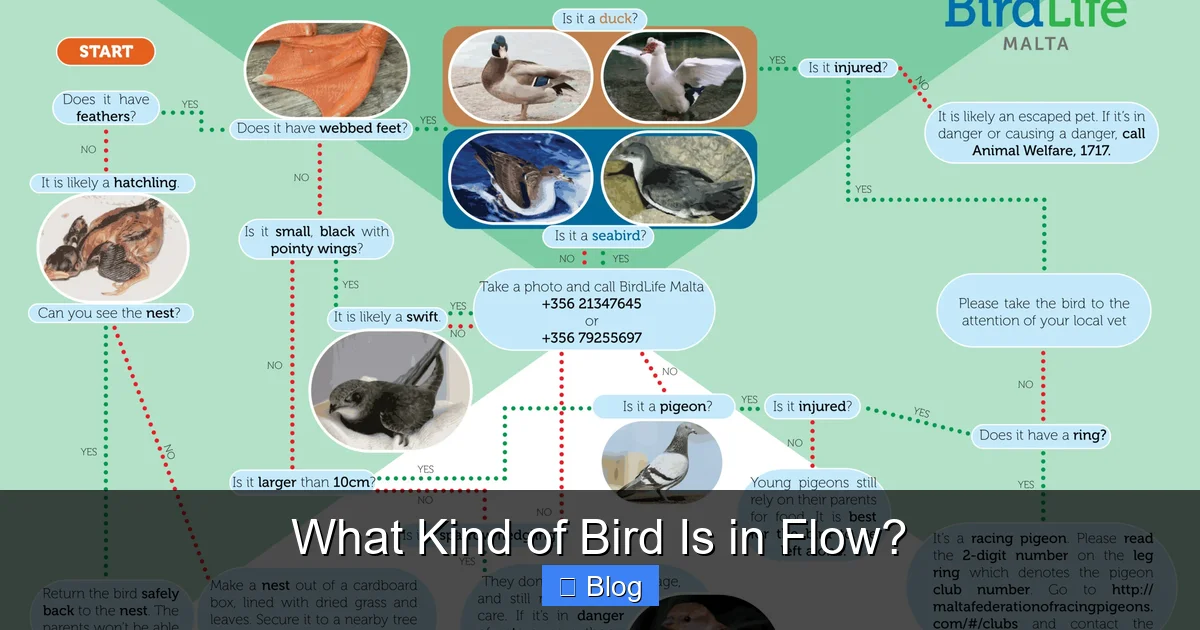
Visual guide about What Kind of Bird Is in Flow?
Image source: birdlifemalta.org
Instinct, Optimization, and Focused Action
For birds, life is a constant series of challenges: finding food, avoiding predators, migrating vast distances, attracting mates, and raising young. Evolution has optimized their physiology and instincts to meet these challenges with incredible efficiency and precision. When a bird is engaged in a vital activity – say, a peregrine falcon stooping for prey – it exhibits:
- Clear “Goals”: Catching the prey, reaching the destination, building the nest.
- Immediate Feedback: Did it catch the fish? Is the twig correctly placed? Is the song attracting a mate?
- Challenge-Skill Balance: Every hunting attempt, every migratory flight, every nest construction tests its abilities against environmental variables. They operate at the peak of their species’ innate and learned capabilities.
- Absorbed Attention: There’s no room for distraction when survival is on the line.
- Effortless Action: When perfectly executed, their movements appear fluid, powerful, and natural, embodying a kind of grace.
So, while we cannot claim birds experience the *subjective joy* or *self-reflection* associated with human flow, we can certainly observe an *objective manifestation* of deep engagement, mastery, and focused execution that remarkably mirrors the outward signs of a flow state. Perhaps it’s a form of “instinctual flow” – a genetically programmed optimal performance state. This leads us to ask, concretely, what kind of bird is in flow in various scenarios?
Birds in Action: Examples of “Flow-like” Behavior
Let’s look at specific avian examples where we can clearly see behaviors that resemble a flow state.
The Hunter in Harmony: Raptors and Fisher Birds
When thinking about what kind of bird is in flow, raptors immediately come to mind. Consider the Peregrine Falcon, the fastest animal on Earth. When it spots prey from high above and begins its stoop, diving at speeds over 200 mph, it’s a breathtaking display of focus and mastery. Every feather, every muscle is engaged. There’s no hesitation, only precise adjustments in mid-air, a perfect calibration of speed and trajectory. The goal is singular, the feedback instantaneous (is the target still in sight? Is the angle right?), and the skill is absolute. This is a bird in the ultimate state of focused action.
Similarly, an Osprey fishing is a masterclass in concentration. Hovering, adjusting, and then plunging talons-first into the water, emerging with a fish. The coordination, the timing, the muscular control – it all speaks to an animal utterly immersed in its task, demonstrating a profound “flow-like” mastery of its hunting technique.
The Marathoner of the Skies: Migratory Birds
What kind of bird is in flow when undertaking epic journeys? Migratory birds like the Arctic Tern, which travels from the Arctic to the Antarctic and back each year – a journey of over 49,000 miles – exemplify endurance and unwavering purpose. Flying for days, navigating by the sun and stars, riding air currents, and conserving energy, these birds are driven by an innate, compelling force. Their “flow” isn’t about speed, but about sustained, purposeful action, where every flap, every glide, every navigational cue is part of a larger, integrated goal. They are completely present in their monumental journey.
The Architect of Nature: Nest Builders
Look at a Weaver Bird meticulously constructing its intricate nest, knotting and weaving strands of grass or leaves with astonishing dexterity. This isn’t just instinct; it’s a learned, practiced skill, often performed with intense focus over extended periods. The clear goal is a secure home, the feedback is immediate (does the knot hold? Is the shape right?), and the process is repetitive yet creative. The bird seems lost in its task, demonstrating an almost meditative engagement. This highly skilled, repetitive, and purposeful activity is a clear answer to what kind of bird is in flow during construction.
The Performer: Courtship Displays
When considering what kind of bird is in flow, we might also look at the elaborate courtship displays of birds like the Birds of Paradise. Their intricate dances, complex vocalizations, and precise movements are performed with intense concentration and energy, all with the clear goal of attracting a mate. The bird is the performer, the environment its stage, and the potential mate its audience. Every action is deliberate, precise, and part of a larger, coordinated sequence, suggesting a deep engagement in the act of display.
The Human Connection: Learning from Avian “Flow”
Observing birds in these states can be incredibly inspiring. They teach us valuable lessons about focus, presence, and the beauty of purposeful action. When we ask, “what kind of bird is in flow?”, we’re not just looking for an answer about birds; we’re often seeking insights into our own potential for optimal experience.
Lessons in Focus and Resilience
Birds don’t get distracted by their smartphones or existential dread. When they are hunting, they are hunting. When they are building, they are building. This singular focus, born of necessity and honed by evolution, is a powerful reminder of what we can achieve when we fully commit to a task. Their resilience in the face of environmental challenges, whether a storm during migration or a failed hunting attempt, shows a profound ability to adapt and persist.
Living in the Present Moment
A bird’s life is largely lived in the immediate present. They react to their environment, pursue their needs, and engage in their behaviors without much apparent rumination on the past or anxiety about the distant future. This “now-ness” is a hallmark of the flow state – a complete immersion in the task at hand. Learning from what kind of bird is in flow can guide us toward greater mindfulness and presence in our own lives.
Cultivating Your Own “Flow State” Inspired by Birds
While we can’t literally fly or build nests with our beaks, we can certainly adopt principles from the avian world to foster flow in our human endeavors. If you’ve ever wondered, “what kind of bird is in flow?” and how you can emulate that intense focus, here are some tips:
Practical Steps to Achieve Flow
- Set Clear Goals: Like a bird heading to a specific nesting site, know exactly what you want to achieve in your activity. Break down complex tasks into manageable steps.
- Match Challenge to Skill: Don’t attempt tasks that are too easy (boring) or too hard (frustrating). Find the sweet spot that pushes your abilities slightly. If a task feels too daunting, develop the prerequisite skills first, like a young bird learning to fly.
- Eliminate Distractions: Turn off notifications, find a quiet space, and let others know you need uninterrupted time. Birds don’t have pop-up ads; neither should you during your flow time.
- Seek Immediate Feedback: If possible, engage in activities where you quickly know if you’re on the right track. This helps you adjust and improve, much like a raptor adjusting its dive.
- Engage Intensely: Fully immerse yourself. Don’t multitask. Be present in the activity, whether it’s writing, gardening, coding, or playing an instrument.
- Find Intrinsic Rewards: Do the activity for the sheer joy of it, for the satisfaction of mastery, not just for external praise or payment. This is key to sustained flow, just as a bird finds intrinsic reward in a successful hunt or a completed nest.
- Practice Mindfulness: Learn to bring your attention back to the present moment when your mind wanders. This constant refocusing helps to merge action and awareness.
The Beauty of Observing Birds in Their Element
There’s a unique joy in observing birds. Whether it’s the simple act of watching sparrows forage in the garden or binoculars focused on a rare shorebird, these moments can themselves be opportunities for human flow. The act of birdwatching often requires patience, quiet observation, and intense focus – all ingredients for a flow state. As we quietly watch a bird deeply engrossed in its natural activity, we too can enter a state of peaceful immersion, forgetting our own worries and simply being present with nature.
When you ask yourself “what kind of bird is in flow?”, you’re not just asking a biological question; you’re touching upon a universal principle of optimal engagement and living fully. While we cannot attribute human consciousness to our feathered friends, their lives offer a powerful mirror. They are masters of their domain, living their purpose with an intensity and grace that can inspire us all to find our own moments of deep, satisfying flow. The next time you see a bird performing its daily tasks with what appears to be effortless expertise, take a moment to appreciate it – you might just be witnessing the closest thing to an avian flow state, and perhaps even entering one yourself.
Frequently Asked Questions
What is the main characteristic of a bird that appears to be “in flow”?
The main characteristic is an intense, almost singular focus on a specific activity, executed with high skill and apparent effortlessness. The bird seems completely absorbed, demonstrating mastery over its task, whether it’s hunting, building, or navigating.
Can young birds experience flow, or is it only for experienced adults?
While adult birds often display more refined “flow-like” behaviors due to perfected skills, young birds can certainly show elements of flow during intense learning or play. For instance, a fledgling bird mastering flight might exhibit deep concentration and engaged effort, balancing new challenges with developing skills.
Do birds feel joy or pleasure when they are “in flow”?
It’s impossible to say definitively if birds experience joy or pleasure in the human sense. However, the intrinsic reward of successfully completing a vital task – like a successful hunt or a completed nest – likely provides a biological satisfaction that reinforces these “flow-like” behaviors, driving their continued engagement.
Are certain types of bird activities more likely to induce a “flow state”?
Activities that require high levels of skill, concentration, and involve a clear outcome are most likely to induce “flow-like” states. Examples include complex foraging, intricate courtship displays, precise navigation during migration, and detailed nest construction.
How does a bird recover from a “flow” activity?
After intense “flow-like” activity, a bird might rest, preen, or simply switch to a less demanding behavior like foraging or social interaction. This allows them to replenish energy and prepare for the next challenging task, much like humans need recovery after intense focus.
Can observing a bird “in flow” help humans find their own flow?
Yes, observing a bird deeply engrossed in its activity can be a powerful inspiration for humans. Witnessing their natural focus, determination, and efficiency can serve as a reminder to clear distractions and fully immerse ourselves in our own tasks, fostering a more mindful and engaged approach to life.