
When considering what is the biggest bird in the world, the Common Ostrich undeniably holds the title for both height and weight among living birds. However, “biggest” can be defined in various ways, with the Wandering Albatross boasting the longest wingspan and certain extinct species dwarfing them all. This article dives into these magnificent creatures, celebrating their unique adaptations and the challenges they face.
What Is the Biggest Bird in the World?
Have you ever looked up at a soaring eagle or watched a tiny hummingbird flit by and wondered about the extremes of the avian world? Birds come in an astonishing array of shapes and sizes, from the minuscule to the truly enormous. Among them, some species stand out for their sheer scale, captivating our imaginations and reminding us of nature’s incredible diversity.
When people ask, “What is the biggest bird in the world?”, a common answer immediately springs to mind: the ostrich. And for good reason! This iconic creature is a marvel of the natural world, instantly recognizable for its towering height and impressive bulk. But is it truly the biggest in every sense? The definition of “biggest” can actually be a bit tricky. Are we talking about weight, height, wingspan, or perhaps a combination of all these factors? What about birds that are no longer with us?
This article will take you on a fascinating journey to explore the true giants of the avian kingdom, both past and present. We’ll delve into the incredible adaptations that allow these birds to thrive, understand the different ways we can measure “bigness,” and discover not just the undisputed champion, but also other contenders for the title of the biggest bird in the world based on various impressive attributes. Get ready to be amazed by the colossal creatures that grace our planet and its history!
Key Takeaways
- The Common Ostrich is the biggest bird in the world by height and weight: Standing up to 9 feet tall and weighing over 300 pounds, it’s the undisputed champion among living birds, though it cannot fly.
- “Biggest” depends on the metric: While the Ostrich is the heaviest and tallest, other birds claim “biggest” titles for different attributes, such as wingspan or flight capability.
- The Wandering Albatross has the longest wingspan: With wings stretching up to 11 feet, it’s a master of oceanic soaring, spending most of its life at sea.
- The Kori Bustard and Great Bustard are among the heaviest flying birds: These impressive birds challenge the limits of avian flight with their significant weight.
- Extinct birds were even larger: Ancient species like the Elephant Bird, Moa, and Argentavis magnificens highlight a past era of truly gigantic avian life.
- Size offers advantages and disadvantages: Large size can deter predators and aid in foraging, but it also demands substantial energy, specific habitats, and often limits flight.
- Big birds face significant conservation challenges: Habitat loss, climate change, and human impact pose serious threats to the survival of many large bird species today.
Quick Answers to Common Questions
Which bird lays the biggest egg?
The Common Ostrich lays the largest eggs of any living bird. Each egg is approximately 6 inches (15 cm) long, 5 inches (13 cm) wide, and can weigh up to 3 pounds (1.4 kg), equivalent to about two dozen chicken eggs.
Can the biggest bird in the world fly?
The Common Ostrich, which is the biggest bird in the world by height and weight, cannot fly. Its immense size and powerful legs are adapted for terrestrial life and running at high speeds.
What is the heaviest bird that can fly?
Among living birds, the Kori Bustard and the Great Bustard are generally considered the heaviest birds capable of sustained flight. Males of these species can weigh up to 40-44 pounds (18-20 kg).
Where does the biggest bird in the world live?
The Common Ostrich, the biggest bird by mass and height, is native to various open, arid, and semi-arid regions across Africa, including savannas and grasslands.
What makes the Wandering Albatross so special regarding its size?
The Wandering Albatross is special for having the longest wingspan of any living bird, reaching up to 11 feet (3.4 meters). This adaptation allows it to soar over vast ocean distances with incredible efficiency.
📑 Table of Contents
The Undisputed Heavyweight Champion: The Common Ostrich (Struthio camelus)
When the question “what is the biggest bird in the world?” is posed, the answer, for most living metrics, is unequivocally the Common Ostrich. This magnificent bird, native to Africa, is a true marvel of evolution, adapted to life on the open plains where its size offers both advantages and challenges. It is the tallest and heaviest living bird by a significant margin.
Size and Weight: Unmatched Terrestrial Bird
Imagine a bird that can stand taller than most humans – that’s the Ostrich! Adult male Ostriches can reach an astonishing height of up to 9 feet (2.7 meters), with females slightly smaller. Their weight is equally impressive, with large males tipping the scales at over 300 pounds (136 kilograms), and sometimes even more, up to 340 pounds (155 kg). This makes it by far the heaviest living bird. Their massive legs and powerful bodies are built for life on the ground, supporting their substantial bulk with ease. Their thick, strong legs, though appearing somewhat ungainly, are incredibly efficient for locomotion and defense.
Speed and Strength: More Than Just Big
Despite their immense size, Ostriches are far from slow. In fact, they are the fastest birds on land, capable of reaching speeds up to 45 miles per hour (70 km/h) over short bursts, and maintaining a steady speed of 30 mph (50 km/h) for extended periods. This incredible speed is crucial for escaping predators like lions, cheetahs, and hyenas in their open grassland habitats. Their long, powerful legs, equipped with just two toes (most birds have four), act like springs, propelling them forward with incredible efficiency.
Beyond speed, their strength is formidable. An Ostrich’s kick can be deadly, powerful enough to seriously injure or even kill a human or a predator. This defensive capability, combined with their sharp claws, makes them formidable opponents when cornered. Their small head and long neck allow them to spot predators from a great distance, giving them ample time to react.
Diet and Habitat: Adapting to Arid Lands
Ostriches are primarily herbivores, grazing on grasses, shrubs, flowers, seeds, and fruits. However, they are opportunistic feeders and will also consume insects, lizards, and small rodents when available, making them omnivores. Their diet is diverse and helps them extract nutrients from the often-sparse vegetation of their semi-arid and arid habitats across Africa. They can go for long periods without drinking water, obtaining much of their hydration from the plants they eat, a vital adaptation for desert survival.
They thrive in savannas, grasslands, and semi-deserts, areas characterized by open spaces where their speed and keen eyesight are maximized. They often live alongside other large herbivores, forming mixed-species herds that offer more eyes and ears for detecting danger.
Social Structure and Reproduction: A Family Affair
Ostriches are social animals, typically living in nomadic groups ranging from 5 to 50 individuals. These groups often consist of a dominant male, several females, and their offspring. The dominant male typically mates with the dominant female, but other females may also lay their eggs in the communal nest. The dominant female takes the primary role in incubating the eggs during the day, while the male takes over at night. This shared responsibility helps to protect the large, thick-shelled eggs, which are the largest of any living bird, equivalent to about 24 chicken eggs! The incubation period lasts around 35 to 45 days, after which adorable, fluffy chicks emerge, ready to learn the ways of the world from their towering parents.
Beyond Weight: Exploring Other “Biggest” Metrics
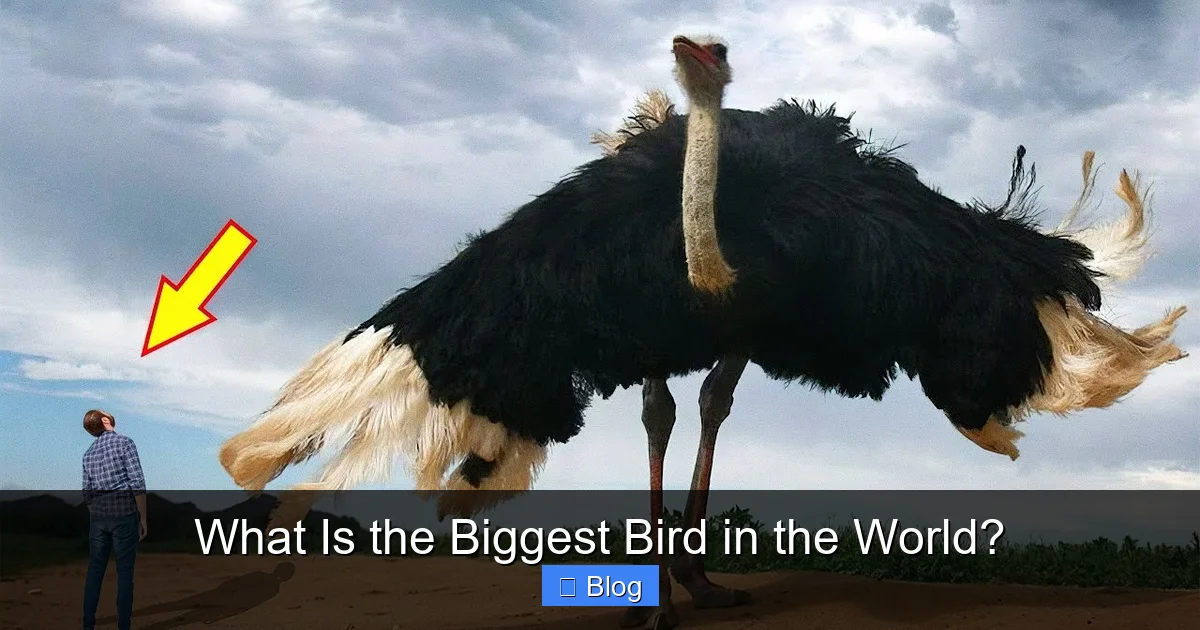
Visual guide about What Is the Biggest Bird in the World?
Image source: i.ytimg.com
While the Ostrich is undeniably the biggest bird in the world by weight and height, the definition of “biggest” becomes more nuanced when we consider other attributes. The avian world boasts other champions when it comes to wingspan, flight, and overall stature in the sky.
Longest Wingspan: The Wandering Albatross (Diomedea exulans)
If you’re measuring by wingspan, then the title of the biggest bird in the world goes to the magnificent Wandering Albatross. These incredible seabirds are true masters of the sky, designed for a life of perpetual soaring over the vast Southern Ocean.
Their wingspan can reach an incredible 11 feet (3.4 meters), with some recorded individuals even exceeding this. To put that into perspective, that’s roughly the width of a small car! These incredibly long, narrow wings are perfectly adapted for dynamic soaring, allowing the Albatross to glide effortlessly on oceanic winds for thousands of miles with minimal energy expenditure. They spend most of their lives at sea, only coming to land to breed on remote islands. This remarkable adaptation means they can circumnavigate the globe without ever touching land, flying vast distances in search of food.
Tallest Flying Bird: The Sarus Crane (Antigone antigone)
For the tallest bird that can still take to the skies, we look to the elegant Sarus Crane. Native to the wetlands and cultivated lands of the Indian subcontinent, Southeast Asia, and northern Australia, these majestic birds can stand impressively tall.
Sarus Cranes can reach heights of up to 5 feet 9 inches (1.75 meters). While they don’t have the bulk of an Ostrich, their slender build and long legs give them a commanding presence. They are known for their spectacular courtship dances and their loud, trumpeting calls that can be heard over long distances. Their ability to fly, despite their height, is a testament to the efficient design of their large wings and powerful flight muscles.
Heaviest Flying Bird: The Great Bustard (Otis tarda) and Kori Bustard (Ardeotis kori)
The challenge of flight becomes exponentially harder with increasing weight. To truly appreciate the scale, imagine a bird heavy enough that you’d struggle to lift it, yet it can still take to the air. That’s the realm of the heaviest flying birds.
The Great Bustard, found across Europe and Asia, is one of the contenders for the title of the heaviest flying bird. Males can weigh up to 40 pounds (18 kg), with some records indicating individuals slightly heavier. They possess robust bodies and strong wings to achieve lift. Similarly, the Kori Bustard, found in Africa, is another prime candidate. Male Kori Bustards average around 25-30 pounds (11-13 kg), but exceptionally large individuals can reach weights up to 44 pounds (20 kg), making them arguably the heaviest living bird capable of sustained flight. Both species require a considerable run-up to take off, akin to an airplane. Their impressive weight pushes the very limits of what is physically possible for avian flight.
The Giants of the Past: Extinct Avian Megafauna
While the Ostrich currently holds the crown for the biggest bird in the world among living species, our planet’s history reveals a truly awe-inspiring array of avian behemoths that make today’s giants seem almost modest. These extinct birds were the true kings of size, occupying ecological niches that no modern bird could fill.
The Elephant Bird (Aepyornis maximus): A True Behemoth
Perhaps the most famous of the extinct giants is the Elephant Bird, native to Madagascar. This flightless ratite was absolutely colossal. Standing over 10 feet (3 meters) tall and estimated to weigh up to an incredible 1,100 pounds (500 kg), the Elephant Bird was by far the heaviest bird known to have ever lived. To give you an idea of their scale, their eggs were also the largest known eggs, capable of holding the volume of about 150 chicken eggs!
These gentle giants roamed Madagascar’s forests and grasslands until around the 17th or 18th century, when they likely succumbed to human hunting and habitat destruction. Their enormous size suggests they were slow-moving herbivores, akin to modern-day ostriches or cassowaries, but on a much grander scale.
The Moa (Dinornis robustus): New Zealand’s Lost Giants
New Zealand was once home to its own set of avian giants: the Moa. There were several species of Moa, but the South Island Giant Moa (Dinornis robustus) was the tallest, reaching heights of up to 12 feet (3.6 meters) with its neck outstretched. While not as heavy as the Elephant Bird, weighing around 500 pounds (230 kg), its sheer height made it a truly dominant presence in New Zealand’s pre-human ecosystems.
Moa were flightless herbivores, browsing on leaves, twigs, and fruits. They were the apex herbivores in New Zealand, until the arrival of Māori settlers in the 13th century led to their rapid decline and eventual extinction within a couple of hundred years, primarily due to hunting and habitat loss.
Argentavis magnificens: The Sky Titan
If we shift our focus from terrestrial giants to aerial ones, then Argentavis magnificens (meaning “magnificent Argentine bird”) takes the cake as arguably the largest flying bird ever. This prehistoric condor relative soared over ancient South America about 6 million years ago.
Estimates for its wingspan vary, but most place it between 16 to 23 feet (5 to 7 meters), with some suggesting even larger. Imagine a bird with wings wider than a full-size car is long! Its weight is estimated to have been around 150-160 pounds (70-73 kg), making it a heavyweight among flying creatures. With such an enormous wingspan, Argentavis likely relied heavily on thermal currents and updrafts to stay airborne, much like modern-day condors and large vultures, but on an unprecedented scale. Taking off would have been a significant challenge, likely requiring a running start down a slope or into a strong headwind.
Why Size Matters: The Evolutionary Advantage (and Disadvantage)
Being the biggest bird in the world, whether by height, weight, or wingspan, comes with a unique set of evolutionary pressures and adaptations. Size is not just a random trait; it’s a product of millions of years of natural selection, offering both benefits and drawbacks in the struggle for survival.
Predation and Defense
For large, flightless birds like the Ostrich and the extinct Moa or Elephant Bird, sheer size is a primary defense mechanism. A large body can deter many predators simply because it’s too big or too dangerous to tackle. An Ostrich’s powerful kick, for example, is a formidable weapon against even large carnivores. The energy required to bring down a huge bird means that only the most determined and well-coordinated predators will attempt it. However, while adults may be safe, their eggs and chicks remain vulnerable, leading to complex social and reproductive strategies for protection.
Foraging and Energy Needs
Large animals generally require more food. Being a big bird means needing a lot of calories to fuel that enormous body. This can be an advantage in some environments, allowing them to access food sources that smaller animals cannot or to consume vast quantities when available. For instance, the long neck of an Ostrich allows it to browse on vegetation higher than smaller grazers can reach. However, it also means they need extensive foraging grounds and are sensitive to habitat loss. Their digestive systems must be highly efficient to extract maximum nutrition from their often fibrous diets.
Flight Dynamics vs. Terrestrial Life
The laws of physics place significant constraints on flying birds, especially regarding size. As a bird gets larger, the ratio of its wing surface area to its body mass becomes less favorable for flight. This is why the biggest bird in the world (Ostrich) cannot fly. Flight requires immense energy and powerful muscles, and beyond a certain point, the energy cost outweighs the benefits, leading to flightlessness.
For birds like the Wandering Albatross, their huge wingspan is a specialization for a particular type of flight – dynamic soaring – which requires minimal flapping. This allows them to exploit wind energy over vast distances. Heaviest flying birds like the Kori Bustard are at the extreme upper limit of what can achieve sustained flight, often requiring a great deal of effort to get airborne. Conversely, flightless giants like the Moa and Elephant Bird evolved in environments where terrestrial predators were scarce or absent, removing the selective pressure to fly and allowing them to dedicate all their energy to growing larger bodies.
Conservation Challenges for Big Birds
While impressive, being the biggest bird in the world, or just a large bird, often comes with significant vulnerability in the face of human activity. Many of the world’s large bird species, both flying and flightless, face severe threats to their survival.
Habitat Loss and Fragmentation
Large birds typically require extensive territories to find sufficient food and breeding grounds. As human populations expand, these habitats are increasingly lost to agriculture, urbanization, and infrastructure development. The remaining habitats become fragmented, isolating populations and making it harder for birds to find mates or necessary resources. For ground-nesting birds like the Ostrich, habitat destruction means fewer safe places to lay their enormous eggs and raise their chicks. For the Wandering Albatross, overfishing depletes their food sources and bycatch from longline fishing poses a deadly threat.
Human Conflict and Poaching
Historically, and even today, large birds have been targeted by humans for various reasons. Their meat, eggs, and feathers have been prized, leading to intensive hunting pressure that contributed to the extinction of species like the Moa and Elephant Bird. Ostriches, while now farmed, still face poaching in some wild areas. Even for flying giants like cranes and bustards, direct persecution or accidental poisoning (from pesticides) can have devastating effects on their populations, which are often slow to reproduce.
Climate Change Impacts
Climate change introduces another layer of threat. Shifts in weather patterns can alter habitats, affect food availability, and disrupt breeding cycles. For species dependent on specific environmental conditions, like the Sarus Crane’s reliance on wetlands, changes in rainfall or increased drought can be catastrophic. Sea-level rise threatens coastal breeding grounds for albatrosses, while altered ocean currents can impact their marine food sources.
What We Can Do: Supporting Conservation
Protecting these magnificent creatures requires concerted effort. Here are some practical ways we can help:
- Support Conservation Organizations: Donate to or volunteer with organizations dedicated to bird conservation and habitat protection.
- Be a Responsible Tourist: Choose eco-tourism operators that respect wildlife and contribute to local conservation efforts, especially when visiting areas where large birds live.
- Reduce Your Carbon Footprint: Climate change affects all species. Reducing energy consumption and supporting sustainable practices helps mitigate its impact.
- Educate Others: Share your knowledge about these incredible birds and the challenges they face. Awareness is the first step towards action.
- Advocate for Policy Changes: Support policies that protect natural habitats, regulate fishing practices, and combat poaching.
Conclusion
So, what is the biggest bird in the world? The answer, as we’ve discovered, is wonderfully complex, depending on how you measure “biggest.” For sheer height and massive weight among living birds, the Common Ostrich reigns supreme, a flightless giant perfectly adapted to its African grasslands. Yet, the Wandering Albatross takes the title for the longest wingspan, effortlessly gliding across vast oceans, while the Sarus Crane stands as the tallest flying bird. And let’s not forget the incredible extinct giants like the Elephant Bird, Moa, and Argentavis magnificens, which truly redefined avian scale.
Each of these colossal birds, whether alive today or lost to history, offers a captivating glimpse into the power and adaptability of avian evolution. They remind us that nature’s creations can push the boundaries of what seems possible. However, their very size, while impressive, often comes with unique vulnerabilities, making them particularly susceptible to human-induced threats. By appreciating their grandeur and understanding their challenges, we can all play a part in ensuring that the future still holds a place for these magnificent feathered giants. The biggest bird in the world, in all its forms, deserves our wonder and our protection.
Frequently Asked Questions
What is the Ostrich’s top speed?
Ostriches are the fastest birds on land, capable of reaching speeds up to 45 miles per hour (70 km/h) over short distances. They can also maintain a steady speed of around 30 mph (50 km/h) for extended periods.
Are there any birds taller than the Ostrich?
Among living birds, no bird is taller than the Common Ostrich, which can stand up to 9 feet tall. However, some extinct birds, like the Moa, were even taller, reaching up to 12 feet.
How long do Wandering Albatrosses live?
Wandering Albatrosses are long-lived birds, often surviving for 50 years or more in the wild. Their slow reproductive rate and long lifespan make them particularly vulnerable to threats like fishing bycatch.
What did the extinct Elephant Bird eat?
The extinct Elephant Bird was primarily herbivorous, feeding on plants, fruits, and seeds. Their massive size and powerful legs would have allowed them to browse on various types of vegetation in their Madagascan habitat.
Why did the Moa go extinct?
The Moa went extinct primarily due to overhunting by Māori settlers who arrived in New Zealand, combined with habitat loss. They were relatively easy prey due to their large size and flightless nature.
Are big birds more endangered than smaller birds?
Many large bird species are indeed more vulnerable to extinction than smaller ones. Their larger habitat requirements, slower reproductive rates, and often higher appeal for hunting or poaching make them particularly susceptible to human pressures like habitat loss and climate change.