
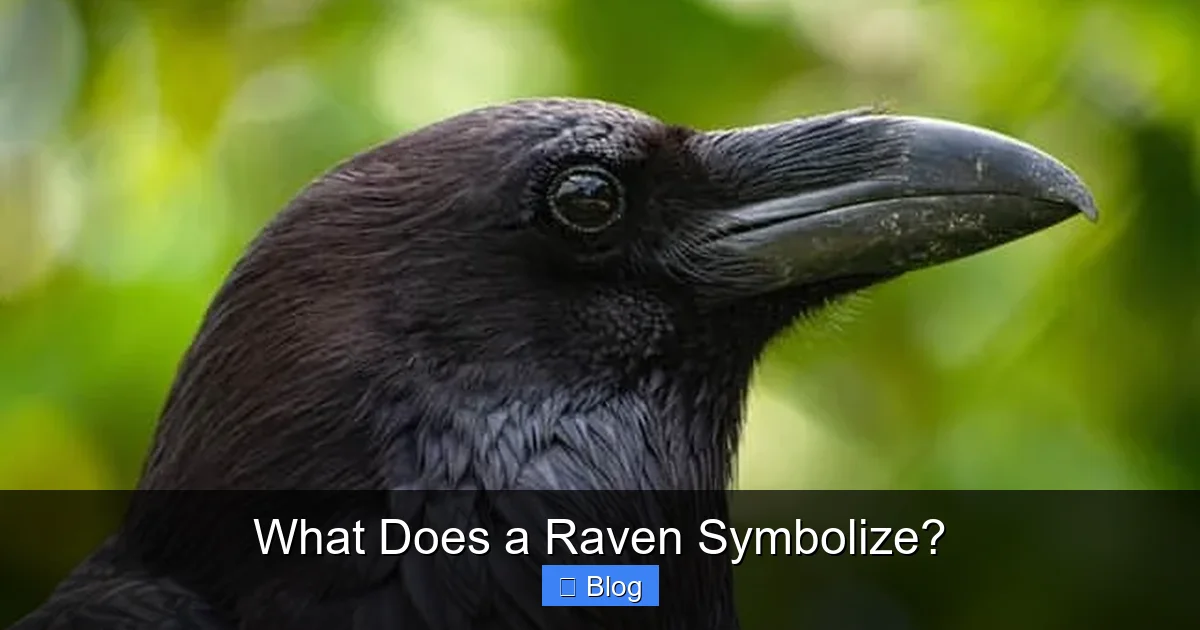
Ravens are creatures steeped in rich, multifaceted symbolism across cultures worldwide. Often seen as messengers between worlds, they represent wisdom, mystery, and magic, owing to their intelligence and dark plumage. However, they also carry associations with death, transformation, and the unknown, embodying both creation and destruction, making their meaning incredibly diverse and compelling.
Have you ever seen a raven perched high on a branch, their glossy black feathers shimmering in the sun, their eyes seemingly piercing and intelligent? There’s an undeniable allure to these magnificent birds. They glide through our skies with an air of ancient mystery, their calls echoing with a primeval wisdom. It’s no wonder that across countless cultures and throughout history, the raven has captured our imaginations and become a powerful symbol.
These aren’t just any birds; ravens are extraordinarily intelligent, adaptable, and strikingly beautiful. Their presence often sparks a sense of wonder, sometimes even a touch of unease. So, when one crosses your path, it’s natural to ask: “What does a raven symbolize?” The answer, as you’ll soon discover, is as rich and complex as the raven itself, weaving through folklore, mythology, and personal experiences from every corner of the globe.
Let’s embark on a journey to unravel the deep and varied meanings associated with these iconic birds. We’ll explore their significance in ancient myths, examine their dualistic nature, and discover what a raven symbolize for us in the modern world. Get ready to see the raven not just as a bird, but as a potent emblem of life’s deepest mysteries.
Key Takeaways
- Multifaceted Symbolism: Ravens hold diverse meanings, not just one single interpretation, varying greatly across different cultures and contexts. Their symbolism is rarely singular.
- Wisdom and Mystery: Due to their remarkable intelligence, dark color, and often secretive nature, ravens are frequently associated with wisdom, magic, secrets, hidden knowledge, and the unknown.
- Transformation and Death: They often symbolize the cycle of life and death, acting as psychopomps (guides of souls) or harbingers of significant change, renewal, and rebirth.
- Omens and Messengers: Ravens are widely regarded as messengers from the spirit world or the divine, bringing omens, prophecies, or important insights and warnings.
- Trickster and Creator: In many mythologies, ravens embody a powerful duality, serving as both mischievous tricksters who challenge norms and powerful creators who bring light or knowledge to humanity.
- Cultural Variation: The specific meaning of a raven is highly dependent on particular cultural narratives and individual interpretations, ranging from revered deities to ominous portents.
Quick Answers to Common Questions
What is the spiritual meaning of a raven?
Spiritually, a raven often symbolizes deep insight, hidden knowledge, wisdom, and the ability to navigate between the physical and spiritual realms. It can be seen as a messenger from the spirit world or a guide during times of significant personal or spiritual transformation.
Is seeing a raven a good or bad omen?
The interpretation of seeing a raven as a good or bad omen varies greatly by culture and context. While some traditions link them to death or misfortune, many others see them as harbingers of wisdom, prophecy, significant change, or even good luck due to their intelligence and role as creators.
What do ravens symbolize in dreams?
In dreams, ravens often symbolize the uncovering of hidden truths, deep introspection, or a pending transformation. They can represent your shadow self, forgotten memories, or a powerful message from your subconscious urging you to seek wisdom or face a significant change.
What do ravens symbolize in Norse mythology?
In Norse mythology, ravens are highly revered. Odin, the Allfather, has two ravens, Huginn (thought) and Muninn (memory), who bring him news from the world. Therefore, ravens symbolize thought, memory, wisdom, divine knowledge, and prophecy in Norse traditions.
What does a group of ravens symbolize?
A group of ravens, often called an “unkindness” or “conspiracy,” can symbolize a gathering of powerful forces or a significant collective message. It might indicate a strong spiritual presence, a moment of profound revelation, or a warning about communal issues or impending change within a group context.
📑 Table of Contents
The Enigmatic Raven: A Global Perspective
The raven’s symbolism isn’t confined to a single story or culture. From the icy lands of the Norse to the sun-drenched deserts of Indigenous America, the raven has played a starring role in the human narrative. Their striking appearance, incredible intelligence, and often solitary nature have made them perfect subjects for myths and legends.
Ancient Origins and Mythology
In Norse mythology, Odin, the Allfather, had two ravens, Huginn (thought) and Muninn (memory), who flew across the world daily, bringing him news. This connection elevated ravens to symbols of knowledge, wisdom, and divine insight. They weren’t just birds; they were extensions of a god’s perception, embodying the very essence of thought and memory.
Across the Atlantic, many Indigenous North American tribes view the raven as a powerful creator or trickster figure. In tales from the Pacific Northwest, Raven stole the sun, moon, and stars from a selfish chief, bringing light to the world. Here, the raven symbolize ingenuity, resourcefulness, and a playful defiance of authority, often leading to both good and bad outcomes through their cleverness.
Meanwhile, in Celtic traditions, ravens were often associated with battle, death, and prophecy. Goddesses like the Morrigan, a formidable figure linked to fate and war, sometimes appeared in raven form. This ties the raven to powerful, often transformative, forces, highlighting its role as a harbinger of significant events, whether triumphant or tragic.
General Characteristics Informing Symbolism
Why do these birds hold such universal power? A lot of it comes down to their inherent traits. Ravens are notoriously intelligent, capable of solving complex problems, using tools, and even mimicking human speech. This intelligence naturally leads to associations with wisdom, cleverness, and hidden knowledge.
Their sleek, iridescent black feathers contribute significantly to what a raven symbolize. Black is often linked to mystery, the unknown, and the night – realms where secrets reside. This deep color also connects them to the void, the primeval, and the fertile darkness from which all things emerge. Their distinctive, guttural calls, too, add to their mystical aura, often interpreted as messages or warnings from another realm.
Wisdom, Magic, and Mysticism: The Raven’s Clever Mind
One of the most enduring answers to “what does a raven symbolize?” points directly to their astounding intellect. These are not simple birds; they are problem-solvers, communicators, and observers, traits that have cemented their place as symbols of wisdom and magic.
Visual guide about What Does a Raven Symbolize?
Image source: joyceelliott.com
Intelligence Beyond Belief
Ravens have demonstrated cognitive abilities akin to some primates. They can recognize faces, remember locations, and even hold grudges! Their ability to adapt and thrive in various environments showcases a profound understanding of their surroundings. This sharpness is why they often represent deep wisdom, strategic thinking, and the ability to navigate complex situations with cunning and insight.
Bearers of Secrets and Hidden Knowledge
With their dark plumage and often solitary, observant nature, ravens are frequently seen as keepers of secrets and hidden knowledge. They dwell in shadowed places, flying between the seen and unseen worlds. This makes them powerful symbols for those seeking deeper truths, spiritual insights, or access to esoteric wisdom. If a raven appears to you, it might be a nudge to look beyond the obvious, to uncover what lies beneath the surface.
Connection to the Spirit World
Throughout history, the raven has been considered a bridge between the physical and spiritual realms. Shamans in various cultures have revered ravens as spirit guides, capable of traveling to other dimensions and bringing back vital information. This makes the raven a potent symbol for spiritual exploration, psychic abilities, and communication with ancestors or other entities. They can symbolize the veil between worlds, thinning when they are near.
Harbingers of Change: Death, Transformation, and Rebirth
While their intelligence is celebrated, what does a raven symbolize in a more somber light? The raven’s association with death and the underworld is profound, yet it’s crucial to understand that this often isn’t a negative symbol but rather one of profound transformation.
Guides to the Underworld (Psychopomps)
In many ancient cultures, ravens were seen as psychopomps – guides for the souls of the deceased on their journey to the afterlife. Their presence near battlefields, feeding on the fallen, solidified this connection. However, this role isn’t about morbid fascination; it’s about facilitating a necessary transition. They represent the natural cycle of life, death, and what lies beyond, helping souls find their way.
The Cycle of Life and Death
The raven’s black color often links it to the void, the end, and the beginning. Death isn’t always an ending; it’s often a precursor to rebirth, renewal, and new beginnings. Therefore, the raven can symbolize the completion of one phase and the inevitable start of another. It reminds us that change, even difficult change, is a fundamental part of existence.
Personal Transformation
Encountering a raven, or dreaming of one, might signify a period of deep personal transformation. It could mean shedding old habits, beliefs, or relationships that no longer serve you. The raven encourages you to embrace the darker, unknown aspects of yourself and to emerge stronger and more authentic. It’s about facing your shadows and finding the light within them.
The Trickster and the Creator: A Dual Nature
One of the most fascinating aspects of what a raven symbolize is its dual role as both a mischievous trickster and a benevolent creator. This duality reflects the complexities of life itself – where creation often arises from chaos, and cunning can lead to profound benefits.
Bringing Light and Knowledge (Indigenous North American Myths)
As mentioned earlier, in many Indigenous North American mythologies, Raven is a culture hero. He is responsible for bringing the sun, moon, stars, fresh water, and salmon to humanity. Though often achieved through clever trickery and shape-shifting, these acts are ultimately for the good of humankind. Here, the raven symbolize the bringing of light, knowledge, and essential elements that sustain life, often by challenging the status quo.
Mischief and Chaos (Norse and Other Mythologies)
In other tales, particularly those influenced by Norse mythology where ravens are linked to Loki’s cunning as well as Odin’s wisdom, ravens can represent mischief, chaos, and unpredictability. They might upset order or play pranks. This aspect of the raven reminds us that life isn’t always orderly. Sometimes, a little disruption is necessary to shake things up, reveal truths, or pave the way for new growth. It’s a symbol of intelligent disobedience and challenging authority.
This dual nature teaches us that even seemingly negative actions can lead to positive outcomes, and that creativity often requires a willingness to bend the rules. The raven encourages us to embrace our full spectrum of traits – both light and shadow – and to understand that even our mischievous sides can serve a purpose.
Omens, Prophecies, and Personal Encounters
Beyond ancient myths, what does a raven symbolize in our everyday lives? For many, an encounter with a raven is more than just seeing a bird; it feels like a message or a sign. These perceptions are deeply rooted in their historical role as omens.
Interpreting Raven Sightings
If a raven repeatedly appears in your life, pay attention. It might be a sign to embrace change, to seek deeper knowledge, or to trust your intuition. A single raven might represent solitude, a challenge, or a new beginning. A pair of ravens often signifies balance, partnership, or deep connection. Some traditions believe multiple ravens (a “conspiracy” or “unkindness” of ravens) can denote a significant spiritual event or a powerful message about a community or situation.
Consider the context: Where did you see it? What were you thinking about? What was your emotional state? These details can help you personalize the raven’s message. For example, seeing a raven during a difficult decision might suggest trusting your inner wisdom, while seeing one after a loss could symbolize that transformation is at hand.
Ravens in Dreams
Dreams are powerful messengers, and a raven appearing in your dream can carry significant weight. Dreaming of a raven often points to uncovering hidden truths, confronting your shadow self, or undergoing a major transformation. It could signal a need to pay attention to your intuition or to seek out forgotten knowledge. The specifics of the dream – what the raven was doing, how you felt – will refine the interpretation. A friendly raven might suggest guidance, while a menacing one could point to fears needing to be addressed.
The Call of the Raven
The distinctive “caw” or “kraa” of a raven is often considered an omen in itself. Some believe it’s a warning, a prophecy, or a call to pay attention. In some cultures, hearing a raven’s call might be a sign of good fortune, especially if it’s a clear, strong call. In others, it might signal an approaching challenge or the presence of spirits. Listening to the nuances of the call and your own inner feeling can provide clues to its meaning.
Modern Interpretations and Personal Connection
In our contemporary world, what does a raven symbolize now? While the ancient meanings persist, ravens continue to inspire artists, writers, and individuals seeking meaning in their lives.
Ravens in Literature and Pop Culture
From Edgar Allan Poe’s iconic poem “The Raven,” where it became a symbol of sorrow, loss, and haunting memory, to more recent fantasy series like George R.R. Martin’s “Game of Thrones,” where ravens serve as messengers carrying vital intelligence across vast distances, their symbolism evolves. They appear in tattoos, art, and fashion, embodying a sense of edgy wisdom, dark beauty, and independence. In these modern contexts, they still represent mystery, knowledge, and a connection to something deeper and often darker than the mundane.
Finding Your Own Meaning
Ultimately, while cultural and historical interpretations provide a rich foundation, the most powerful answer to “what does a raven symbolize?” might come from your personal connection. What does this majestic bird evoke in you? Does it spark a sense of wonder, contemplation, or perhaps a call to explore your own inner wisdom? Trust your intuition when a raven crosses your path. It might be a powerful guide, a reminder, or a personal totem inviting you to embrace its multifaceted magic.
Perhaps you see the raven as a symbol of resilience, thriving in places others cannot. Maybe its black plumage represents the creative void from which new ideas emerge. Or maybe its intelligence inspires you to be more curious and observant. The beauty of the raven’s symbolism is its flexibility and depth, allowing for personal resonance that makes it uniquely meaningful to each individual.
Conclusion
So, what does a raven symbolize? As we’ve journeyed through myths, folklore, and modern interpretations, it’s clear there isn’t one single answer. The raven is a complex tapestry woven with threads of wisdom, mystery, death, transformation, creation, and mischief. It’s a messenger between worlds, a guide through the unknown, and a powerful emblem of intellect and adaptability.
Whether you view them as ominous harbingers or divine guides, ravens compel us to look deeper, to question, and to embrace the rich paradoxes of life. They remind us that even in the darkest shadows, there is profound wisdom, and that endings are often just new beginnings in disguise. The next time you see a raven, take a moment. Beyond its striking appearance, consider the ancient stories it carries and the personal message it might hold for you. The raven’s enigma endures, inviting us all to delve into its powerful and timeless symbolism.
Frequently Asked Questions
Are ravens symbols of death?
While ravens are often associated with death, particularly in older folklore and battlefield scenarios, this symbolism is typically not meant in a purely negative sense. Instead, they represent the natural cycle of life, death, and rebirth, acting as guides for souls transitioning to the afterlife and symbolizing profound transformation rather than just an end.
Why are ravens considered intelligent?
Ravens are considered highly intelligent due to their advanced problem-solving skills, ability to use tools, excellent memory, and capacity for mimicry. Scientific studies have shown they possess cognitive abilities comparable to some primates, allowing them to adapt to diverse environments and learn complex behaviors, which solidifies their symbolic link to wisdom and knowledge.
Do ravens mate for life?
Yes, ravens are generally monogamous and form strong, lifelong pair bonds. They are devoted partners, working together to build nests, incubate eggs, and raise their young. This behavior adds to their symbolism of loyalty, deep partnership, and enduring commitment in many cultures.
What is the difference between a raven and a crow?
While both are black birds from the Corvid family, ravens are typically larger than crows, with a heavier bill, shaggier throat feathers (called hackles), and a wedge-shaped tail (crows have fan-shaped tails). Ravens often fly alone or in pairs and have a deeper, guttural “kraa” call, while crows are more social and have a higher-pitched “caw.”
Can a raven be a spirit animal?
Yes, for many, the raven can serve as a powerful spirit animal or totem. If you feel a strong connection to ravens, they might be guiding you to embrace wisdom, magic, transformation, or to seek hidden truths. A raven spirit animal often encourages introspection, adaptability, and the courage to face the unknown.
What does a white raven symbolize?
A white raven is extremely rare and often symbolizes purity, spiritual awakening, enlightenment, or a unique, sacred message. In some stories, a white raven signifies a reversal of fate or a profound shift in perception, representing a bridge between the mundane and the extraordinary, or even a return to an original, pristine state of being before corruption.