

Most birds soar through the sky, but a surprising number have evolved to thrive without flight. These flightless birds like ostriches, penguins, and kiwis have developed unique adaptations, from powerful legs for running to sleek bodies for swimming, allowing them to excel in their specific environments. Their inability to fly often stems from evolutionary choices made in predator-free environments, highlighting nature’s incredible diversity.
What Birds Can’t Fly?
When you think of a bird, what’s the first thing that comes to mind? Chances are, it’s a creature soaring gracefully through the sky, wings beating, defying gravity with effortless elegance. The ability to fly is practically synonymous with being a bird, a defining characteristic that sets them apart from most other animals. But what if I told you that this widely held belief isn’t entirely true? What if there’s a fascinating world of birds that can’t fly?
It’s a surprising fact for many, but not all birds take to the air. In fact, some of the most iconic and beloved avian species on our planet have given up flight altogether, choosing instead to live their lives firmly on the ground or navigating underwater. These birds are living proof that nature is full of incredible adaptations and evolutionary twists, where species evolve to best suit their unique environments, even if it means ditching a trait we consider fundamental. Exploring what birds can’t fly opens up a captivating window into avian diversity.
So, let’s embark on an exciting journey to discover these extraordinary creatures. We’ll delve into the reasons behind their grounded existence, explore their remarkable adaptations, and meet some of the most famous and surprising members of the flightless club. Prepare to have your perceptions of what it means to be a bird wonderfully challenged!
Key Takeaways
- Flight is Not Universal for Birds: While flight defines most birds, a significant and fascinating group has evolved without the ability to fly, demonstrating the incredible adaptability of avian species.
- Evolutionary Trade-offs: The loss of flight often occurs in environments with few predators, allowing birds to reallocate energy and resources from maintaining flight to developing other traits like larger body size, stronger legs for running, or enhanced diving capabilities.
- Diverse Examples Exist Worldwide: Flightless birds aren’t just ostriches and penguins; they include unique species like the Kakapo (a flightless parrot), Takahe, and flightless cormorants, each with specialized adaptations to their specific habitats.
- Physical Adaptations are Key: Birds that can’t fly typically have denser bones, reduced or absent keels on their sternums (where flight muscles attach), and smaller, often modified wings that serve different purposes (e.g., flippers for swimming, balance aids).
- Vulnerability to Introduced Predators: Many flightless bird species evolved on isolated islands free from terrestrial predators. This makes them exceptionally vulnerable to introduced species like rats, stoats, and cats, leading to significant conservation challenges.
- Conservation is Crucial: Numerous flightless birds are endangered or vulnerable, requiring intensive conservation efforts, including predator control, habitat protection, and captive breeding programs, to ensure their survival.
Quick Answers to Common Questions
Which flightless bird is the largest?
The Ostrich is the largest and heaviest flightless bird, native to Africa.
Are all penguins flightless?
Yes, all species of penguins are flightless birds, perfectly adapted for swimming rather than flying.
Which country is home to the most unique flightless birds?
New Zealand is renowned for its high number of unique flightless bird species, including the kiwi, kakapo, and takahe.
Why did some birds lose the ability to fly?
Many birds lost the ability to fly in environments where there were no ground predators, making flight unnecessary and allowing them to save energy by developing other advantageous traits.
Can a flightless bird still use its wings?
Yes, even though they can’t fly, some flightless birds use their wings for other purposes, such as balance (ostrich), display, or as flippers for swimming (penguins).
📑 Table of Contents
The Evolutionary Puzzle: Why Can’t Some Birds Fly?
It might seem counterintuitive for a bird to lose the power of flight. After all, flying offers so many advantages: escape from predators, access to food sources, and efficient travel. Yet, for a significant number of bird species, the benefits of staying grounded outweighed the costs of taking to the skies. Understanding what birds can’t fly often means understanding their evolutionary path.
Loss of Flight: A Cost-Benefit Analysis
Flying is incredibly energy-intensive. It requires powerful muscles, a lightweight skeletal structure, and a high metabolic rate. Maintaining this machinery demands a lot of food and energy. In environments where the benefits of flight are reduced, birds can save a lot of energy by giving it up. Imagine a bird living on an island with no land predators. Why would it need to fly away from danger? Instead, it can use that energy for other things, like growing bigger, laying more eggs, or developing stronger legs for running or swimming. This is a classic evolutionary trade-off.
When flight muscles are no longer needed, they can shrink, and the bones that support them, particularly the keel (a prominent ridge on the sternum where flight muscles attach), can reduce in size or disappear entirely. This allows for denser, stronger bones, which can be advantageous for diving (like penguins) or for supporting a larger body mass (like ostriches). These physical changes are key indicators of what birds can’t fly.
Island Living: A Common Thread
A striking pattern among many flightless birds is their historical or current association with islands. Isolated islands often present unique ecological conditions. Historically, many oceanic islands lacked terrestrial mammalian predators. Without the constant threat of ground-dwelling hunters, the selective pressure to fly away from danger significantly diminished. This created an evolutionary sandbox where birds could experiment with alternative survival strategies.
On these islands, food might be plentiful and easily accessible on the ground or in the water. Building strong flight muscles and maintaining lightweight bones becomes an unnecessary burden. Instead, birds could evolve to forage more efficiently on land, grow larger to deter aerial predators, or become expert swimmers and divers. The Kakapo of New Zealand and the Flightless Cormorant of the Galapagos are prime examples of this island phenomenon, demonstrating what birds can’t fly when given the chance to adapt differently.
Icons of Flightlessness: Famous Non-Flying Birds
When most people think about what birds can’t fly, a few famous names immediately come to mind. These are the giants of the flightless world, known for their distinctive appearances and remarkable adaptations.
Visual guide about What Birds Can’t Fly?
Image source: worldanimalfoundation.org
Ostriches and Relatives: The Ratites
The ostrich is perhaps the most iconic flightless bird, an undisputed champion of the terrestrial realm. Native to Africa, these magnificent birds are the largest and heaviest birds on Earth, standing up to 9 feet tall and weighing over 300 pounds. Their wings are too small to lift their massive bodies, but what they lack in air travel, they more than make up for on the ground. Ostriches are incredible runners, reaching speeds of up to 45 miles per hour, making them one of the fastest animals on two legs. Their powerful legs also serve as formidable defensive weapons, capable of delivering a lethal kick. This makes them a prime example of what birds can’t fly, but still dominate their environment.
Ostriches belong to a group called “ratites,” which includes other large, flightless birds found across the Southern Hemisphere:
- Emus: Australia’s largest native bird, the emu is the second-tallest bird in the world. Like ostriches, they are powerful runners, built for speed across vast plains.
- Rheas: Found in South America, rheas resemble smaller ostriches and also rely on speed to escape predators.
- Cassowaries: Native to the rainforests of New Guinea and Australia, cassowaries are known for their vibrant blue and red heads, casque (a helmet-like growth on their head), and notoriously aggressive nature. They are also powerful runners and jumpers.
- Kiwis: These nocturnal, shy birds are the national emblem of New Zealand. They are unique for laying enormous eggs (relative to their body size) and having long beaks with nostrils at the tip, which they use to sniff out insects and worms. Their wings are tiny, almost vestigial, and hidden beneath their shaggy, hair-like feathers. Kiwis are the smallest of the ratites.
Penguins: Masters of the Aquatic Realm
Another beloved example of what birds can’t fly are penguins. Found almost exclusively in the Southern Hemisphere, from the icy waters of Antarctica to the Galapagos Islands near the equator, penguins are perfectly adapted for life in the water. Their wings have evolved into powerful, rigid flippers, ideal for propelling them through the ocean with incredible speed and agility. They “fly” through the water, rather than the air.
Their bodies are streamlined, and their bones are denser than those of flying birds, helping them dive deep. A thick layer of blubber and dense, waterproof feathers provide excellent insulation against the cold. While clumsy waddling on land, in the water, penguins are unparalleled aquatic hunters, feeding on fish, squid, and krill. Species like the Emperor Penguin, the largest of all penguins, showcase just how successful a flightless avian life can be.
Surprising Non-Flyers: Lesser-Known Wonders
Beyond the famous flightless giants, a diverse array of other bird species have also forgone flight. These often-lesser-known birds offer even more intriguing insights into what birds can’t fly and why.
Kakapo: The World’s Only Flightless Parrot
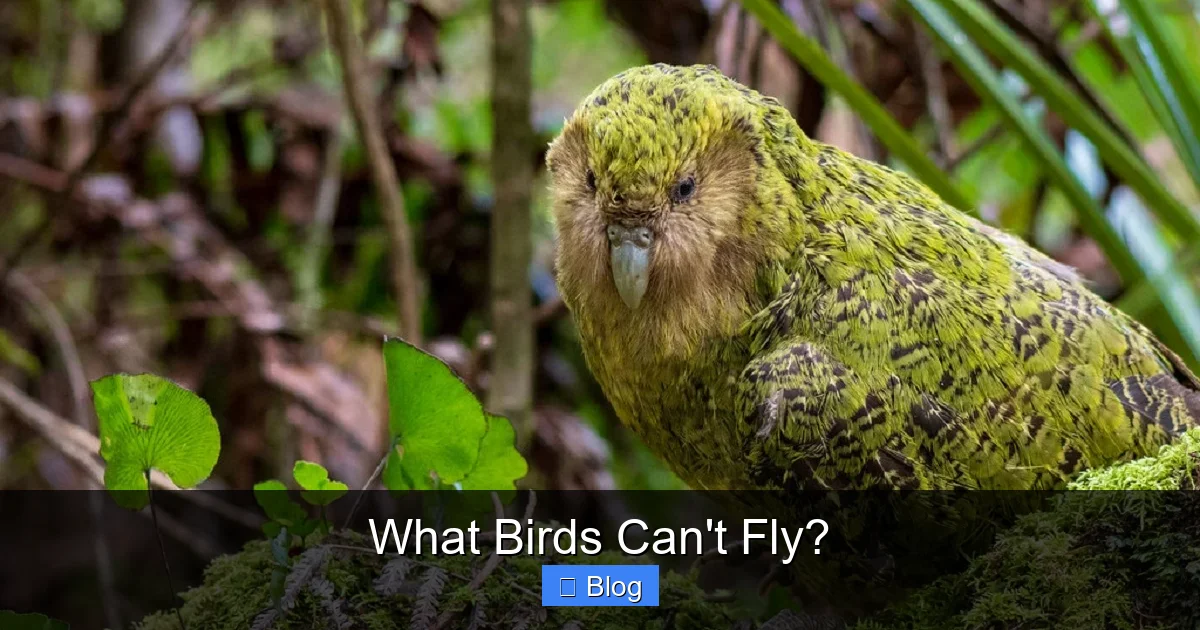
Meet the Kakapo, a truly extraordinary bird from New Zealand. It’s the only flightless parrot in the world, the heaviest parrot, and the only nocturnal parrot. Imagine a large, moss-green parrot that smells like flowers and honey, can climb trees, but has wings too small and muscles too weak to get off the ground. Kakapos have a powerful sense of smell and large facial discs, similar to owls, which help them navigate and forage in the dark. Their ground-dwelling lifestyle, however, made them incredibly vulnerable to introduced predators, bringing them to the brink of extinction. Intensive conservation efforts are slowly bringing them back from the edge.
Takahe: New Zealand’s Resilient Relic
Another New Zealand native, the Takahe, is a large, colorful rail thought to be extinct for many years until its dramatic rediscovery in 1948. These beautiful blue and green birds have short, stout legs and a strong red bill, which they use to feed on tussock grass and other vegetation. Like many island species, they evolved in the absence of mammalian predators and thus never developed the need for flight. Their resilience and the dedication of conservationists make them a symbol of hope for what birds can’t fly but can still survive.
The Flightless Cormorant: Galapagos’ Unique Diver
The Galapagos Islands are famous for their unique species, and the Flightless Cormorant is one of its most remarkable residents. Unlike its flying relatives found worldwide, this cormorant has significantly reduced wings, too small to lift its relatively large body. Instead, these wings are used for balance as it dives into the rich waters surrounding the islands, expertly hunting fish and eels. Its streamlined body and powerful legs make it an exceptional swimmer, highlighting another path for what birds can’t fly.
Weka: The Curious Bush Hen
The Weka is another flightless rail from New Zealand. These medium-sized, brown birds are known for their curious and bold nature, often approaching humans. They are omnivores, foraging for insects, seeds, fruit, and even scavenging. Wekas are highly adaptable and can be found in a variety of habitats, from forests to grasslands. Their sturdy legs and inquisitive behavior are their primary tools for survival in a world where they can’t simply fly away from trouble. They truly embody a grounded existence among what birds can’t fly.
Physical Adaptations for a Grounded Life
So, if a bird can’t fly, what does its body look like? The physical adaptations of flightless birds are incredibly diverse, reflecting their varied lifestyles and environments. These changes are crucial for understanding what birds can’t fly and why they thrive.
Bone Structure and Muscle Mass
Flying birds have lightweight, hollow bones to reduce their overall mass, making flight easier. Birds that can’t fly, however, often have denser, solid bones. This added weight can be an advantage for diving birds like penguins, helping them submerge. It also provides structural strength for large, heavy birds like ostriches.
Perhaps the most significant skeletal difference is the sternum, or breastbone. In flying birds, the sternum has a large, prominent keel, which acts as an anchor point for the powerful flight muscles (pectorals). In flightless birds, this keel is either greatly reduced or entirely absent. Without the need for massive flight muscles, there’s no need for a large attachment point. Instead, their leg muscles are often much more developed, allowing for powerful running, jumping, or swimming.
Wing Morphology: Vestigial or Modified
The wings of birds that can’t fly are often quite different from those of their flying relatives. In some species, like the kiwi, the wings are tiny, almost vestigial, hidden beneath their body feathers and serving no apparent function other than perhaps minor balance. For ostriches, their relatively small wings are used more for display, balance during high-speed running, or even as a rudimentary cooling system.
Penguins offer a dramatic example of wing modification. Their wings have evolved into stiff, paddle-like flippers, perfectly shaped for hydrodynamic efficiency in water. They use these flippers to propel themselves with incredible power and precision, essentially “flying” through the ocean. The Flightless Cormorant’s wings are also small and stubby, serving as rudders or stabilizers during its underwater pursuits. These modifications illustrate the ingenuity of what birds can’t fly.
Powerful Legs and Feet
Since they can’t fly away, birds that can’t fly rely heavily on their legs and feet for locomotion, defense, and foraging. Ostriches, emus, and rheas have long, powerful legs designed for sustained high-speed running across open terrain. Their feet are often large and padded, providing excellent traction and shock absorption.
Penguins, while clumsy on land, have strong legs positioned far back on their bodies, giving them an upright posture ideal for swimming (using their feet as rudders). Their webbed feet are also powerful propulsors in water. Ground-dwelling birds like the Kakapo and Takahe have stout, strong legs capable of efficient walking, climbing, and digging for food. These strong lower limbs are a universal adaptation for what birds can’t fly.
Challenges and Conservation for Flightless Birds
While their unique adaptations make flightless birds fascinating, their grounded lifestyle also presents significant challenges, particularly in a world altered by human activities. Many species that can’t fly are facing severe threats.
Vulnerability to Predators
The primary threat to many flightless bird species stems from their evolutionary history. Many evolved in environments where they had no natural land predators. This meant they often lacked the instinctive fear or defensive behaviors needed to protect themselves from animals like stoats, rats, cats, and dogs – all species introduced to their habitats by humans. For example, the Kakapo and Kiwi populations in New Zealand were decimated by introduced predators, as were many other island-dwelling species. These birds simply didn’t evolve defenses against these new threats.
Habitat Loss and Human Impact
Like many species, flightless birds are also suffering from habitat loss due to deforestation, agriculture, urban expansion, and climate change. Their specialized habitats, often unique to islands, are particularly vulnerable. For example, the Takahe relies on specific tussock grasslands, which have been greatly reduced. Climate change also impacts penguins, affecting their food sources and breeding grounds.
Conservation Success Stories and Ongoing Efforts
Despite the challenges, there are inspiring conservation success stories. New Zealand, in particular, has been at the forefront of protecting its unique flightless birds. Intensive predator control programs, including trapping and poisoning on predator-free islands and mainland sanctuaries, have been vital. The Kakapo, once critically endangered with only a handful of individuals, is slowly making a comeback thanks to a dedicated recovery program that monitors every single bird, breeds them in captivity, and relocates them to safe havens.
Similar efforts are underway for the Takahe, with protected areas and predator management helping their numbers rise. For penguins, protecting marine environments, reducing plastic pollution, and addressing climate change are crucial. These efforts remind us that understanding what birds can’t fly is just the first step; actively protecting them is the next.
Conclusion
The world of birds is far more diverse and surprising than we often imagine. While the image of a bird in flight is deeply ingrained in our minds, the existence of species that can’t fly offers a powerful testament to evolution’s ingenuity. From the towering ostrich to the diminutive kiwi, each flightless bird tells a unique story of adaptation, survival, and the intricate dance between species and their environment.
These grounded aviators have carved out successful niches, developing powerful legs, sleek bodies for aquatic life, or even an extraordinary sense of smell, all in lieu of the ability to soar. They remind us that nature doesn’t always follow a predictable path, and sometimes, giving up a key trait can unlock new opportunities for survival and thriving. Learning what birds can’t fly helps us appreciate the full spectrum of avian life.
However, their unique evolutionary paths have also made many flightless birds incredibly vulnerable in a rapidly changing world. As we continue to learn about and admire these remarkable creatures, it’s more important than ever to support conservation efforts that protect their habitats and shield them from threats. By doing so, we ensure that these fascinating, grounded wonders continue to enrich our planet for generations to come, reminding us of the endless possibilities of life on Earth.
Frequently Asked Questions
Are there any flying birds that resemble flightless birds?
While most flying birds have distinct flight adaptations, some ground-dwelling flying birds might share certain features with flightless ones, like strong legs. However, they will always retain the skeletal and muscular structures necessary for flight, such as a prominent keel on their sternum.
Do flightless birds have feathers?
Yes, all flightless birds have feathers, just like flying birds. Their feathers can vary in texture and purpose, such as the shaggy, hair-like feathers of the kiwi or the dense, waterproof plumage of penguins, which are essential for insulation and protection.
How do flightless birds defend themselves if they can’t fly away?
Flightless birds have evolved various defense mechanisms. Large species like ostriches rely on their incredible speed to outrun predators and can deliver powerful kicks. Penguins use camouflage in water and flock together, while smaller species might rely on excellent camouflage, nocturnal habits, or hiding in dense vegetation.
Are there any flightless birds in North America?
No, there are no native flightless bird species in North America. The continent’s diverse predator populations and extensive landmass didn’t create the isolated, predator-free conditions that typically lead to the evolution of flightlessness in birds.
What is the smallest flightless bird?
The Inaccessible Island Rail, found on Inaccessible Island in the South Atlantic, is considered the smallest living flightless bird. It’s tiny, measuring only about 17 cm (6.7 inches) in length.
Can flightless birds climb trees?
Some flightless birds can indeed climb trees. The Kakapo, the world’s only flightless parrot, is an excellent climber and often climbs trees to feed, then glides back down to the ground using its small wings for balance, but it cannot fly upwards.