The phrase ‘the birds and the bees’ is a gentle way to talk about human reproduction and sexuality. It covers fundamental biological processes like how babies are made, alongside important lessons about puberty, relationships, respect, and consent. Understanding what are the birds and the bees helps individuals make informed decisions and fosters open communication about these natural life stages.
What Are the Birds and the Bees?
Ah, “the birds and the bees.” Just hearing that phrase probably brings a little smile to your face, or perhaps a slight awkward twitch! It’s an age-old idiom, a classic euphemism that parents and caregivers have used for generations to talk about a very important, yet sometimes tricky, subject: human reproduction and sexuality.
But what does it *really* mean? And why do we use such a poetic, nature-filled phrase to talk about something so fundamental to human life? Well, let’s peel back the layers of this charming metaphor together. We’re going to explore the biological truths behind it, the human journey from childhood to adulthood, and the broader lessons about relationships, respect, and communication that are all part of understanding what are the birds and the bees.
This isn’t just about biology; it’s about life. It’s about understanding ourselves, our bodies, and how we connect with others. Knowing what are the birds and the bees helps us navigate personal growth, make informed decisions, and build healthy relationships. So, let’s dive into this fascinating and essential topic with an open mind and a friendly spirit.
Key Takeaways
- Decoding the Idiom: “The birds and the bees” is a metaphor for human reproduction and sexuality, often used to explain complex topics simply to children.
- Biological Basics: It introduces the core concepts of how living things, including humans, reproduce, covering fertilization and the journey of creating new life.
- Puberty and Development: The discussion extends to the physical and emotional changes experienced during puberty, highlighting natural growth and development.
- Relationships and Consent: Beyond biology, understanding “the birds and the bees” involves learning about healthy relationships, personal boundaries, respect, and the crucial concept of consent.
- Open Communication: It emphasizes the importance of open, honest, and age-appropriate conversations about sexuality, fostering trust and providing accurate information.
- Life’s Full Cycle: Ultimately, it teaches about the natural cycle of life, growth, and reproduction, encouraging a positive and informed perspective on these fundamental human experiences.
- Empowerment through Knowledge: Understanding what are the birds and the bees empowers individuals to make safe, healthy choices and navigate their relationships with confidence and responsibility.
Quick Answers to Common Questions
What is the simplest explanation of “the birds and the bees”?
The simplest explanation is that it’s a gentle way to talk about where babies come from and how living things, including humans, reproduce. It covers the basic biological facts of how a male and female come together to create new life.
At what age should I start talking about “the birds and the bees” with my child?
It’s best to start early and treat it as an ongoing conversation. Begin with simple, age-appropriate answers to their questions, even in preschool years, and gradually provide more detailed information as they grow older and become more curious, especially during puberty.
Does “the birds and the bees” only refer to biology?
While it starts with biological reproduction, “the birds and the bees” also encompasses important social and emotional aspects like healthy relationships, consent, respect, personal boundaries, and making responsible choices. It’s a holistic discussion about growing up.
Why is it called “the birds and the bees”?
The phrase uses examples from nature (birds laying eggs, bees pollinating flowers) to metaphorically and gently explain human reproduction. It’s a traditional euphemism that helps to introduce a complex subject in a less direct, more palatable way, particularly for children.
What is the most important lesson from “the birds and the bees”?
Beyond the biological facts, one of the most important lessons is the concept of consent and respect for yourself and others. Understanding that all physical interactions must be consensual, respectful, and safe is crucial for healthy development and relationships.
📑 Table of Contents
Decoding the Metaphor: What *Are* the Birds and the Bees?
At its heart, “the birds and the bees” is a gentle way to introduce the concept of how living things reproduce. It uses examples from the natural world to explain the basics of creating new life. Let’s look at the literal meanings and then connect them to the human experience.
The Birds: Avian Reproduction
Think about birds. What comes to mind? Nests, eggs, baby birds chirping. Birds reproduce by laying eggs. The female bird lays an egg, which has been fertilized by the male bird. This fertilized egg then develops outside her body, usually in a cozy nest.
- Courtship: Male birds often put on elaborate displays – singing, dancing, showing off colorful feathers – to attract a mate. This is their way of saying, “Hey, I’m a good partner!”
- Fertilization: For the egg to become a baby bird, it needs to be fertilized. This happens internally, where sperm from the male combines with an egg from the female.
- Nesting and Hatching: Once fertilized, the female lays the egg. Both parents often take turns incubating it, keeping it warm until the chick hatches. Then, they work together to feed and care for their young.
So, the “birds” part teaches us about the coming together of male and female, the creation of an egg, and the nurturing of new life.
The Bees: Insect Reproduction and Pollination
Now, let’s consider the bees. Bees are famous for their role in pollination. As they fly from flower to flower collecting nectar, they inadvertently transfer pollen – a powdery substance that contains male reproductive cells – from one flower to another. This transfer allows plants to create seeds and reproduce.
- Pollination: This is the bee’s main job in the context of reproduction. Bees help flowers make seeds, which then grow into new plants. It’s a vital part of nature’s cycle.
- Queen Bee and Drones: In a beehive, there’s a queen bee whose primary role is to lay eggs. Male bees, called drones, fertilize these eggs. Worker bees, who are female but usually sterile, do all the other jobs to support the hive.
The “bees” part helps us understand the idea of transfer, contribution, and how different roles come together to create new life, especially in plants. It also introduces the concept of male and female roles in reproduction, even within the insect world.
Taken together, what are the birds and the bees? They are nature’s simple, elegant examples of reproduction: the joining of male and female elements to create new life, and the nurturing of that life to ensure survival.
From Nature to Humans: Applying the Concept
Once we understand the natural world’s approach to “the birds and the bees,” we can gently translate these concepts to human life. This is where it gets more personal and detailed.
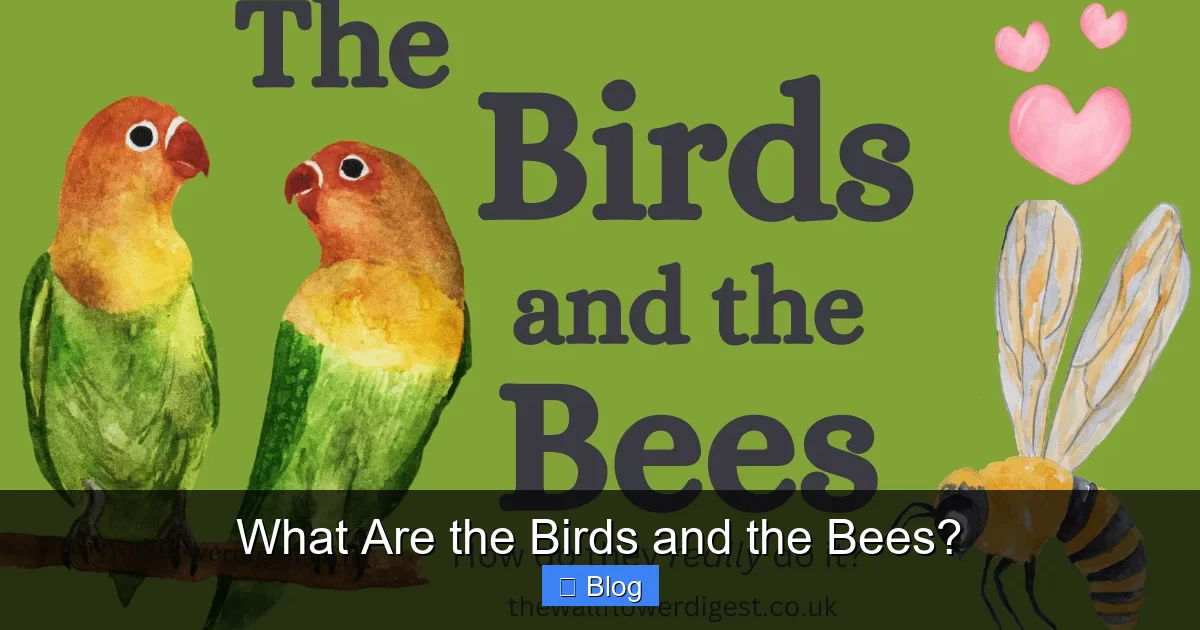
Visual guide about What Are the Birds and the Bees?
Image source: thewallflowerdigest.co.uk
Puberty and Physical Changes
Before reproduction can happen, our bodies need to mature. This stage is called puberty. It’s a time of amazing, natural changes as a child’s body grows into an adult body, capable of reproduction.
- For Girls: Puberty usually starts between ages 8 and 13. Girls develop breasts, grow hair in new places (underarms, pubic area), and start their menstrual periods. Menstruation means the body is preparing an egg each month, and if it’s not fertilized, the lining of the uterus sheds, leading to bleeding. This is a sign that a girl’s body is becoming capable of carrying a baby.
- For Boys: Puberty typically begins between ages 9 and 14. Boys experience growth spurts, their voices deepen, they grow hair on their face and body, and their testicles and penis grow larger. They also start to produce sperm, which are tiny cells necessary for reproduction.
These changes are all part of nature’s plan, preparing our bodies for the possibility of making babies. Understanding what are the birds and the bees starts with understanding these natural developments.
Understanding Reproduction in Humans
So, how do humans make a baby? It’s similar in concept to the birds and the bees, but more complex and intimate. It involves a male and a female. For a baby to be conceived, a sperm cell from a male needs to meet and fertilize an egg cell from a female.
- Sperm and Egg: Males produce sperm in their testicles. Females produce eggs in their ovaries. Each month, usually one egg is released from a female’s ovary (this is called ovulation).
- Sexual Intercourse: During sexual intercourse, the male’s penis is inserted into the female’s vagina. Sperm are released into the vagina. If sexual intercourse happens around the time of ovulation, sperm can travel up to meet the egg.
- Fertilization: When a sperm successfully joins with an egg, it’s called fertilization. This fertilized egg then travels to the female’s uterus and implants itself in the lining.
- Pregnancy and Birth: Once implanted, the fertilized egg begins to grow and develop into a baby over approximately nine months. This period is called pregnancy. At the end of pregnancy, the baby is born.
This is the core biological answer to “what are the birds and the bees?” in humans. It’s a natural, incredible process that allows us to create new life.
The Emotional and Social Side of “The Birds and The Bees”
But “the birds and the bees” isn’t just about biology. It’s also deeply connected to our emotions, relationships, and social well-being. These aspects are just as important as the physical facts.
Feelings, Relationships, and Love
As we grow, we start to develop romantic feelings for others. Relationships become a significant part of our lives. These feelings are natural and can bring great joy and companionship. Love, intimacy, and connection are important parts of human experience.
- Attraction: It’s normal to feel attraction towards others, both physically and emotionally.
- Forming Bonds: Healthy relationships are built on trust, respect, communication, and shared interests.
- Intimacy: As relationships deepen, physical intimacy can become a part of them. It’s an expression of love and connection between consenting adults.
Understanding what are the birds and the bees also means understanding these evolving emotional landscapes and how they influence our interactions with others.
Consent, Boundaries, and Safe Choices
This is a crucial part of the conversation. Whenever we talk about physical relationships, we must talk about consent and boundaries. This applies to all relationships, not just romantic ones.
- Consent: Consent means clearly and enthusiastically agreeing to engage in an activity. It must be freely given, sober, and can be withdrawn at any time. “Yes means yes.” Without consent, any sexual activity is harmful and unacceptable.
- Boundaries: Personal boundaries are limits we set for ourselves in relationships. They define what we are comfortable with and what we are not. Respecting your own boundaries and those of others is fundamental to healthy interactions.
- Safe Choices: Making safe choices means protecting your physical and emotional health. This includes discussing contraception (birth control) to prevent unintended pregnancies and practicing safe sex (using condoms) to prevent sexually transmitted infections (STIs). It also means seeking help if you ever feel unsafe or uncomfortable in a relationship.
These are vital lessons within the broader discussion of what are the birds and the bees. They empower individuals to make responsible decisions and to demand respect.
Talking About It: A Guide for Parents and Educators
One of the biggest challenges around “the birds and the bees” is how to talk about it. Open, honest, and age-appropriate communication is key. Parents, caregivers, and educators all play a role in guiding young people through these essential topics.
When to Start the Conversation
There’s no single “perfect” age to start talking about what are the birds and the bees. It’s often best to begin early and continue these conversations as children grow and their questions evolve.
- Early Childhood (Preschool-Age): Simple answers to simple questions. If a child asks where babies come from, a simple answer like “from a mommy’s tummy” is often enough. Introduce correct anatomical terms for body parts.
- Elementary School: As children become more curious, you can explain more about how a sperm and an egg come together. You can talk about different types of families and the concept of love.
- Pre-Teens/Teens: This is a critical time for detailed discussions about puberty, menstruation, sperm production, sexual intercourse, contraception, STIs, consent, healthy relationships, and making responsible choices.
Think of it as an ongoing dialogue, not a one-time lecture. This way, children feel comfortable coming to you with questions as they arise.
Age-Appropriate Information
Tailor your explanations to the child’s developmental stage. You don’t need to give a full biology lecture to a five-year-old! Keep it simple, direct, and factual. Use correct terminology. Avoid euphemisms beyond the initial “birds and bees” phrase itself, as they can sometimes be confusing.
- Use Simple Language: Break down complex topics into easy-to-understand sentences.
- Answer Questions Directly: If a child asks a question, answer that specific question without over-explaining.
- Be Honest: Don’t lie or make up stories. If you don’t know the answer, say so and offer to find out together.
Openness, Honesty, and Comfort
Creating an atmosphere of trust and openness is paramount. Children should feel that they can ask anything without judgment or embarrassment.
- Be Approachable: Let your child know you are always available to talk about anything, even sensitive topics.
- Normalize the Conversation: Treat “the birds and the bees” as a natural and normal part of life, just like talking about nutrition or safety.
- Share Your Values: Discuss your family’s values around relationships, respect, and responsibility.
Remember, your goal is to empower young people with accurate information and the confidence to make healthy decisions for themselves. This is a huge part of understanding what are the birds and the bees.
Beyond Biology: Life Lessons from the Birds and the Bees
The lessons embedded in “the birds and the bees” extend far beyond just the mechanics of reproduction. They offer profound insights into life, responsibility, and our place in the world.
Responsibility and Respect
Understanding reproduction comes with a deep sense of responsibility. If we have the capacity to create new life, we also have the responsibility to nurture, protect, and care for it. This extends to respecting our own bodies and the bodies of others.
- Self-Respect: Valuing your body, your choices, and your personal boundaries.
- Respect for Others: Acknowledging and honoring the boundaries, feelings, and choices of others. This includes understanding the concept of consent in all interactions.
- Responsible Choices: Making decisions that consider the well-being of yourself and others, especially concerning sexual health and relationships.
These values are at the very core of what are the birds and the bees teaches us about healthy human interaction.
The Cycle of Life and Interconnectedness
The birds and the bees show us the continuous cycle of life: birth, growth, reproduction, and new beginnings. It highlights how all living things are connected and how crucial each role is in maintaining balance and continuity.
- Nature’s Design: Appreciating the intricate and beautiful ways nature ensures the continuation of species.
- Our Place in the World: Recognizing that humans are part of this grand cycle, with our own unique roles and responsibilities.
- Future Generations: Understanding that our actions today can impact the lives of those who come after us.
When we understand what are the birds and the bees, we gain a greater appreciation for the natural world and our vital connection to it.
Conclusion
“What are the birds and the bees?” is more than just a quaint saying; it’s an invitation to explore the wondrous journey of life, growth, and connection. From the simple elegance of avian nesting to the vital role of busy bees, nature provides a beautiful framework for understanding the complex realities of human reproduction, puberty, relationships, and emotional development.
This comprehensive understanding empowers individuals to make healthy choices, respect themselves and others, and communicate openly about topics that are fundamental to our existence. By fostering environments of trust and providing accurate, age-appropriate information, we ensure that the next generation approaches these vital aspects of life with knowledge, confidence, and a strong sense of responsibility. So, let’s keep the conversations going, simply and honestly, about all that “the birds and the bees” truly encompasses.
Frequently Asked Questions
What exactly does “the birds and the bees” refer to in human terms?
In human terms, “the birds and the bees” refers to the process of human reproduction, including how sperm from a male fertilizes an egg from a female, leading to pregnancy and the birth of a baby. It also broadly covers physical changes during puberty and aspects of sexuality and relationships.
Is it okay to use the phrase “the birds and the bees” with children today?
Yes, it’s perfectly fine to use “the birds and the bees” as an initial, gentle introduction to the topic. However, it should be followed up with clear, factual, and age-appropriate information using correct anatomical terms to ensure children receive accurate knowledge.
How can I make talking about “the birds and the bees” less awkward?
Making it less awkward involves being open, honest, and treating the topic as a natural part of life. Use simple language, answer questions directly without over-explaining, and create an atmosphere where your child feels comfortable asking anything without judgment.
What should I teach about consent when discussing “the birds and the bees”?
Teach that consent means clearly and enthusiastically agreeing to any physical interaction, that it must be freely given, and can be withdrawn at any time. Emphasize respecting one’s own body and the bodies of others, and that “no” always means no.
Beyond reproduction, what social lessons does “the birds and the bees” teach?
Beyond reproduction, “the birds and the bees” teaches crucial social lessons about healthy relationships, respect, personal boundaries, empathy, and making responsible choices. It helps young people understand emotional development and how to navigate social interactions safely and respectfully.
Why is it important to have these conversations early and often?
Having these conversations early and often helps children feel more comfortable and less confused about their bodies and relationships. It builds trust, ensures they receive accurate information from a reliable source (you), and prepares them to make informed and healthy decisions as they grow.