
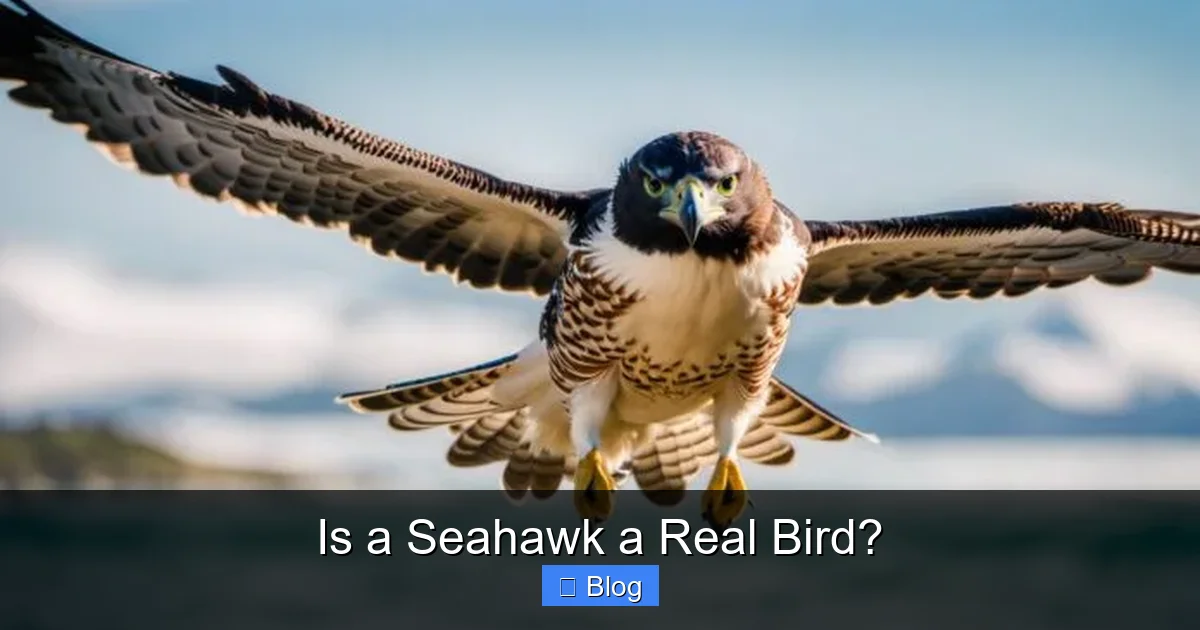
While “Seahawk” isn’t the formal name of a single bird species, it commonly refers to the Osprey, a magnificent fish-eating raptor found worldwide. The Seattle Seahawks NFL team adopted this powerful bird as their mascot due to its fierce hunting skills and coastal habitat, perfectly embodying the spirit of the Pacific Northwest. This article explores the Osprey’s incredible life and clarifies the “Seahawk” identity.
Is a Seahawk a Real Bird?
Have you ever found yourself cheering for the Seattle Seahawks, admiring their majestic bird logo, and then pausing to wonder, “Is a ‘Seahawk’ actually a real bird?” It’s a fantastic question that many people ponder, especially those new to birdwatching or American football. The name itself conjures images of a powerful, ocean-dwelling hunter, perfectly suited for the rugged beauty of the Pacific Northwest.
The short answer is both a “yes” and a “no,” which might seem a little confusing at first! While “Seahawk” isn’t the scientific name of a specific species you’d find in an ornithology textbook, it’s a widely recognized common name that most often refers to a particular, truly incredible raptor. This bird embodies everything you’d imagine a “Seahawk” to be: a formidable fisher, a master of its coastal domain, and a symbol of strength and agility.
Today, we’re going to dive deep into the fascinating world behind the “Seahawk” name. We’ll uncover the true identity of this avian marvel, explore its unique characteristics, understand its connection to the famous NFL team, and even learn a bit about its global journey and conservation story. So, grab your binoculars, and let’s embark on this exciting exploration of one of nature’s most impressive hunters!
Key Takeaways
- “Seahawk” is a colloquial term: There isn’t a single, formally recognized bird species named “Seahawk.”
- It primarily refers to the Osprey: The magnificent Osprey (scientific name: Pandion haliaetus) is the bird most commonly associated with the “Seahawk” moniker, especially in North America.
- The Seattle Seahawks mascot: The NFL team’s “Seahawk” logo and live mascots are directly inspired by and are Ospreys, chosen for their prowess as fish-eating raptors.
- Ospreys are unique raptors: They are specialized fish-eaters with distinctive physical adaptations, like reversible outer toes and spiny pads, for gripping slippery prey.
- Globally distributed and migratory: Ospreys are found on every continent except Antarctica and undertake impressive annual migrations between breeding and wintering grounds.
- Conservation success story: Once threatened by pesticides like DDT, Osprey populations have made a remarkable recovery thanks to conservation efforts and habitat protection.
Quick Answers to Common Questions
Is “Seahawk” a scientific name for a bird species?
No, “Seahawk” is a colloquial or common name, not a formal scientific name for any single bird species. The bird it typically refers to is the Osprey.
What’s the main diet of an Osprey?
Ospreys are highly specialized piscivores, meaning their diet consists almost exclusively (about 99%) of fish.
Do Ospreys migrate?
Yes, many Osprey populations are migratory, undertaking long journeys between their breeding grounds in northern regions and their wintering grounds in warmer southern climates.
Where are Ospreys typically found?
Ospreys have an incredibly widespread global distribution and are found on every continent except Antarctica, always near bodies of water like oceans, rivers, lakes, and estuaries.
Does the Seattle Seahawks team use a real Osprey as a mascot?
Yes, the Seattle Seahawks NFL team has historically featured live Osprey mascots, such as Taima, who make appearances at games and events.
📑 Table of Contents
Unmasking the “Seahawk”: It’s an Osprey!
So, let’s clear up the mystery right away: when people talk about a “Seahawk,” they are almost always referring to the **Osprey** (scientific name: *Pandion haliaetus*). This magnificent bird of prey is the original inspiration for the “Seahawk” moniker, a testament to its incredible fishing abilities and its preference for coastal and aquatic habitats. It’s a unique raptor, so distinct that it belongs to its very own family, Pandionidae, separate from eagles, hawks, and falcons.
The Name Game: Why “Seahawk”?
The term “Seahawk” is a colloquial or common name, meaning it’s a popular, informal way of referring to the Osprey, especially in regions where it’s a prominent bird. The “sea” part of the name makes perfect sense because Ospreys are almost always found near water – oceans, rivers, lakes, and estuaries – where they can hunt their primary food source: fish. The “hawk” part connects it to other birds of prey, reflecting its nature as a skilled hunter with sharp talons and keen eyesight. It’s a descriptive name that paints a vivid picture of this aerial angler.
A Global Traveler: Where Ospreys Call Home
One of the most remarkable things about the Osprey, or “Seahawk,” is its incredibly widespread distribution. You can find Ospreys on every continent except Antarctica! This global presence makes them one of the most successful and adaptable raptors in the world. They thrive in North America, South America, Europe, Asia, Africa, and Australia.
In North America, Ospreys breed across Canada and the United States, often spending their winters in warmer southern regions like Central and South America. They are truly masters of adaptation, able to find suitable nesting and hunting grounds in diverse environments as long as there’s a reliable source of fish. Imagine a bird that can navigate thousands of miles across continents, simply following the seasons and the availability of its favorite meal!
The Osprey: A True Avian Marvel
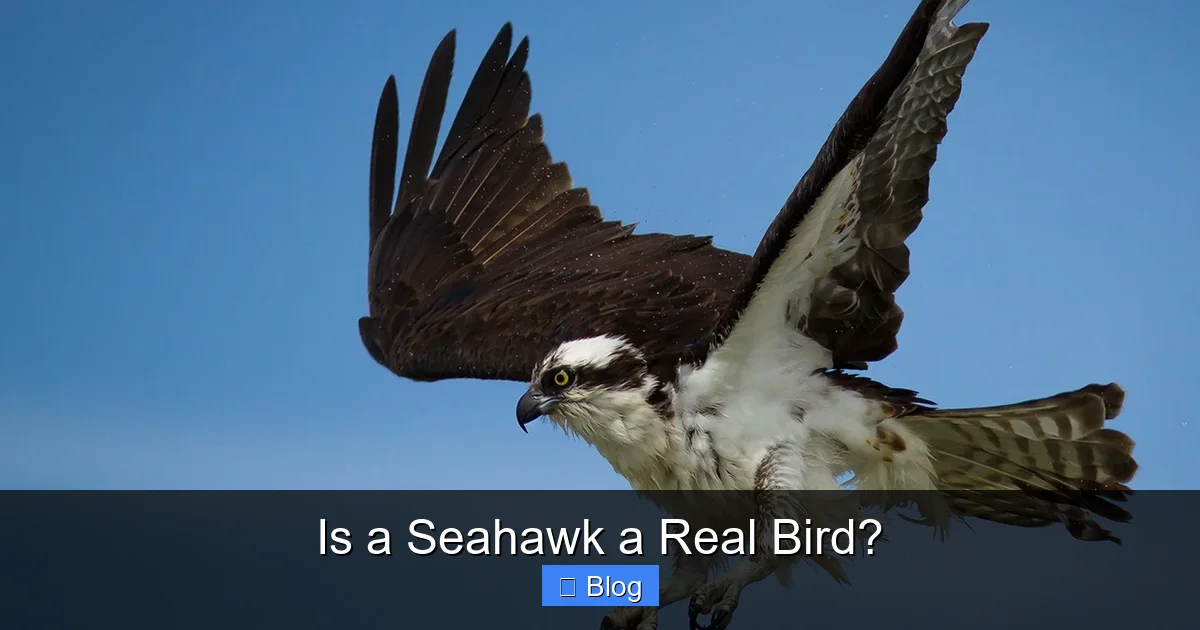
Visual guide about Is a Seahawk a Real Bird?
Image source: blog.nwf.org
To truly appreciate why the Osprey is called a “Seahawk,” we need to look at what makes this bird so special. Ospreys are perfectly designed for their niche in the ecosystem – they are highly specialized fish-eaters, and every aspect of their biology reflects this.
Physical Prowess: Built for the Hunt
An Osprey is a medium-large raptor, typically measuring about 21 to 25 inches (54-64 cm) in length with a wingspan that can reach an impressive 5 to 6 feet (152-182 cm). Their plumage is striking: a dark brown back and wings, a pristine white belly, and a distinctive dark stripe that runs through each eye. This “bandit mask” look helps reduce glare from the water, enhancing their already exceptional vision.
Their flight is powerful and purposeful, often characterized by a distinctive “M” shape when viewed from below, due to a slight kink in their wings. When soaring, they hold their wings in a dihedral, a shallow V-shape, making them easily identifiable even from a distance.
Unique Hunting Strategies: The Dive and Grab
This is where the Osprey truly earns its “Seahawk” reputation. Unlike many other raptors that perch and then swoop, Ospreys are aerial hunters. They circle over water, sometimes hovering intently, scanning the surface for fish. Once they spot their prey, often from heights of 30 to 100 feet (9-30 meters), they plunge headfirst, sometimes completely submerging themselves in the water with an incredible splash!
Their feet are uniquely adapted for this task. They possess reversible outer toes, meaning they can turn one of their front toes backward, effectively creating two toes pointing forward and two pointing backward. This gives them an incredibly strong, vice-like grip on slippery fish. Furthermore, the soles of their feet are covered in spiny pads, which act like natural sandpaper, preventing the fish from wriggling free during the flight back to the nest or a perch. No other raptor possesses these specific adaptations for fish-catching!
Diet of a Champion: Almost Exclusively Fish
As you might guess, Ospreys are piscivores, meaning their diet consists almost entirely of fish – typically 99% of their meals! They’re not picky about the type of fish, as long as it’s of a manageable size (usually 6-12 inches long, but they can carry fish up to 2 pounds or more). Common prey includes flounder, trout, carp, perch, and catfish. Occasionally, they might catch a snake, frog, or small mammal if fish are scarce, but these are rare exceptions. This highly specialized diet underscores their strong reliance on healthy aquatic ecosystems.
Life of an Osprey: From Nest to Flight
Understanding the life cycle of the Osprey helps us appreciate its resilience and intelligence. From building massive nests to embarking on incredible migratory journeys, every stage of an Osprey’s life is a marvel.
Nesting Habits: Grand Platforms for Family Life
Ospreys are impressive architects. They build large, bulky nests, often atop tall structures that offer a good vantage point and protection from predators. These can include dead trees, utility poles, navigation buoys, purpose-built nesting platforms, and even communication towers. Their nests are constructed from sticks, branches, and often incorporate odd bits of human debris like rope, plastic, or even old fishing nets. Over the years, a nest can grow to be enormous, sometimes several feet deep and wide.
Both parents participate in nest building and incubation. The female typically lays 2-4 eggs, which are incubated for about 5 weeks. It’s a demanding period, with the male often doing the bulk of the fishing to feed the female during incubation.
Rearing the Young: A Demanding Task
Once the chicks hatch, they are helpless and completely dependent on their parents. The male continues to be the primary provider of fish, bringing them back to the nest where the female tears them into smaller, digestible pieces for the young. As the chicks grow, they develop a huge appetite, requiring a constant supply of fish. This intensive feeding period lasts for about 8-10 weeks until the young Ospreys are ready to fledge, or take their first flight.
Even after fledging, the young Ospreys remain dependent on their parents for a few more weeks, honing their hunting skills and learning the art of the dive. This period is crucial for their survival, teaching them the vital techniques they’ll need for their independent lives and long migrations.
Migration: An Epic Journey
Many Osprey populations are migratory, undertaking incredible journeys between their breeding grounds and their wintering areas. For instance, Ospreys that breed in North America might spend their winters as far south as Brazil or Argentina, covering thousands of miles twice a year! These migrations are perilous, demanding immense energy and navigating skills. They often follow coastlines or major river systems, using favorable winds to conserve energy. It’s a testament to their strength and endurance, a true saga of survival and instinct that makes them even more worthy of the “Seahawk” name.
The Seattle Seahawks Connection: A Mascot Story
Now, let’s tie this all back to the famous NFL team. The Seattle Seahawks chose their name and logo very deliberately, seeking a symbol that would perfectly represent the strength, agility, and spirit of the Pacific Northwest.
Why the Osprey? The Perfect Symbol
The decision to call the team the “Seahawks” and adopt an Osprey-like logo was a brilliant choice. The Osprey is a powerful, predatory bird intimately connected with the coastal and aquatic environments that define the Seattle area and the broader Pacific Northwest. Its keen eyesight, swift dives, and unwavering focus when pursuing prey mirror the qualities desired in a championship football team: precision, power, and an unyielding drive to capture the goal.
The team’s original logo, and even its current updated version, clearly depict the distinctive features of an Osprey: the dark eye stripe, the hooked beak, and the fierce, focused gaze. It’s a powerful and majestic image that resonates with fans and perfectly symbolizes the team’s identity.
The Real-Life Mascots: Taima and Others
The Seattle Seahawks even have live mascots – actual Ospreys! For many years, a majestic female Osprey named Taima captivated fans with her pre-game flights around the stadium. (She officially retired in 2024 after a long and celebrated career). These live mascots provide a tangible link to the natural world and allow fans to see the real-life bird that inspires their team. They are a powerful reminder of the beauty and wildness of the Osprey, a true “Seahawk” in every sense. These birds are ambassadors, showcasing the intelligence and grandeur of their species.
Osprey Conservation: Protecting Our Flying Fishermen
The story of the Osprey is not just one of natural wonder; it’s also a compelling tale of conservation and recovery. These magnificent birds faced significant challenges in the past, but their comeback is a testament to dedicated environmental efforts.
Past Challenges and Remarkable Recovery
During the mid-20th century, Osprey populations, particularly in North America, suffered drastic declines. The primary culprit was the widespread use of DDT and other organochlorine pesticides. These chemicals accumulated in the food chain, leading to thinner eggshells in Ospreys (and other raptors like Bald Eagles), causing them to break during incubation. This resulted in reproductive failure and a sharp drop in their numbers, pushing them to the brink in many areas.
However, thanks to the ban of DDT in the United States and Canada in the early 1970s, coupled with extensive conservation efforts like habitat protection, nest platform installation, and public education, Ospreys have made a remarkable recovery. Today, their populations are robust in many regions, a true success story in environmental conservation. It shows what’s possible when we understand and act to protect our precious wildlife.
How You Can Help Ospreys Thrive
Even though Ospreys are doing well, their continued health depends on healthy aquatic ecosystems and human stewardship. Here are a few ways you can help:
- Support clean water initiatives: Healthy fish populations and clean water are essential for Ospreys. Support organizations working to reduce water pollution.
- Protect wetlands and coastal areas: These vital habitats provide food and nesting sites for Ospreys.
- Avoid disturbing nests: If you spot an Osprey nest, observe from a respectful distance, especially during breeding season.
- Install nesting platforms: In areas where natural nesting sites are scarce, providing artificial nesting platforms can be a huge boost for Ospreys.
- Educate others: Share the amazing story of the Osprey and its connection to the “Seahawk” name. The more people who understand and appreciate these birds, the better their chances for future generations.
Conclusion
So, is a “Seahawk” a real bird? Absolutely! While it might not have its own specific entry in the scientific lexicon, the term “Seahawk” brilliantly encapsulates the essence of the Osprey – a truly majestic, specialized bird of prey. It’s a global traveler, an unparalleled fisher, and a symbol of resilience that has inspired a beloved sports team.
From its incredible diving prowess to its remarkable migratory journeys, the Osprey is a testament to nature’s ingenuity. Next time you hear the name “Seahawk,” whether cheering on the football team or spotting one soaring gracefully over a lake, remember the true avian marvel behind the name. It’s a reminder of the wild beauty that surrounds us and the importance of protecting the natural world that these magnificent birds call home. Keep an eye out for these incredible “Seahawks” – you might be surprised at how often you spot one!
Frequently Asked Questions
What’s the difference between an Osprey and an eagle?
While both are large birds of prey, Ospreys are highly specialized fish-eaters with unique adaptations like reversible toes and spiny pads. Eagles, such as the Bald Eagle, have a broader diet that includes fish, mammals, and carrion, and lack the Osprey’s specific fish-catching foot structure.
How do Ospreys catch fish?
Ospreys hunt by circling over water, then diving feet-first to snatch fish from just below the surface, often submerging completely. They use their specialized feet with reversible outer toes and spiny pads to secure their slippery prey.
What do baby Ospreys eat?
Baby Ospreys, called chicks, are fed fish exclusively by their parents. The male Osprey primarily fishes, bringing the catch back to the nest where the female tears it into small pieces for the growing young.
Are Ospreys endangered?
No, Osprey populations have made a remarkable recovery and are generally considered stable or increasing in most parts of their range. They were once threatened by pesticides like DDT, but conservation efforts have helped them thrive again.
Can I see Ospreys in my backyard?
If your backyard is near a large body of water like a lake, river, or coastal area with abundant fish, it’s possible you might spot an Osprey, especially during migration season. They prefer open areas with tall structures for nesting.
How long do Ospreys live?
In the wild, Ospreys typically live for 15 to 20 years. Some individuals have been recorded living even longer, with the oldest known wild Osprey reaching over 25 years of age.