
Introduction
Have you ever looked at a bird’s nest and wondered how tiny baby birds survive in the wild? The world of baby birds is full of fascinating moments, from breaking out of their eggs to receiving their first meals and eventually learning to fly. Behind many of these amazing journeys are caring parent birds that work tirelessly to protect and raise their young.
Baby birds depend on their parents for warmth, food, protection, and guidance. After hatching, many chicks are unable to see clearly, move properly, or find food independently. Their parents must bring food, keep them safe from danger, and provide the care they need to grow.
Different bird species have different parenting behaviors. Some birds raise their chicks together, while in other species one parent performs most of the care. Certain birds build carefully hidden nests, while others use tree cavities, cliffs, or simple nesting platforms.
In this vlog, we will explore the beautiful relationship between baby birds and their caring parents. We will discover how chicks hatch, how parents feed them, how they protect their nests, and how young birds gradually learn to survive on their own.
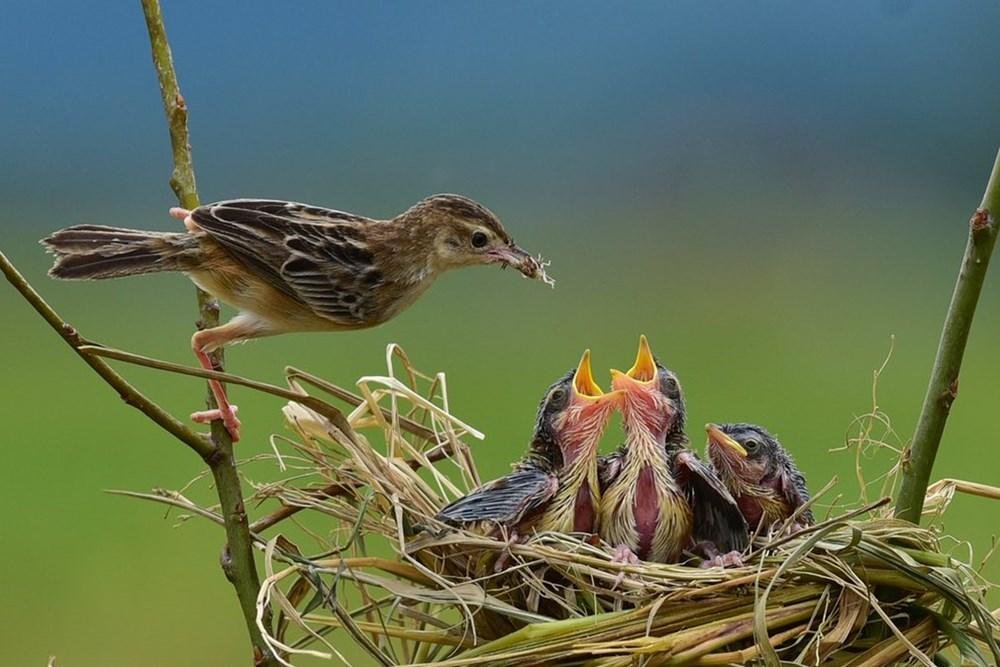
1. The Wonderful Beginning of a Baby Bird’s Life
A baby bird’s life usually begins inside an egg. Before the chick hatches, it develops inside the egg and receives nutrients from the yolk and other contents.
Parent birds often prepare a nest before laying their eggs. The nest may be made from twigs, grass, leaves, feathers, moss, mud, or other suitable materials, depending on the species.
After the eggs are laid, one or both parents may incubate them. Incubation keeps the eggs at a suitable temperature for the developing embryos. Parents may also turn the eggs as part of their normal nesting behavior.
The length of incubation varies widely among bird species. Some small songbirds hatch after roughly two weeks, while other birds require a much longer period.
As hatching approaches, the chick begins to break through the eggshell using a specialized structure called an egg tooth in many species. The process can take considerable time and effort.
When the chick finally emerges, it enters a world filled with new sounds, smells, movements, and challenges. Its parents become essential to its survival.
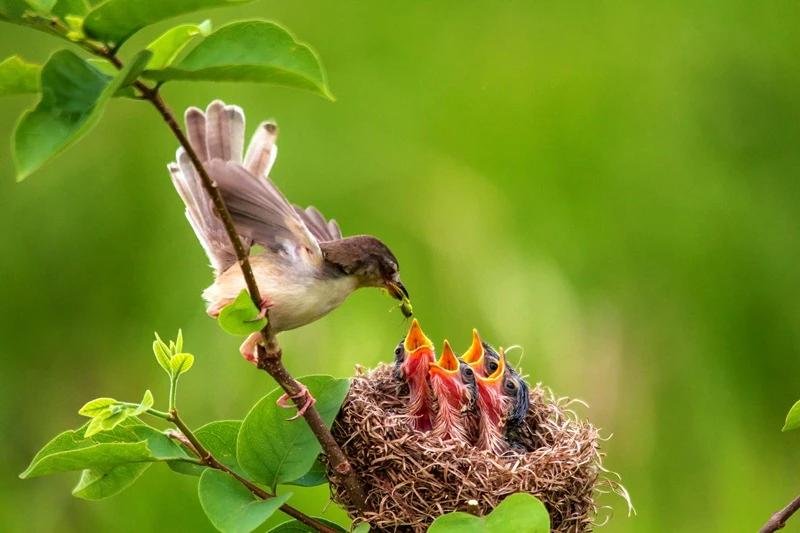
2. How Parent Birds Care for Their Newborn Chicks
Newly hatched birds are not all equally developed. Some chicks hatch almost naked, with closed eyes and very limited mobility. Others hatch covered in down feathers and can move around soon after emerging.
Many newly hatched songbirds are helpless and rely heavily on their parents. They need warmth, frequent feeding, and protection from predators and bad weather.
Parent birds may brood their chicks by sitting over or beside them. This helps maintain their body temperature, especially during the early days of life.
As the chicks grow, the parents gradually adjust their care. They may spend more time searching for food and less time covering the young continuously.
The amount of parental care depends on the species, the age of the chicks, the weather, and the conditions around the nest.
The first days of a baby bird’s life are particularly important because the chicks are growing rapidly and have limited ability to survive without help.
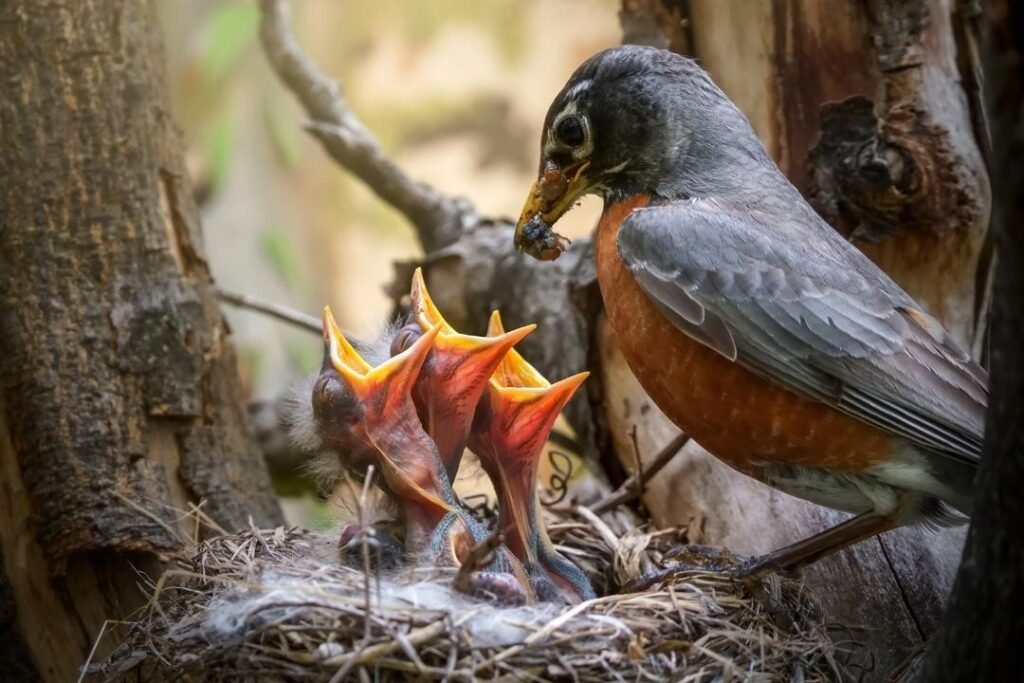
3. How Do Parent Birds Feed Their Babies?
Feeding is one of the most demanding responsibilities of raising baby birds. Growing chicks require energy, protein, and other nutrients to develop muscles, feathers, bones, and internal organs.
Many parent birds collect insects, worms, larvae, seeds, or other suitable food. The diet depends on the species and the nutritional needs of the chicks.
Insect-eating songbirds may make repeated trips to collect caterpillars and other small invertebrates. Birds that eat fish may bring small fish to their young, while pigeons and doves produce a special nutrient-rich substance called crop milk to feed their chicks.
When a parent returns to the nest, hungry chicks may raise their heads and open their mouths in response to the parent’s movements or signals. This behavior encourages feeding.
In many species, both parents share the work of collecting food. One parent may remain close to the nest while the other searches for food, or both may take turns feeding the chicks.
The frequency of feeding varies. Some chicks receive food very frequently during daylight hours because they grow quickly and have high energy needs.
Successful feeding helps baby birds gain weight, grow feathers, and develop the strength required for their next stage of life.
4. Why Do Baby Birds Open Their Mouths?
One of the most recognizable sights in a bird’s nest is a group of chicks stretching their necks and opening their mouths when a parent arrives.
This behavior is called begging. It is a signal that communicates the chicks’ need for food.
In many species, young birds respond to movement, sounds, or other cues associated with their parents. The inside of a chick’s mouth may also have visible colors or markings that help parents recognize feeding signals.
Begging behavior is not simply a sign of hunger in every situation. It can be influenced by the age of the chicks, competition among nestmates, and the amount of food available.
In nests with several chicks, individuals may compete for the parent’s attention. Parents must distribute food among their young while balancing their own energy needs and the demands of finding more food.
As chicks mature, their begging behavior may change. They gradually become better able to move around, recognize food, and eventually feed themselves.
This simple behavior is an important part of communication between baby birds and their parents.
5. How Parent Birds Protect Their Babies From Predators
Life in the wild can be dangerous for young birds. Predators may include snakes, cats, rats, larger birds, and other animals that eat eggs or chicks.
Parent birds use several strategies to reduce these risks. Some choose concealed nest sites among dense leaves, tree cavities, tall grasses, or other protected locations.
Other birds make alarm calls when danger approaches. These calls can alert their mates, their chicks, or nearby birds.
Some parent birds attempt to distract a predator by moving away from the nest and displaying behavior that draws attention toward themselves. Others may mob a predator, approaching it repeatedly to encourage it to leave.
The strategy depends on the species and the type of threat. No parent can prevent every danger, but nest placement, vigilance, and defensive behavior can improve the chances of survival.
Human activity can also disturb nesting birds. Approaching nests too closely, repeatedly touching nesting areas, or allowing pets to disturb them may increase risks.
Observing birds from a respectful distance helps parents care for their young without unnecessary interference.
6. How Birds Keep Their Babies Warm
Temperature regulation is important for developing chicks, especially those that hatch with few feathers.
Parent birds may brood their young by covering them with their bodies or spreading their feathers over the nest. Their body heat helps the chicks remain warm.
During cold weather, this behavior can be particularly important. Very young chicks may lose heat quickly because they have limited insulation and cannot regulate their temperature as effectively as adults.
As chicks grow and develop feathers, they generally become better able to maintain their body temperature. Parents may gradually spend less time brooding them.
Warmth is not the only concern. In hot weather, parent birds may change their position, provide shade, or adjust how much they cover their young to reduce overheating.
A suitable nest location can help protect chicks from extreme temperatures, wind, and rain.
The careful way parent birds respond to changing weather shows how their behavior supports the development of their young.
7. How Parent Birds Protect Their Nests During Rain
Rain can create problems for nests, especially when heavy showers are accompanied by strong winds or falling temperatures.
Some birds build nests under dense foliage, beneath overhangs, or inside cavities that provide protection. Nest materials and construction methods vary greatly across species.
During rain, parent birds may remain close to their chicks or position themselves to reduce exposure to wet and cold conditions.
However, not every nest is fully waterproof. Heavy rainfall may soak nesting material, while flooding can threaten nests located on the ground or close to water.
If a nest becomes damaged, some birds may repair it when conditions improve. Others may face difficulties if the structure is destroyed.
Young chicks are particularly vulnerable when their feathers are not fully developed. Staying warm and receiving food becomes especially important during prolonged periods of bad weather.
People can help by protecting trees and nesting habitats and avoiding unnecessary disturbance during the breeding season.
8. How Baby Birds Grow Their Feathers
Feathers are essential for birds because they provide insulation, support flight, and help protect the body.
Many baby songbirds hatch with little or no feather covering. They initially have down feathers or develop them soon after hatching, depending on the species.
As the chicks grow, their juvenile feathers emerge. Their bodies become more insulated, and their wings gradually develop the structure needed for flight.
Feather growth requires energy and nutrients, so a steady supply of suitable food is important.
The timing of feather development varies. Some birds grow rapidly and leave the nest within a short period, while other species remain dependent on their parents for much longer.
Young birds do not always look exactly like adults. Their juvenile plumage may have different colors or patterns, which can change as they mature.
Watching a tiny chick gradually develop feathers is one of the most remarkable stages in the life of a bird.
9. How Parent Birds Teach Their Babies to Survive
Birds do not teach their young in exactly the same way humans teach children, but parental care and experience can help young birds develop essential survival skills.
As chicks grow, they observe their parents’ behavior and respond to environmental cues. Depending on the species, they may learn where to find food, recognize danger, and interact with other birds.
Some skills develop largely through instinct and practice rather than direct instruction.
For example, young birds gradually improve their coordination as they move around the nest and exercise their wings. After leaving the nest, many continue receiving food and protection from their parents.
Parent birds may lead their fledglings to feeding areas or respond to their begging calls. Young birds also learn through their own experiences as they explore their surroundings.
Over time, they become more capable of locating food, avoiding threats, and navigating their habitat.
The transition from complete dependence to relative independence is a major step in a bird’s life.
10. When Do Baby Birds Learn to Fly?
The first flight is a major milestone for many young birds. Before flying, chicks develop stronger wing muscles, grow flight feathers, and practice moving around the nest.
The age at which a bird first flies varies considerably by species. Many small songbirds leave their nests after roughly two to three weeks, although some take less or more time.
Leaving the nest is known as fledging. A fledgling may be able to fly only short distances at first, and its coordination may still be developing.
Young birds sometimes spend time on the ground or on low branches while their flight improves. Their parents may continue feeding and guarding them during this period.
A fledgling sitting outside the nest is not necessarily abandoned. Its parents may be nearby, watching it or searching for food.
If a fledgling is in a safe place, people should generally observe from a distance and avoid taking it away from its parents.
If the bird is visibly injured or in immediate danger, contact a qualified wildlife rehabilitator or local wildlife authority for guidance.
11. Do Both Parent Birds Take Care of Their Babies?
Many bird species share parenting responsibilities, but the arrangement varies.
In numerous songbird species, both parents help incubate eggs, defend the nest, and feed the chicks. Sharing these duties can help ensure that young birds receive sufficient care.
In some species, one parent performs most of the incubation or feeding. In other species, several adults may help raise the young.
For example, some birds exhibit cooperative breeding, in which additional individuals assist the breeding pair with feeding or protecting the chicks.
Pigeons and doves commonly share parental duties, and both sexes can produce crop milk for their young.
These different arrangements reflect adaptations to each species’ environment, food supply, and reproductive biology.
There is no single parenting pattern for all birds. However, the care provided by parents or other group members can be vital to the survival of young chicks.
12. Why Do Baby Birds Sometimes Fall Out of Their Nests?
Finding a baby bird on the ground can be worrying, but several different situations may explain why it is there.
Some young birds leave the nest before they can fly well. These fledglings may hop on the ground or sit on low branches while their parents continue to care for them.
Other chicks may accidentally fall from a nest because of strong winds, nest damage, or movement within a crowded nest.
A very young chick that has few feathers and cannot move properly may need expert assistance if it has fallen from its nest.
If the bird is a healthy fledgling, the safest action is often to keep people and pets away and observe from a distance.
If a nestling is found and the original nest is accessible and safe, a qualified wildlife professional can advise whether it should be returned. Human scent alone does not generally cause parent birds to reject their young, but handling can still cause unnecessary stress or injury.
Never give a baby bird milk, bread, or water directly into its mouth. Incorrect feeding can cause serious harm.
13. How Long Do Baby Birds Stay With Their Parents?
The period of parental care depends on the species, the young bird’s development, and environmental conditions.
Some small songbirds leave the nest after a relatively short time but continue receiving food from their parents for days or weeks.
Other birds, including certain large species, may remain dependent on their parents for months.
During this period, young birds develop stronger flight skills, learn to find food, and improve their ability to recognize threats.
Some species remain in family groups after the young become independent. Others disperse to find their own territories.
A bird’s first flight does not necessarily mean that it can survive completely alone. Fledglings often require additional time and experience before they can consistently find enough food and avoid danger.
The gradual process of learning and growing gives young birds a better chance of surviving independently.
14. How Humans Can Help Baby Birds and Their Parents
People can help nesting birds by protecting their habitats and allowing parent birds to care for their young without unnecessary disturbance.
Protect nesting trees: Avoid cutting branches with active nests whenever possible, and follow local wildlife regulations.
Keep pets away from nests: Cats and dogs can injure chicks or disturb parent birds.
Observe from a distance: Use binoculars or a camera with a zoom lens rather than approaching nests closely.
Keep the environment clean: Properly dispose of plastic, fishing line, and other waste that can injure birds.
Provide bird-friendly plants: Native trees, shrubs, and flowers can support insects and provide food and shelter.
Avoid harmful feeding: Never feed baby birds bread, milk, or unsuitable household foods. Their nutritional needs differ from those of humans.
Do not disturb fledglings unnecessarily: A young bird on the ground may still be receiving care from its parents.
Seek professional help when necessary: Contact a wildlife rehabilitator or local wildlife authority if a baby bird is seriously injured, visibly ill, or in immediate danger.
The most effective way to help most wild baby birds is to protect their natural surroundings and give their parents the opportunity to care for them.
15. Amazing Facts About Baby Birds and Their Parents
Here are some interesting facts about bird families:
- Baby birds are called chicks, although young birds that have left the nest are often called fledglings.
- Many songbird chicks open their mouths and beg when a parent arrives with food.
- Some bird species have both parents feeding and protecting the young.
- Pigeons and doves produce crop milk to feed their chicks.
- Some young birds leave the nest before they are capable of sustained flight.
- Parent birds may use alarm calls or defensive behavior when predators approach.
- Nest materials and nest-building methods differ greatly among bird species.
- Young birds often continue receiving parental care after their first flight.
- Feather growth requires energy and nutrients from suitable food.
- A baby bird found on the ground is not always abandoned; its parents may be nearby.
These facts reveal how different bird species have evolved their own ways of raising the next generation.
Frequently Asked Questions (FAQ)
What do baby birds eat?
Baby birds eat different foods depending on their species. Many songbird chicks receive insects and other small invertebrates, while other birds receive seeds, fish, fruit, or specialized food produced by their parents.
How do parent birds feed their babies?
Parent birds collect suitable food and deliver it to their chicks. In many species, chicks beg by opening their mouths and raising their heads when a parent arrives.
How do birds protect their babies from predators?
They may conceal their nests, give alarm calls, defend the nesting area, or distract predators. The exact behavior depends on the species and situation.
How long does it take for baby birds to fly?
It varies by species. Many small songbirds leave the nest after roughly two to three weeks, but other birds take a different amount of time.
Do parent birds abandon their babies if humans touch them?
Human scent alone does not generally cause birds to abandon their young. However, unnecessary handling and disturbance can harm chicks, so wild nests should be left undisturbed.
What should I do if I find a baby bird on the ground?
First, observe from a distance and determine whether it is a feathered fledgling or a very young nestling. Keep pets away, avoid feeding it, and seek expert guidance if it is injured or in immediate danger.
Do both mother and father birds feed their babies?
In many species, both parents help feed and protect the chicks. In other species, one parent performs most of the care or additional helpers assist.
Conclusion
Baby birds and their caring parents offer a wonderful example of how life develops through protection, nourishment, and experience. From the moment a chick breaks out of its eggshell, its survival may depend on the warmth, food, and protection provided by its parents.
Parent birds work hard to find suitable food, guard their nests, protect their young from bad weather, and respond to possible dangers. As the chicks grow, they develop feathers, strengthen their wings, and gradually learn the skills needed to survive in the wild.
Although bird parenting differs from species to species, successful care can make an important difference to the survival of young birds. Unfortunately, habitat destruction, pollution, predators, and human disturbance can create additional challenges for bird families.
We can help by protecting trees, respecting active nests, keeping pets away from vulnerable chicks, and avoiding unnecessary handling of young birds.
Every baby bird represents the next generation of its species. By protecting bird families and their natural habitats, we help preserve the beauty and diversity of the natural world.
Call to Action: Have you ever watched a parent bird feeding its babies? Share your experience in the comments, and follow our blog for more amazing bird facts, wildlife stories, and nature discoveries.
Introduction
Have you ever looked at a bird’s nest and wondered how tiny baby birds survive in the wild? The world of baby birds is full of fascinating moments, from breaking out of their eggs to receiving their first meals and eventually learning to fly. Behind many of these amazing journeys are caring parent birds that work tirelessly to protect and raise their young.
Baby birds depend on their parents for warmth, food, protection, and guidance. After hatching, many chicks are unable to see clearly, move properly, or find food independently. Their parents must bring food, keep them safe from danger, and provide the care they need to grow.
Different bird species have different parenting behaviors. Some birds raise their chicks together, while in other species one parent performs most of the care. Certain birds build carefully hidden nests, while others use tree cavities, cliffs, or simple nesting platforms.
In this vlog, we will explore the beautiful relationship between baby birds and their caring parents. We will discover how chicks hatch, how parents feed them, how they protect their nests, and how young birds gradually learn to survive on their own.
1. The Wonderful Beginning of a Baby Bird’s Life
A baby bird’s life usually begins inside an egg. Before the chick hatches, it develops inside the egg and receives nutrients from the yolk and other contents.
Parent birds often prepare a nest before laying their eggs. The nest may be made from twigs, grass, leaves, feathers, moss, mud, or other suitable materials, depending on the species.
After the eggs are laid, one or both parents may incubate them. Incubation keeps the eggs at a suitable temperature for the developing embryos. Parents may also turn the eggs as part of their normal nesting behavior.
The length of incubation varies widely among bird species. Some small songbirds hatch after roughly two weeks, while other birds require a much longer period.
As hatching approaches, the chick begins to break through the eggshell using a specialized structure called an egg tooth in many species. The process can take considerable time and effort.
When the chick finally emerges, it enters a world filled with new sounds, smells, movements, and challenges. Its parents become essential to its survival.
2. How Parent Birds Care for Their Newborn Chicks
Newly hatched birds are not all equally developed. Some chicks hatch almost naked, with closed eyes and very limited mobility. Others hatch covered in down feathers and can move around soon after emerging.
Many newly hatched songbirds are helpless and rely heavily on their parents. They need warmth, frequent feeding, and protection from predators and bad weather.
Parent birds may brood their chicks by sitting over or beside them. This helps maintain their body temperature, especially during the early days of life.
As the chicks grow, the parents gradually adjust their care. They may spend more time searching for food and less time covering the young continuously.
The amount of parental care depends on the species, the age of the chicks, the weather, and the conditions around the nest.
The first days of a baby bird’s life are particularly important because the chicks are growing rapidly and have limited ability to survive without help.
3. How Do Parent Birds Feed Their Babies?
Feeding is one of the most demanding responsibilities of raising baby birds. Growing chicks require energy, protein, and other nutrients to develop muscles, feathers, bones, and internal organs.
Many parent birds collect insects, worms, larvae, seeds, or other suitable food. The diet depends on the species and the nutritional needs of the chicks.
Insect-eating songbirds may make repeated trips to collect caterpillars and other small invertebrates. Birds that eat fish may bring small fish to their young, while pigeons and doves produce a special nutrient-rich substance called crop milk to feed their chicks.
When a parent returns to the nest, hungry chicks may raise their heads and open their mouths in response to the parent’s movements or signals. This behavior encourages feeding.
In many species, both parents share the work of collecting food. One parent may remain close to the nest while the other searches for food, or both may take turns feeding the chicks.
The frequency of feeding varies. Some chicks receive food very frequently during daylight hours because they grow quickly and have high energy needs.
Successful feeding helps baby birds gain weight, grow feathers, and develop the strength required for their next stage of life.
4. Why Do Baby Birds Open Their Mouths?
One of the most recognizable sights in a bird’s nest is a group of chicks stretching their necks and opening their mouths when a parent arrives.
This behavior is called begging. It is a signal that communicates the chicks’ need for food.
In many species, young birds respond to movement, sounds, or other cues associated with their parents. The inside of a chick’s mouth may also have visible colors or markings that help parents recognize feeding signals.
Begging behavior is not simply a sign of hunger in every situation. It can be influenced by the age of the chicks, competition among nestmates, and the amount of food available.
In nests with several chicks, individuals may compete for the parent’s attention. Parents must distribute food among their young while balancing their own energy needs and the demands of finding more food.
As chicks mature, their begging behavior may change. They gradually become better able to move around, recognize food, and eventually feed themselves.
This simple behavior is an important part of communication between baby birds and their parents.
5. How Parent Birds Protect Their Babies From Predators
Life in the wild can be dangerous for young birds. Predators may include snakes, cats, rats, larger birds, and other animals that eat eggs or chicks.
Parent birds use several strategies to reduce these risks. Some choose concealed nest sites among dense leaves, tree cavities, tall grasses, or other protected locations.
Other birds make alarm calls when danger approaches. These calls can alert their mates, their chicks, or nearby birds.
Some parent birds attempt to distract a predator by moving away from the nest and displaying behavior that draws attention toward themselves. Others may mob a predator, approaching it repeatedly to encourage it to leave.
The strategy depends on the species and the type of threat. No parent can prevent every danger, but nest placement, vigilance, and defensive behavior can improve the chances of survival.
Human activity can also disturb nesting birds. Approaching nests too closely, repeatedly touching nesting areas, or allowing pets to disturb them may increase risks.
Observing birds from a respectful distance helps parents care for their young without unnecessary interference.
6. How Birds Keep Their Babies Warm
Temperature regulation is important for developing chicks, especially those that hatch with few feathers.
Parent birds may brood their young by covering them with their bodies or spreading their feathers over the nest. Their body heat helps the chicks remain warm.
During cold weather, this behavior can be particularly important. Very young chicks may lose heat quickly because they have limited insulation and cannot regulate their temperature as effectively as adults.
As chicks grow and develop feathers, they generally become better able to maintain their body temperature. Parents may gradually spend less time brooding them.
Warmth is not the only concern. In hot weather, parent birds may change their position, provide shade, or adjust how much they cover their young to reduce overheating.
A suitable nest location can help protect chicks from extreme temperatures, wind, and rain.
The careful way parent birds respond to changing weather shows how their behavior supports the development of their young.
7. How Parent Birds Protect Their Nests During Rain
Rain can create problems for nests, especially when heavy showers are accompanied by strong winds or falling temperatures.
Some birds build nests under dense foliage, beneath overhangs, or inside cavities that provide protection. Nest materials and construction methods vary greatly across species.
During rain, parent birds may remain close to their chicks or position themselves to reduce exposure to wet and cold conditions.
However, not every nest is fully waterproof. Heavy rainfall may soak nesting material, while flooding can threaten nests located on the ground or close to water.
If a nest becomes damaged, some birds may repair it when conditions improve. Others may face difficulties if the structure is destroyed.
Young chicks are particularly vulnerable when their feathers are not fully developed. Staying warm and receiving food becomes especially important during prolonged periods of bad weather.
People can help by protecting trees and nesting habitats and avoiding unnecessary disturbance during the breeding season.
8. How Baby Birds Grow Their Feathers
Feathers are essential for birds because they provide insulation, support flight, and help protect the body.
Many baby songbirds hatch with little or no feather covering. They initially have down feathers or develop them soon after hatching, depending on the species.
As the chicks grow, their juvenile feathers emerge. Their bodies become more insulated, and their wings gradually develop the structure needed for flight.
Feather growth requires energy and nutrients, so a steady supply of suitable food is important.
The timing of feather development varies. Some birds grow rapidly and leave the nest within a short period, while other species remain dependent on their parents for much longer.
Young birds do not always look exactly like adults. Their juvenile plumage may have different colors or patterns, which can change as they mature.
Watching a tiny chick gradually develop feathers is one of the most remarkable stages in the life of a bird.
9. How Parent Birds Teach Their Babies to Survive
Birds do not teach their young in exactly the same way humans teach children, but parental care and experience can help young birds develop essential survival skills.
As chicks grow, they observe their parents’ behavior and respond to environmental cues. Depending on the species, they may learn where to find food, recognize danger, and interact with other birds.
Some skills develop largely through instinct and practice rather than direct instruction.
For example, young birds gradually improve their coordination as they move around the nest and exercise their wings. After leaving the nest, many continue receiving food and protection from their parents.
Parent birds may lead their fledglings to feeding areas or respond to their begging calls. Young birds also learn through their own experiences as they explore their surroundings.
Over time, they become more capable of locating food, avoiding threats, and navigating their habitat.
The transition from complete dependence to relative independence is a major step in a bird’s life.
10. When Do Baby Birds Learn to Fly?
The first flight is a major milestone for many young birds. Before flying, chicks develop stronger wing muscles, grow flight feathers, and practice moving around the nest.
The age at which a bird first flies varies considerably by species. Many small songbirds leave their nests after roughly two to three weeks, although some take less or more time.
Leaving the nest is known as fledging. A fledgling may be able to fly only short distances at first, and its coordination may still be developing.
Young birds sometimes spend time on the ground or on low branches while their flight improves. Their parents may continue feeding and guarding them during this period.
A fledgling sitting outside the nest is not necessarily abandoned. Its parents may be nearby, watching it or searching for food.
If a fledgling is in a safe place, people should generally observe from a distance and avoid taking it away from its parents.
If the bird is visibly injured or in immediate danger, contact a qualified wildlife rehabilitator or local wildlife authority for guidance.
11. Do Both Parent Birds Take Care of Their Babies?
Many bird species share parenting responsibilities, but the arrangement varies.
In numerous songbird species, both parents help incubate eggs, defend the nest, and feed the chicks. Sharing these duties can help ensure that young birds receive sufficient care.
In some species, one parent performs most of the incubation or feeding. In other species, several adults may help raise the young.
For example, some birds exhibit cooperative breeding, in which additional individuals assist the breeding pair with feeding or protecting the chicks.
Pigeons and doves commonly share parental duties, and both sexes can produce crop milk for their young.
These different arrangements reflect adaptations to each species’ environment, food supply, and reproductive biology.
There is no single parenting pattern for all birds. However, the care provided by parents or other group members can be vital to the survival of young chicks.
12. Why Do Baby Birds Sometimes Fall Out of Their Nests?
Finding a baby bird on the ground can be worrying, but several different situations may explain why it is there.
Some young birds leave the nest before they can fly well. These fledglings may hop on the ground or sit on low branches while their parents continue to care for them.
Other chicks may accidentally fall from a nest because of strong winds, nest damage, or movement within a crowded nest.
A very young chick that has few feathers and cannot move properly may need expert assistance if it has fallen from its nest.
If the bird is a healthy fledgling, the safest action is often to keep people and pets away and observe from a distance.
If a nestling is found and the original nest is accessible and safe, a qualified wildlife professional can advise whether it should be returned. Human scent alone does not generally cause parent birds to reject their young, but handling can still cause unnecessary stress or injury.
Never give a baby bird milk, bread, or water directly into its mouth. Incorrect feeding can cause serious harm.
13. How Long Do Baby Birds Stay With Their Parents?
The period of parental care depends on the species, the young bird’s development, and environmental conditions.
Some small songbirds leave the nest after a relatively short time but continue receiving food from their parents for days or weeks.
Other birds, including certain large species, may remain dependent on their parents for months.
During this period, young birds develop stronger flight skills, learn to find food, and improve their ability to recognize threats.
Some species remain in family groups after the young become independent. Others disperse to find their own territories.
A bird’s first flight does not necessarily mean that it can survive completely alone. Fledglings often require additional time and experience before they can consistently find enough food and avoid danger.
The gradual process of learning and growing gives young birds a better chance of surviving independently.
14. How Humans Can Help Baby Birds and Their Parents
People can help nesting birds by protecting their habitats and allowing parent birds to care for their young without unnecessary disturbance.
Protect nesting trees: Avoid cutting branches with active nests whenever possible, and follow local wildlife regulations.
Keep pets away from nests: Cats and dogs can injure chicks or disturb parent birds.
Observe from a distance: Use binoculars or a camera with a zoom lens rather than approaching nests closely.
Keep the environment clean: Properly dispose of plastic, fishing line, and other waste that can injure birds.
Provide bird-friendly plants: Native trees, shrubs, and flowers can support insects and provide food and shelter.
Avoid harmful feeding: Never feed baby birds bread, milk, or unsuitable household foods. Their nutritional needs differ from those of humans.
Do not disturb fledglings unnecessarily: A young bird on the ground may still be receiving care from its parents.
Seek professional help when necessary: Contact a wildlife rehabilitator or local wildlife authority if a baby bird is seriously injured, visibly ill, or in immediate danger.
The most effective way to help most wild baby birds is to protect their natural surroundings and give their parents the opportunity to care for them.
15. Amazing Facts About Baby Birds and Their Parents
Here are some interesting facts about bird families:
- Baby birds are called chicks, although young birds that have left the nest are often called fledglings.
- Many songbird chicks open their mouths and beg when a parent arrives with food.
- Some bird species have both parents feeding and protecting the young.
- Pigeons and doves produce crop milk to feed their chicks.
- Some young birds leave the nest before they are capable of sustained flight.
- Parent birds may use alarm calls or defensive behavior when predators approach.
- Nest materials and nest-building methods differ greatly among bird species.
- Young birds often continue receiving parental care after their first flight.
- Feather growth requires energy and nutrients from suitable food.
- A baby bird found on the ground is not always abandoned; its parents may be nearby.
These facts reveal how different bird species have evolved their own ways of raising the next generation.
Frequently Asked Questions (FAQ)
What do baby birds eat?
Baby birds eat different foods depending on their species. Many songbird chicks receive insects and other small invertebrates, while other birds receive seeds, fish, fruit, or specialized food produced by their parents.
How do parent birds feed their babies?
Parent birds collect suitable food and deliver it to their chicks. In many species, chicks beg by opening their mouths and raising their heads when a parent arrives.
How do birds protect their babies from predators?
They may conceal their nests, give alarm calls, defend the nesting area, or distract predators. The exact behavior depends on the species and situation.
How long does it take for baby birds to fly?
It varies by species. Many small songbirds leave the nest after roughly two to three weeks, but other birds take a different amount of time.
Do parent birds abandon their babies if humans touch them?
Human scent alone does not generally cause birds to abandon their young. However, unnecessary handling and disturbance can harm chicks, so wild nests should be left undisturbed.
What should I do if I find a baby bird on the ground?
First, observe from a distance and determine whether it is a feathered fledgling or a very young nestling. Keep pets away, avoid feeding it, and seek expert guidance if it is injured or in immediate danger.
Do both mother and father birds feed their babies?
In many species, both parents help feed and protect the chicks. In other species, one parent performs most of the care or additional helpers assist.
Conclusion
Baby birds and their caring parents offer a wonderful example of how life develops through protection, nourishment, and experience. From the moment a chick breaks out of its eggshell, its survival may depend on the warmth, food, and protection provided by its parents.
Parent birds work hard to find suitable food, guard their nests, protect their young from bad weather, and respond to possible dangers. As the chicks grow, they develop feathers, strengthen their wings, and gradually learn the skills needed to survive in the wild.
Although bird parenting differs from species to species, successful care can make an important difference to the survival of young birds. Unfortunately, habitat destruction, pollution, predators, and human disturbance can create additional challenges for bird families.
We can help by protecting trees, respecting active nests, keeping pets away from vulnerable chicks, and avoiding unnecessary handling of young birds.
Every baby bird represents the next generation of its species. By protecting bird families and their natural habitats, we help preserve the beauty and diversity of the natural world.
Call to Action: Have you ever watched a parent bird feeding its babies? Share your experience in the comments, and follow our blog for more amazing bird facts, wildlife stories, and nature discoveries.