
Introduction
Birds are among the most fascinating creatures on Earth. They live in forests, mountains, deserts, wetlands, grasslands, and even busy cities. Some birds can fly at incredible speeds, while others swim underwater, imitate human speech, travel thousands of kilometers, or build remarkably complex nests.
Amazing Bird Facts You Never Knew will take you on an exciting journey through the world of these extraordinary animals. Although many people see birds every day, there are countless things about their behavior, intelligence, physical abilities, and survival strategies that remain surprising.
Did you know that some birds can recognize individual human faces? Some species use tools, many communicate through complex calls, and certain migratory birds travel enormous distances between their breeding and wintering grounds.
In this vlog, we will explore 30 fascinating bird facts that reveal why birds are so special and why protecting them is important.
1. Birds Are Found Almost Everywhere on Earth
Birds live on every continent, including Antarctica. Different species have adapted to a remarkable range of environments.
Penguins survive in cold southern regions, ostriches live in African landscapes, and tropical parrots inhabit warm forests. Seabirds spend much of their lives over the ocean, while other species live in deserts or high mountains.
Their ability to adapt to different habitats makes birds one of the most widespread groups of land vertebrates.
2. Not All Birds Can Fly
Flying is one of the most recognizable features of birds, but not every bird can fly.
Ostriches, emus, cassowaries, and kiwis are examples of flightless birds. Penguins cannot fly through the air, but their wings have evolved into flippers that help them swim underwater.
Flightless birds often have other adaptations, such as powerful legs for running or specialized bodies for swimming.
Their lives show that birds can thrive without using their wings for powered flight.
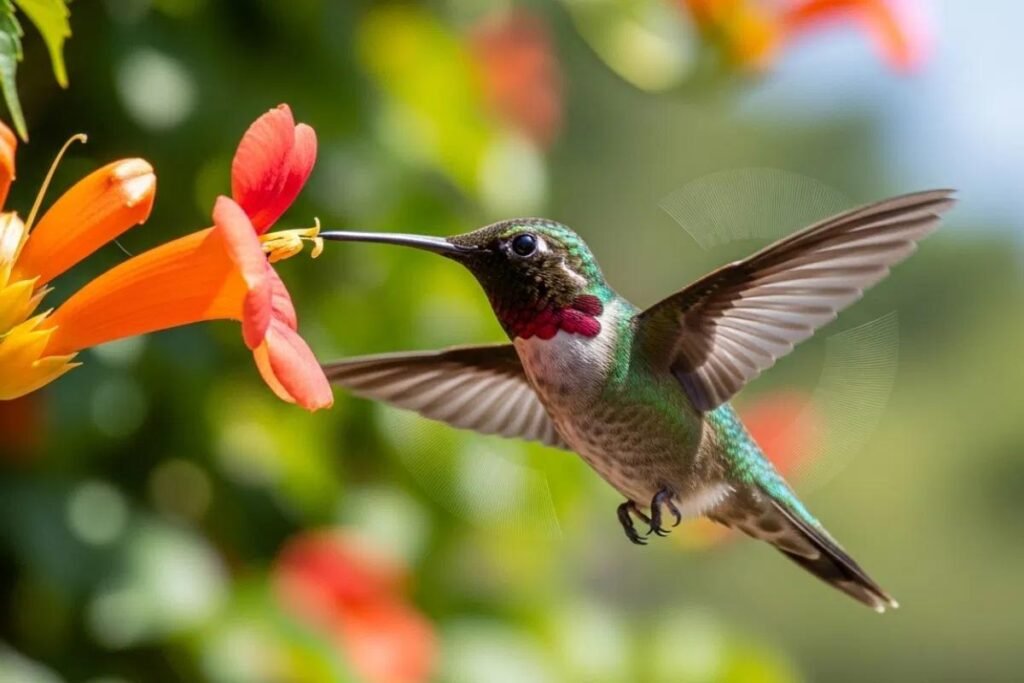
3. Hummingbirds Can Hover in Midair
Hummingbirds are famous for their ability to hover while feeding on nectar.
Their wings move rapidly, generating aerodynamic forces that help them remain almost stationary in front of a flower. They can also move backward, an unusual ability among birds.
Their small bodies and specialized flight muscles support this remarkable movement.
Hummingbirds often feed on nectar, and many also consume small insects and spiders to obtain essential nutrients.
4. The Peregrine Falcon Is an Incredible Speedster
The peregrine falcon is famous for its high-speed hunting dive, known as a stoop.
During this dive, the falcon folds its wings and descends rapidly toward its target. In measured dives, peregrine falcons can exceed 300 kilometers per hour.
This makes the peregrine falcon one of the fastest animals in the world during a hunting dive.
Its streamlined body, pointed wings, and excellent vision help it pursue other birds in flight.
5. Owls Can Fly Very Quietly
Many owls have specialized feather structures that reduce the noise created by their wings during flight.
Quiet flight can help an owl approach prey without producing as much sound as many other birds.
Owls also use their excellent hearing and low-light vision to locate prey. Some species can detect small animals moving beneath vegetation or snow.
However, not every owl hunts at night. Certain species are active during daylight or at dawn and dusk.
6. Some Birds Can Imitate Human Speech
Certain parrots can learn to imitate human words, sounds, and phrases.
African grey parrots are particularly well known for their vocal learning abilities. Budgerigars, some cockatoos, and other parrot species can also imitate human speech.
These birds do not necessarily understand language in the same way humans do. However, some individuals can learn associations between sounds, objects, routines, and rewards.
Their abilities reveal how flexible bird communication and learning can be.
7. Crows Are Remarkably Intelligent
Crows belong to the corvid family, a group that also includes ravens, jays, and magpies.
Research shows that some crows can solve complex problems, use tools, remember useful information, and adapt their behavior to new situations.
Certain crow species use sticks or other objects to extract food from difficult-to-reach places.
Their intelligence challenges the idea that complex problem-solving belongs only to mammals.
8. Birds Have Different Types of Songs and Calls
Birds communicate using songs, calls, visual displays, and body movements.
A call may warn other birds about danger, help family members stay in contact, or signal the location of food. Songs often play important roles in courtship and territorial behavior.
Some birds learn their songs from other members of their species, while others rely more heavily on inherited vocal patterns.
Bird communication varies greatly between species, making the study of bird sounds fascinating.
9. Some Birds Travel Thousands of Kilometers During Migration
Migration is one of the most remarkable bird behaviors.
Many species travel between breeding areas and wintering grounds as seasons change. They may cross oceans, deserts, mountains, and national borders during these journeys.
Birds navigate using different combinations of cues, including landmarks, the Sun, stars, and Earth’s magnetic field.
Migration can require enormous amounts of energy, and birds must find suitable places to rest and feed along the way.
10. The Arctic Tern Makes an Extraordinary Migration
The Arctic tern is famous for its exceptionally long annual migration.
Many Arctic terns travel between breeding areas in the Arctic and wintering regions near Antarctica, experiencing daylight across large portions of the year.
The exact route and distance vary among individuals, but some tracked birds have traveled tens of thousands of kilometers annually.
This extraordinary journey shows how birds can connect distant ecosystems through their movements.
11. Penguins Are Excellent Swimmers
Although penguins cannot fly through the air, they are highly adapted for life in water.
Their wings function as powerful flippers, and their streamlined bodies help them move efficiently through the ocean.
Penguins use their feet and tails to assist with steering. Their dense feathers and layers of body fat help many species maintain warmth in cold environments.
Different penguin species live in different climates, from Antarctic regions to more temperate coastlines.
12. Flamingos Get Their Pink Color from Their Food
Flamingos are famous for their pink or reddish plumage.
Their color comes largely from carotenoid pigments in their diet, which can include algae and small crustaceans.
The pigments are processed by the birds’ bodies and deposited in their feathers and other tissues.
The exact color varies depending on species, diet, and individual condition.
Young flamingos often have grayish or whitish feathers before their characteristic pink coloring develops.
13. Peacocks Use Colorful Displays to Attract Mates
Peacocks are well known for their spectacular tail displays.
A male peacock can fan out its long, colorful tail feathers during courtship. The display includes distinctive eye-like patterns that create a striking visual effect.
Females, called peahens, may assess these displays when choosing a mate.
The famous display is part of sexual selection, a process in which traits that improve mating success can become more common over generations.
14. Birds Have Lightweight Skeletons
Many birds have skeletal adaptations that help them move efficiently during flight.
Some bones contain air spaces or have internal structures that provide strength without excessive weight. However, not all bird bones are hollow, and bone structure varies by species.
The bird skeleton also supports powerful flight muscles and provides attachment points for the wings.
Together with feathers, muscles, and specialized respiratory systems, these adaptations help many birds fly.
15. Birds Have a Highly Efficient Respiratory System
Birds have a respiratory system that differs from the lungs of mammals.
Air sacs work with the lungs to help move air through the respiratory system, supporting efficient gas exchange.
This system is particularly important for the high energy demands of flight.
Different bird species vary in their activity levels and physiology, but their respiratory adaptations are one reason birds can sustain demanding activities.
16. Some Birds Use Tools
Tool use is not limited to humans or other mammals.
Certain crows use sticks to reach insects, while some other birds use objects to obtain food or solve problems.
Tool use varies among species and may be influenced by learning, environmental conditions, and the availability of suitable objects.
These behaviors show that some birds can modify or select objects to achieve a specific goal.
17. Birds Build Many Different Types of Nests
Bird nests vary from simple scrapes in the ground to elaborate woven structures.
Some birds build cup-shaped nests from grass and plant fibers. Others use mud, twigs, moss, feathers, or spider silk.
Woodpeckers often excavate cavities in trees, while certain seabirds nest on cliffs or open ground.
Each nesting strategy reflects the species’ body, habitat, breeding behavior, and need to protect eggs and chicks.
18. Bird Eggs Come in Many Colors and Shapes
Bird eggs can be white, cream, blue, green, brown, or patterned with spots and speckles.
Eggshell pigments create many of these colors, while shell shape and size differ among species.
For some ground-nesting birds, speckled eggs can blend into the surrounding environment. Other species lay eggs in enclosed cavities where camouflage may play a smaller role.
Eggs contain the nutrients and protective structures needed for embryo development.
19. Parent Birds Work Hard to Raise Their Chicks
Many bird parents provide extensive care to their offspring.
Depending on the species, parents may incubate eggs, keep chicks warm, bring food, remove waste, and defend the nest from predators.
Some young birds hatch relatively well developed and can move around soon after hatching. Others are helpless at first and depend heavily on parental care.
The type and duration of care differ greatly across bird species.
20. Some Birds Pretend to Be Injured to Protect Their Nests
Certain ground-nesting birds use distraction displays when a predator approaches their eggs or chicks.
A parent may behave as if it has a damaged wing, moving away from the nest to attract the predator’s attention.
The goal is to draw the threat away from vulnerable young.
This behavior is a fascinating example of how animal actions can help protect offspring without direct physical confrontation.
21. Woodpeckers Have Specialized Tongues
Woodpeckers search tree trunks and branches for insects and larvae.
Many species have long, specialized tongues that help retrieve prey from narrow holes or crevices. The tongue’s shape and supporting structures vary among species.
Their strong bills help them reach food beneath bark or inside wood.
Woodpeckers also create cavities that can later become nesting or shelter sites for other wildlife.
22. Some Birds Can Recognize Human Faces
Research has shown that certain bird species can distinguish individual human faces or learn to recognize people associated with particular experiences.
Crows, for example, have demonstrated the ability to remember human faces associated with danger.
Recognition abilities vary among species, and scientists continue to study how birds process social information.
This behavior highlights the importance of memory and learning in the lives of some birds.
23. Birds Use Different Strategies to Stay Warm
Birds living in cold environments have several ways to conserve heat.
Their feathers trap insulating air, and some birds fluff up their plumage when temperatures fall. Certain species tuck their bills into their feathers or stand on one leg while resting.
Birds may also seek sheltered roosts, feed before cold nights, or migrate to more favorable habitats.
These strategies help them cope with winter without relying on a single solution.
24. Some Birds Store Food for Later
Food caching is the behavior of collecting food and hiding it for future use.
Certain crows, jays, chickadees, and other birds hide seeds, nuts, or other food items in different places.
Some species can remember many hiding locations and retrieve food when supplies become scarce.
Food caching can be especially useful during winter or other periods when food availability changes.
25. Birds Help Pollinate Plants
Many people associate pollination with bees and butterflies, but birds can also play an important role.
Hummingbirds, sunbirds, and some other nectar-feeding species transfer pollen as they visit flowers.
The shape of certain flowers and the feeding behavior of birds have evolved together, making these birds important pollinators in some ecosystems.
Their role can help plants reproduce and maintain biodiversity.
26. Birds Help Control Insect Populations
Many birds eat insects, including flies, beetles, caterpillars, and mosquitoes.
Swallows and swifts catch insects while flying, while woodpeckers search for insects in trees. Other species forage among leaves or on the ground.
By consuming insects, birds contribute to food webs and can influence the abundance of some insect populations.
Their impact depends on the species, habitat, and availability of prey.
27. The Ostrich Is the World’s Largest Living Bird
The ostrich is the largest living bird by height and weight.
Native to Africa, ostriches are flightless but have powerful legs adapted for running. Their long necks and large eyes help them observe their surroundings.
They feed on a variety of plant material and may also consume insects and other small animals.
Their size and running abilities make them very different from small flying birds such as hummingbirds.
28. The Bee Hummingbird Is the Smallest Living Bird
The bee hummingbird, found in Cuba, is widely recognized as the smallest living bird species.
It is only a few centimeters long, and its tiny body allows it to visit small flowers while feeding on nectar and tiny insects.
Despite its size, it has the specialized flight abilities characteristic of hummingbirds.
Its existence demonstrates the extraordinary range of sizes found among birds.
29. Some Birds Can Sleep While Flying
Certain birds, including some swift species, have been studied for their ability to sleep during flight.
Research suggests that some birds can use brief periods of unihemispheric slow-wave sleep, in which one brain hemisphere shows slow-wave sleep while the other remains more alert.
The details vary among species, and not all birds are known to sleep while flying.
This ability may help certain birds manage long periods of flight, although they still require rest and recovery.
30. Protecting Birds Protects the Natural World
Birds contribute to healthy ecosystems in many ways.
Some disperse seeds, some pollinate flowers, some control insects, and others help recycle nutrients by feeding on carrion. Birds are also important parts of food webs and can indicate changes in environmental conditions.
How Can We Help Birds?
We can protect birds by preserving forests, wetlands, grasslands, and other natural habitats. Planting native vegetation, reducing pollution, keeping cats away from nesting areas, and avoiding disturbance around nests can also help.
Clean water and suitable native plants can make gardens more welcoming to local birds.
Every effort to protect bird habitats can contribute to the survival of these remarkable animals.
Frequently Asked Questions (FAQ)
1. What is the most amazing fact about birds?
There is no single answer. Some people are amazed by the peregrine falcon’s high-speed dive, while others find bird migration, tool use, or hummingbird flight more impressive.
2. Which bird flies the fastest?
The peregrine falcon is famous for reaching speeds above 300 kilometers per hour during its hunting dive.
3. Can birds understand human speech?
Some parrots can learn associations between words and objects or situations, and some can use learned sounds in meaningful contexts. Their abilities differ from human language and vary by individual.
4. Are all birds able to fly?
No. Ostriches, emus, kiwis, and penguins are examples of flightless birds.
5. Why do birds migrate?
Birds often migrate to find food, reach suitable breeding grounds, or avoid seasonal changes that make survival more difficult.
6. Do birds have good memories?
Many birds have impressive memories. Some can remember food-storage locations, recognize individuals, and learn complex behaviors.
7. How can we protect birds?
Protect natural habitats, reduce pollution, avoid disturbing nests, plant native vegetation, and provide appropriate food and water when suitable.
Conclusion
These 30 amazing bird facts show that birds are far more than beautiful creatures flying across the sky. They are skilled hunters, intelligent problem-solvers, long-distance travelers, dedicated parents, and important members of natural ecosystems.
From the peregrine falcon’s powerful dive to the hummingbird’s ability to hover, birds display an extraordinary variety of adaptations. Some can imitate human speech, some remember hidden food, and others travel between distant parts of the world every year.