
“A Bird in the Hand Is Worth Two in the Bush” reminds us to value what we already possess over uncertain future prospects. This ancient proverb highlights the wisdom of choosing immediate, guaranteed gains rather than risking them for potentially larger, but speculative, rewards. It encourages practicality, risk assessment, and valuing certainty in our daily decisions across various aspects of life.
Have you ever found yourself at a crossroads, pondering two very different paths? One path offers a sure, immediate benefit, perhaps a small but guaranteed win. The other path glimmers with the promise of something much bigger, much more exciting, but it’s uncertain. It might pay off big, or it might lead to nothing at all. This classic dilemma is exactly what the timeless proverb, “A Bird in the Hand Is Worth Two in the Bush,” speaks to.
This isn’t just an old saying; it’s a profound piece of wisdom passed down through generations. It asks us to consider the real value of what we already hold versus the fleeting allure of what we *might* get. In a world that often celebrates grand ambitions and chasing big dreams, this proverb offers a grounding perspective. It reminds us that sometimes, the smartest move is to appreciate and secure what’s already yours.
The question mark in our title today isn’t about doubting the proverb’s core truth, but rather inviting you to explore its nuances. When is it *always* true? Are there times when we *should* chase those two birds in the bush? Let’s dive deep into this simple yet powerful piece of advice and see how it can guide our decisions in a complex, fast-paced world.
Key Takeaways
- Embrace Certainty: The proverb champions the value of having something concrete and guaranteed, rather than chasing a potentially larger, but uncertain, future reward.
- Assess Risk Wisely: It encourages careful consideration of the risks involved when deciding between a sure thing and a speculative opportunity.
- Guard Against FOMO: In an age of endless options, “A Bird in the Hand Is Worth Two in the Bush” helps combat the fear of missing out by grounding us in present realities.
- Applicable Across Life: This wisdom applies broadly to finance, career choices, relationships, and even daily decisions, guiding us towards more stable outcomes.
- Not a Call for Stagnation: While advocating for certainty, the proverb doesn’t forbid all risk. Instead, it prompts a thoughtful evaluation of whether the potential reward truly outweighs the guaranteed loss.
- Develop a Practical Mindset: It fosters a pragmatic approach to life, prioritizing tangible benefits and current well-being over elusive dreams.
Quick Answers to Common Questions
What does “A Bird in the Hand Is Worth Two in the Bush” mean?
It means that a known, certain possession or advantage is more valuable than a potential, larger, but uncertain one. It advises valuing what you currently have over what you might get.
Is this proverb always true?
While often true, it’s not a rigid rule. It encourages caution and risk assessment, but there are times when calculated risks for significantly greater, well-researched rewards can be wise, especially if the downside is manageable.
How can I apply “A Bird in the Hand Is Worth Two in the Bush” to my finances?
In finance, it means securing your current assets (e.g., emergency fund, stable investments) before pursuing highly speculative ventures. Protect what you have before gambling for potentially larger gains.
Does this proverb discourage ambition?
No, it doesn’t discourage ambition. Instead, it encourages smart, measured ambition. It suggests building a stable foundation first and then carefully evaluating opportunities for growth, rather than recklessly abandoning security.
What is the opposite of this proverb’s wisdom?
The opposite would be a philosophy that always prioritizes potential, large gains over present security, often leading to excessive risk-taking, impulsiveness, and potentially significant losses.
📑 Table of Contents
- Understanding the Proverb: Why Certainty Wins
- The Psychology Behind “A Bird in the Hand”: Our Brains and Risk
- Applying the Wisdom: Life’s Big Decisions (Career, Finance, Relationships)
- When to Challenge the Proverb: Calculated Risks and Big Rewards
- Putting It Into Practice: Strategies for Smart Decision-Making
- The Modern World and Ancient Wisdom: Navigating Today’s Choices
- Conclusion: Finding Your Balance
Understanding the Proverb: Why Certainty Wins
The core message of “A Bird in the Hand Is Worth Two in the Bush” is beautifully simple: a known, immediate benefit is more valuable than a potential, larger, but uncertain one. Imagine you’ve caught a bird. It’s right there, in your hand. You know what you have. But then you spot two more birds fluttering in a nearby bush. You could let go of the one you have, hoping to catch the two. But what if you miss both? Then you’d have nothing. The proverb tells us to hold onto that one bird.
The Power of the Immediate and Tangible
Why does this resonate so strongly? Because humans are wired to appreciate certainty. An immediate gain, no matter how small, provides comfort and stability. It’s a known quantity. The “two in the bush” represent potential, dreams, and possibilities, which are exciting but also carry inherent risk. There’s no guarantee they exist, or that you can catch them. This preference for the tangible over the theoretical is a fundamental aspect of human decision-making.
A Lesson in Risk Management
At its heart, “A Bird in the Hand Is Worth Two in the Bush” is a lesson in practical risk management. It’s not about being afraid to take risks entirely. Instead, it’s about evaluating the trade-off. What are you giving up (the certain bird) for what you *might* gain (the uncertain two)? It teaches us to be cautious when the potential loss is something concrete we already possess. This conservative approach can save us from regret and loss, guiding us toward more stable and predictable outcomes.
The Psychology Behind “A Bird in the Hand”: Our Brains and Risk
Our brains play fascinating tricks on us when it comes to risk and reward. The wisdom of “A Bird in the Hand Is Worth Two in the Bush” taps into several psychological principles that influence our choices. Understanding these can help us apply the proverb more effectively.
Loss Aversion: We Hate Losing More Than We Love Winning
One of the most powerful psychological forces is loss aversion. Studies show that the pain of losing something is generally twice as powerful as the pleasure of gaining something of equal value. When you have “a bird in the hand,” you already possess something. Letting it go to chase something bigger means risking a definite loss. Our brains are wired to avoid that pain, making the immediate, certain bird feel incredibly valuable. This is a key reason why “A Bird in the Hand Is Worth Two in the Bush” feels so intuitively right.
The Endowment Effect: What’s Ours Is More Valuable
The endowment effect is another related concept. It suggests that we tend to value things more highly simply because we own them. That single bird in your hand feels more precious because it’s *yours*. It’s already integrated into your mental ledger of assets. The two birds in the bush, however, are hypothetical. They don’t yet belong to you, so their perceived value, despite being numerically greater, might feel less substantial than your current possession. This effect reinforces the idea that “A Bird in the Hand Is Worth Two in the Bush” is a powerful guiding principle.
Cognitive Bias Towards Certainty
Humans also have a general cognitive bias towards certainty. We prefer clear outcomes over ambiguous ones. Uncertainty can be stressful and cognitively demanding. Choosing the known quantity, the bird in the hand, reduces this cognitive load and provides a sense of security. This innate preference for certainty further strengthens the appeal of holding onto what you have.
Applying the Wisdom: Life’s Big Decisions (Career, Finance, Relationships)
The beauty of “A Bird in the Hand Is Worth Two in the Bush” lies in its versatility. It’s not just about actual birds; it’s a metaphor for any decision involving a trade-off between current certainty and future potential.
Career Choices: The Steady Job vs. The Startup Dream
Consider your career. You might have a stable job with a decent salary and good benefits – your “bird in the hand.” Then, an exciting opportunity comes along: a startup offering a much higher potential salary, equity, and a chance to be part of something revolutionary. But it’s also high-risk. The startup might fail, or the promised equity might never materialize. “A Bird in the Hand Is Worth Two in the Bush” prompts you to seriously weigh the security of your current position against the unproven potential of the new venture. It doesn’t say “never take the startup,” but it asks you to understand the risk of losing your current stability.
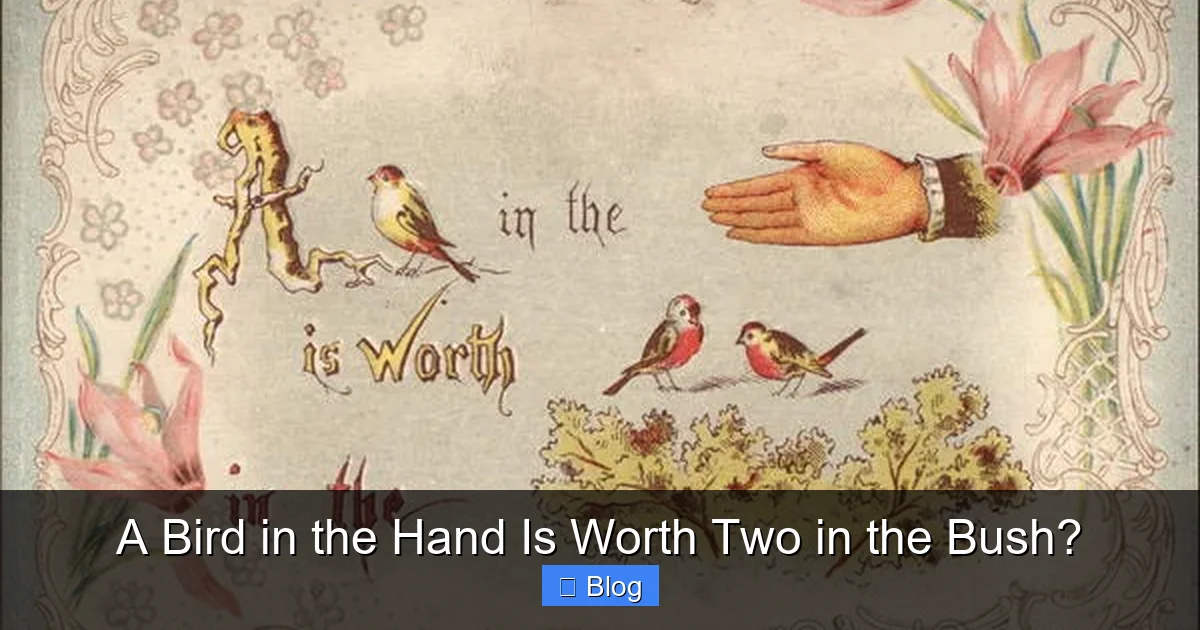
Visual guide about A Bird in the Hand Is Worth Two in the Bush?
Image source: cardcow.com
- Example: Sarah has a secure job as a mid-level manager. She’s offered a VP role at a brand-new, venture-funded tech company. The salary is 50% higher, plus stock options. But the company is in a volatile market and has no established track record. Sarah applies the “A Bird in the Hand Is Worth Two in the Bush” principle, considering her mortgage and family responsibilities. She decides to stay put for now, opting for stability.
Financial Decisions: Investing and Saving
In personal finance, this proverb is practically a golden rule. You have savings in a low-interest account, a guaranteed return, however small. This is your “bird in the hand.” You might be tempted by high-return, high-risk investments promising quick riches – the “two birds in the bush.” These could be speculative stocks, cryptocurrency, or get-rich-quick schemes. The proverb cautions against risking your secure savings for these highly uncertain prospects. It advocates for protecting your principal before chasing potentially larger, but speculative, gains.
- Tip: Always have an emergency fund (your “bird in the hand”) before you start dabbling in more aggressive investments. Protect your known assets first.
Relationships: Comfort vs. “The One”
Even in relationships, the proverb holds weight. You might be in a comfortable, stable relationship that isn’t perfect but offers companionship and security. This is your “bird in the hand.” Then, you meet someone new who seems incredibly exciting, full of potential, and promises a passionate, storybook romance – your “two birds in the bush.” “A Bird in the Hand Is Worth Two in the Bush” encourages careful reflection. Are you willing to give up the known comfort and security for an uncertain, potentially fleeting, passion? It doesn’t mean settling, but it prompts a realistic assessment of what you’re leaving behind for an unknown future.
When to Challenge the Proverb: Calculated Risks and Big Rewards
While “A Bird in the Hand Is Worth Two in the Bush” offers invaluable guidance, it’s not a rigid command to avoid all risks. Life often rewards those who bravely step out of their comfort zones. The key is to understand *when* to challenge this wisdom and how to do it smartly.
Evaluating the “Bush”: Understanding the Odds
The proverb assumes the “two birds in the bush” are purely speculative. However, what if you have good reason to believe those two birds are very catchable? What if the potential reward is so overwhelmingly large that it justifies a reasonable risk? This is where calculated risk-taking comes into play. You need to analyze the bush. Is there strong evidence? Are the odds in your favor? Is the downside manageable?
The Cost of Not Taking a Risk (Opportunity Cost)
Sometimes, holding onto your “one bird” can mean missing out on significant growth or life-changing opportunities. This is known as opportunity cost. If the “two birds in the bush” represent a chance to truly elevate your life, grow personally, or achieve a long-held dream, then *not* pursuing them might be the bigger regret. The proverb teaches caution, but not paralysis.
Managing the Downside: What if You Miss?
Before letting go of “a bird in the hand,” always consider the worst-case scenario. What happens if you fail to catch the two birds? Can you recover? Is the loss acceptable? If the downside is catastrophic (e.g., losing your entire life savings, jeopardizing your family’s well-being), then clinging to “A Bird in the Hand Is Worth Two in the Bush” is likely the wiser choice. But if the downside is manageable, and you have a safety net, then a calculated risk might be warranted.
The Proverb as a Starting Point, Not an End Point
Think of “A Bird in the Hand Is Worth Two in the Bush” as your default setting, your baseline. It’s the sensible, conservative approach. From there, you can consciously decide to deviate *if* the circumstances strongly suggest a greater probability of success, a significant upside, and a manageable downside. It’s about informed decision-making, not blind adherence.
Putting It Into Practice: Strategies for Smart Decision-Making
How can we integrate the wisdom of “A Bird in the Hand Is Worth Two in the Bush” into our daily lives without becoming overly conservative or missing out on opportunities? Here are some practical strategies.
Know Your “Birds”: Clarity on What You Have and What You Seek
Before making any decision, clearly define what your “bird in the hand” is. What exactly are you giving up? What are its benefits, its stability, its known value? Then, clearly define the “two birds in the bush.” What is the potential reward? How certain is it? What are the specific risks involved? Vague ideas lead to poor decisions. The clarity ensures you understand the true value of “a Bird in the Hand Is Worth Two in the Bush.”
The “Sleep On It” Rule
Impulsive decisions are often driven by emotion or fear of missing out. Giving yourself time to think—literally “sleeping on it”—allows your rational brain to catch up. This pause helps you evaluate the certainty of your bird in hand versus the speculation of the birds in the bush more objectively.
Develop Your Safety Net
Having a strong safety net (like an emergency fund, diverse skills, or a supportive network) makes it less risky to occasionally let go of your “bird in the hand.” If you know you can recover from a missed opportunity, the fear of loss is reduced, making calculated risks more palatable. This doesn’t negate the value of “A Bird in the Hand Is Worth Two in the Bush” but gives you more flexibility.
Scenario Planning: “What If…?”
Mentally play out both scenarios:
- Scenario A: You keep the bird in hand. What does that future look like?
- Scenario B: You chase the two in the bush and succeed. What does that future look like?
- Scenario C: You chase the two in the bush and fail. What does that future look like?
Comparing these outcomes can help you see the real trade-offs and risks more clearly.
The Modern World and Ancient Wisdom: Navigating Today’s Choices
In our hyper-connected, fast-paced world, the proverb “A Bird in the Hand Is Worth Two in the Bush” is more relevant than ever. We’re constantly bombarded with choices, opportunities, and the omnipresent fear of missing out (FOMO).
Combating FOMO in the Digital Age
Social media often highlights the “two birds in the bush” that others are supposedly catching – the dream jobs, the amazing vacations, the perfect lives. This can make your own “bird in the hand” feel inadequate. The proverb serves as a powerful antidote to FOMO, reminding us to appreciate our current blessings and to be wary of comparing our certainties with others’ curated highlight reels or perceived grand potentials.
Information Overload and Decision Fatigue
With endless information and options at our fingertips, decision-making can be exhausting. “A Bird in the Hand Is Worth Two in the Bush” offers a simple heuristic – a mental shortcut – to navigate this complexity. When overwhelmed, defaulting to the known, certain path can be a wise choice, preserving mental energy for truly critical decisions.
The Balance: Practicality Meets Ambition
The proverb doesn’t preach a life without ambition or growth. Instead, it urges a balanced approach. Be ambitious, yes, but be smart about it. Build a solid foundation (“a bird in the hand”) first, and then, if the opportunity is genuinely compelling and the risks are manageable, consider venturing out for those “two birds in the bush.” It’s about building a robust life, one smart, well-weighed decision at a time.
Conclusion: Finding Your Balance
“A Bird in the Hand Is Worth Two in the Bush” is more than just a quaint saying; it’s a profound piece of practical philosophy that has guided countless individuals through life’s dilemmas. It teaches us the immense value of certainty, the wisdom of loss aversion, and the importance of cautious risk assessment.
In a world full of shiny, uncertain promises, the proverb serves as a grounding force, encouraging us to appreciate and protect what we already have. It’s a reminder that stability is a treasure, and not every potential gain is worth the risk of losing what’s secure. However, it also subtly encourages us to understand *when* to deviate from this rule, to take calculated risks when the “bush” has been thoroughly scouted and the potential rewards are truly transformative with manageable downsides.
Ultimately, the power of “A Bird in the Hand Is Worth Two in the Bush” lies in its ability to foster a balanced, thoughtful approach to life. It helps us navigate the exciting but often confusing landscape of choices, ensuring we make decisions that lead to both security and, when appropriate, sensible growth. So, next time you face a choice between the known and the unknown, remember your bird in hand, and weigh its worth carefully against the allure of the two in the bush.
Frequently Asked Questions
What is the origin of the proverb “A Bird in the Hand Is Worth Two in the Bush”?
The proverb has roots that go back centuries, appearing in various forms in ancient Greek texts and medieval writings. Its current phrasing became popular in English during the 15th and 16th centuries, reflecting a timeless human understanding of risk and certainty.
How does “A Bird in the Hand Is Worth Two in the Bush” relate to personal relationships?
In relationships, it suggests valuing a stable, comfortable, and known partnership over the uncertain pursuit of a potentially “perfect” or more exciting new connection. It advises considering the tangible benefits of your current relationship before risking it for an unknown future.
Can this proverb be used to justify not taking any risks at all?
No, it’s not a blanket justification for avoiding all risks. It’s about *weighing* the certainty of what you have against the *uncertainty* of potential gains. It encourages calculated decisions and risk assessment, not paralysis.
What are some common pitfalls of ignoring “A Bird in the Hand Is Worth Two in the Bush”?
Ignoring this proverb often leads to regret from losing something valuable you already had, chasing unrealistic dreams, financial instability from speculative ventures, and missed opportunities to build on existing strengths.
How can I teach this proverb to children?
You can teach it to children through simple stories or real-life examples. For instance, explaining why keeping a small toy they have is better than trading it for a chance at a much bigger, unseen toy from a grab bag, highlighting the value of what’s already theirs.
Does the proverb apply to career changes?
Yes, absolutely. It advises carefully considering the security, benefits, and known aspects of your current job (“bird in the hand”) against the potential higher salary, promotions, or excitement of a new role (“two in the bush”) that might be less stable or has unknown challenges.