
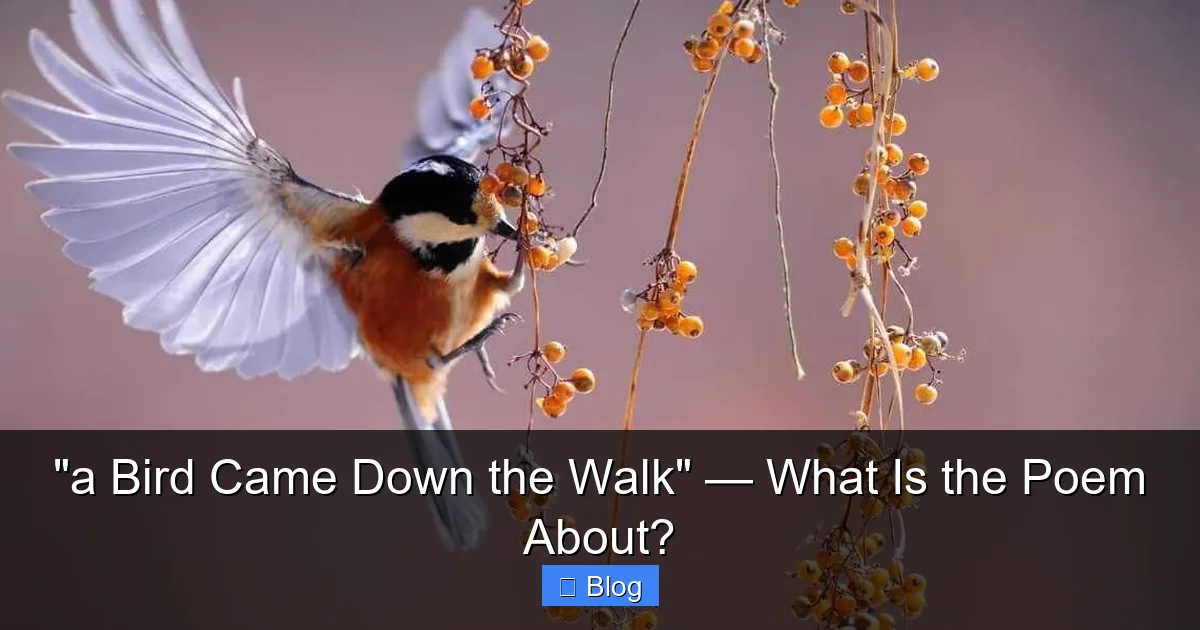
“A Bird Came Down the Walk” by Emily Dickinson is a seemingly simple observation of a bird, yet it delves into profound themes. The poem explores the untamed nature of the wild, the human desire to connect with it, and the inherent boundaries that exist. Through vivid imagery, Dickinson highlights nature’s grace, instinctual fear, and ultimate freedom, leaving the reader with a sense of awe and respectful distance.
“a Bird Came Down the Walk” — What Is the Poem About?
Have you ever paused during your day, truly stopped, and just watched a bird? Not just a quick glance, but really observed its movements, its confidence, its sudden shifts? There’s a certain magic in those moments, a glimpse into a world both familiar and utterly wild. Emily Dickinson, a master of capturing these fleeting yet profound observations, invites us into just such a moment with her beloved poem, “A Bird Came Down the Walk.”
At first glance, this poem might seem like a simple, almost child-like description of a bird’s daily routine. A bird comes down a walk, eats a worm, drinks some dew, and then flies away. But like so much of Dickinson’s work, what lies beneath the surface is a rich tapestry of meaning, symbolism, and a deep reflection on the relationship between humanity and the natural world. It’s a poem that sticks with you, prompting questions about instinct, freedom, and the inherent wildness that often eludes our grasp.
So, let’s take a closer look at this gem. What exactly is “A Bird Came Down the Walk” about? We’ll dive into the literal narrative, explore the layers of symbolism, examine Dickinson’s unmistakable style, and uncover the timeless themes that make this poem resonate with readers centuries later. Get ready to see a simple bird in a whole new light!
Key Takeaways
- A Literal Encounter: The poem first presents a straightforward scene of a speaker observing a bird eating a worm, drinking dew, and eventually flying away when offered a crumb.
- Symbolism of Nature’s Wildness: The bird symbolizes wild, untamed nature – beautiful, self-sufficient, and ultimately beyond human control or understanding. It represents freedom and instinct.
- Humanity’s Role and Limitations: The speaker’s attempt to offer a crumb highlights the human desire to interact with nature, but also the inherent boundaries and nature’s instinctual wariness of human intrusion.
- Dickinson’s Unique Style: The poem showcases Emily Dickinson’s signature style, including her unconventional use of dashes for rhythm and emphasis, precise vocabulary, and vivid, often surprising, imagery (e.g., comparing flight to ships and butterflies).
- Themes of Freedom and Fear: The bird’s sudden, graceful flight embodies ultimate freedom, while its initial caution and quick departure underscore the themes of instinct, self-preservation, and the fragile balance between human and natural worlds.
- The Power of Observation: The poem emphasizes the quiet power of observation and appreciation for nature’s beauty, even when direct interaction is not possible or desired by the wild creature.
Quick Answers to Common Questions
What is the main subject of “A Bird Came Down the Walk”?
The main subject is a speaker’s observation of a bird performing everyday actions and its subsequent flight when the speaker attempts interaction.
What does the bird symbolize in the poem?
The bird primarily symbolizes wild, untamed nature, freedom, and instinctual autonomy.
Why does the bird fly away when offered a crumb?
The bird flies away due to its instinctual wariness and fear of human interaction, asserting its independence and wildness.
What is significant about Dickinson’s use of dashes in the poem?
Dickinson’s dashes create specific rhythms, pauses, connect ideas, and emphasize words, guiding the reader’s interpretation and adding to the poem’s unique voice.
What is the poem’s tone?
The poem has a tone of quiet observation, wonder, and a respectful acceptance of nature’s boundaries.
📑 Table of Contents
The Literal Narrative: A Simple Encounter
The poem begins with a straightforward observation: “A Bird came down the Walk – He did not know I saw –.” The speaker, presumably a human, is a hidden observer. This immediately sets up a dynamic of stealth and natural behavior, as the bird acts without awareness of being watched.
A Bird’s Everyday Life
The bird’s actions are presented with a startling intimacy and detail. It “bit an Angleworm in halves And ate the fellow, raw.” This isn’t a sanitized, romanticized view of nature; it’s raw and real. Then, with a charming precision, it “drank a Dew From a convenient Grass – And then hopped sidewise to the Wall To let a Beetle pass –.” These lines paint a picture of a creature perfectly at home in its environment, navigating its world with a mix of efficiency and almost courteous awareness. It’s a testament to the poet’s keen eye and her ability to find wonder in the mundane.
The Moment of Human Interaction
The scene shifts when the speaker decides to break the observation and attempt a connection. “He glanced with rapid eyes – That hurried all abroad – They looked like frightened Beads, I thought – He stirred his Velvet Head –.” This is a crucial moment. The bird’s “rapid eyes” and “frightened Beads” reveal its inherent wariness, its instinctual fear. The speaker then offers a “Crumb” with “softest, little tables.” This gentle gesture, born perhaps of curiosity or a desire for connection, is met not with acceptance, but with an immediate, decisive reaction. The speaker’s attempt, however benign, is perceived as a threat.
The Untamed Escape
The bird’s response is swift and absolute: “And then he unrolled his feathers – And rowed him softer Home –.” The imagery here is breathtaking, transforming the simple act of flight into something grander and more poetic. It “leaped, without a sound – Into the Firmament –.” This is not just a bird flying away; it’s an ascent, an escape into the vastness of the sky. The poem concludes with two remarkable similes, comparing the bird’s flight to ships sailing without oars and butterflies leaping “off Banks of Noon.” These comparisons elevate the bird’s departure into a magnificent, almost magical event, highlighting its effortless freedom.
Beyond the Literal: Symbolism and Deeper Meanings
Visual guide about “a Bird Came Down the Walk” — What Is the Poem About?
Image source: ecdn.teacherspayteachers.com
While the literal story of “A Bird Came Down the Walk” is compelling on its own, Dickinson’s genius lies in her ability to infuse everyday scenes with profound symbolic weight. Every detail, every action, carries a deeper resonance.
The Bird as a Symbol of Wild Nature
The most prominent symbol in the poem is, of course, the bird itself. It stands for nature in its purest, most untamed form. It is self-sufficient, instinctively aware, and fundamentally independent of humanity. Its actions – eating a worm, drinking dew, letting a beetle pass – demonstrate a complete harmony with its natural environment. It doesn’t need humans; it simply exists. This contrasts sharply with the human world, which often seeks to control, categorize, or domesticate nature. The bird’s wildness is its essence, its freedom its birthright.
The Speaker’s Crumb: An Attempt at Connection or Control?
The speaker’s offering of a “Crumb” is a loaded gesture. On one hand, it can be seen as an innocent attempt at friendship, a desire to bridge the gap between human and animal. On the other, it represents humanity’s often misguided attempts to interact with, or even tame, nature. The bird, by rejecting the crumb, asserts its autonomy. It doesn’t need human charity or intervention; its instincts guide it perfectly. This rejection can be seen as a powerful statement about respecting boundaries and recognizing that some things are meant to remain wild and free.
The Firmament and Freedom
The “Firmament” into which the bird leaps is more than just the sky; it’s a symbol of ultimate freedom and boundless possibility. The comparisons to ships sailing “without a sail or Row” and “Butterflies, off Banks of Noon” reinforce this sense of effortless, unrestricted movement. These images suggest a kind of transcendence, a graceful escape from earthly constraints. The bird, through its flight, embodies a freedom that humans, bound by gravity and societal norms, can only observe with admiration and perhaps a touch of envy.
Dickinson’s Style: Precision, Punctuation, and Paradox
Emily Dickinson’s unique poetic style is on full display in “A Bird Came Down the Walk.” Her use of language, punctuation, and imagery is distinctive and contributes significantly to the poem’s impact.
The Power of the Dash
Perhaps the most striking feature of Dickinson’s style is her idiosyncratic use of the dash. In this poem, dashes appear frequently, serving multiple purposes:
- Creating Pauses: They dictate a specific rhythm for reading, often slowing the pace and allowing for reflection. “He did not know I saw –”
- Connecting Disparate Ideas: They can link phrases that might not traditionally be joined by standard punctuation, forcing the reader to make connections. “They looked like frightened Beads, I thought – He stirred his Velvet Head –”
- Emphasizing Words or Phrases: A dash can draw attention to the word immediately preceding or following it, lending it greater weight. “And ate the fellow, raw –”
- Indicating Abrupt Shifts: They often mark a sudden change in thought or action, mirroring the bird’s quick movements. “And then he unrolled his feathers –”
These dashes are not random; they are integral to the poem’s musicality and meaning, guiding the reader through the speaker’s observations and internal reflections.
Vivid and Specific Imagery
Dickinson’s ability to create vivid pictures with precise language is remarkable. Consider “Angleworm in halves,” “convenient Grass,” “frightened Beads,” “Velvet Head.” These specific details ground the poem in reality, making the scene palpable. The similes at the end – comparing flight to sailing ships and leaping butterflies – are not only beautiful but also unexpected, broadening the scope of the poem beyond a mere bird. They invite us to see the familiar in a new, imaginative way.
Conciseness and Economy of Words
Every word in a Dickinson poem feels carefully chosen, serving a specific purpose. There’s no wasted language. This conciseness adds to the poem’s power, making each image and idea stand out. The poem is short, yet it conveys a vast amount of meaning and emotion, a hallmark of her minimalist approach.
Themes Explored: Nature, Humanity, Fear, and Freedom
Beyond its literal and symbolic interpretations, “A Bird Came Down the Walk” delves into several universal themes that continue to resonate with readers.
The Autonomy and Mystery of Nature
One of the central themes is the independent and often mysterious nature of the wild. The bird operates according to its own laws, instincts, and rhythms, entirely separate from human concerns. Despite humanity’s attempts to understand or interact, nature retains an essential wildness that cannot be fully comprehended or controlled. The bird’s quick departure reinforces this idea, asserting its right to remain unfettered.
The Limitations of Human Connection
The poem subtly critiques humanity’s place in the natural world. The speaker’s desire to offer a crumb, while well-intentioned, is ultimately futile. It highlights the inherent barrier between humans and wild animals – a barrier built on instinct, fear, and different modes of existence. It suggests that perhaps the best way to appreciate nature is through respectful observation, rather than intrusive interaction. This can be a useful tip for anyone wanting to truly experience nature: sometimes, the most profound connection comes from simply watching, not interfering.
Fear as an Instinctive Safeguard
The bird’s “frightened Beads” and immediate flight underscore the theme of fear as a fundamental, life-preserving instinct in the animal kingdom. This isn’t a moral judgment on the bird, but rather an acknowledgment of its innate wisdom. Its fear is not irrational; it’s a mechanism for survival, a testament to the harsh realities of the wild. This theme offers a stark contrast to human rationality, suggesting that sometimes, instinct is a more reliable guide.
The Allure of Freedom
Perhaps the most powerful theme is that of freedom. The bird’s ability to fly away, “without a sound,” into the “Firmament” symbolizes an ultimate, unburdened liberty. For humans, confined by gravity, responsibilities, and often self-imposed limitations, this freedom holds immense appeal. The poem allows us to vicariously experience that boundless sensation, reminding us of the yearning for liberation that often resides within the human spirit. It’s a reminder that true freedom is often found in simplicity and adherence to one’s own natural course.
Why This Poem Resonates: Timeless Lessons
“A Bird Came Down the Walk” continues to captivate readers because its themes are timeless and universally applicable. It’s not just a poem about a bird; it’s a poem about perception, respect, and the boundaries between different worlds.
Appreciating the Unseen and Untamed
The poem teaches us to look closer, to find wonder in the ordinary, and to appreciate creatures for what they are, not what we wish them to be. It encourages us to respect the autonomy of nature and recognize that some beauty is best observed from a respectful distance. This is a practical lesson for our modern world, where the impulse to interact or document often overshadows the quiet act of pure observation. Next time you see a bird, try just watching it, without pulling out your phone or trying to get closer. You might find a deeper appreciation.
Reflecting on Our Place in the World
By subtly highlighting the limitations of human intervention in the natural world, the poem invites self-reflection. It asks us to consider our relationship with the environment and other living beings. Are we always considerate? Do we always understand? Often, nature has its own perfect order, and our role might simply be to witness and protect, rather than to alter or demand interaction. It’s a gentle reminder of humility.
The Beauty of Simplicity
In a world often filled with complexity, Dickinson’s poem reminds us of the profound beauty found in simple observations. The quiet grace of a bird, the instinctual dance of life and survival – these are accessible wonders that can enrich our daily lives if we only take the time to notice. It’s a call to slow down, be present, and find poetry in the everyday.
“A Bird Came Down the Walk” is far more than just a charming nature poem. It’s a masterclass in observation, symbolism, and the delicate balance between connection and respect. Through a single, seemingly trivial encounter, Emily Dickinson opens up a vast world of ideas about nature’s untamed spirit, humanity’s place within it, and the enduring allure of freedom. It’s a poem that encourages us to look, listen, and learn from the smallest, most ordinary moments around us.
Frequently Asked Questions
What is “A Bird Came Down the Walk” about in simple terms?
In simple terms, the poem is about a person quietly watching a bird eat and drink, and then try to offer it a piece of food. The bird, however, gets scared and flies away into the sky, showcasing its wild freedom.
What are the key themes in “A Bird Came Down the Walk”?
The key themes include the untamed nature of the wild, the inherent boundaries between humans and animals, the power of instinct and fear, and the profound allure of freedom. It also explores the act of respectful observation.
How does Emily Dickinson use imagery in this poem?
Dickinson uses vivid and precise imagery to bring the scene to life, such as “Angleworm in halves” and “frightened Beads” for the bird’s eyes. She also employs striking similes, comparing the bird’s flight to ships sailing and butterflies leaping, to evoke a sense of effortless grace and freedom.
What does the speaker learn from the bird’s actions?
The speaker learns about the wildness and independence of nature, and the importance of respecting its boundaries. The bird’s flight teaches a lesson about instinctual self-preservation and the ultimate freedom of the natural world, even from well-intentioned human interference.
Is “A Bird Came Down the Walk” a celebration of nature?
Yes, it is definitely a celebration of nature, but a nuanced one. It celebrates nature’s beauty, efficiency, and untamed spirit, recognizing that part of its wonder lies in its independence and wildness, which humans can only admire from a distance.
How does the poem relate to Emily Dickinson’s other works?
“A Bird Came Down the Walk” shares many hallmarks with Dickinson’s broader body of work: keen observation of nature, introspective themes, unconventional use of dashes and capitalization, and a focus on profound ideas expressed through deceptively simple language. It exemplifies her unique voice and her constant exploration of life’s fundamental questions through the lens of everyday experience.