Introduction
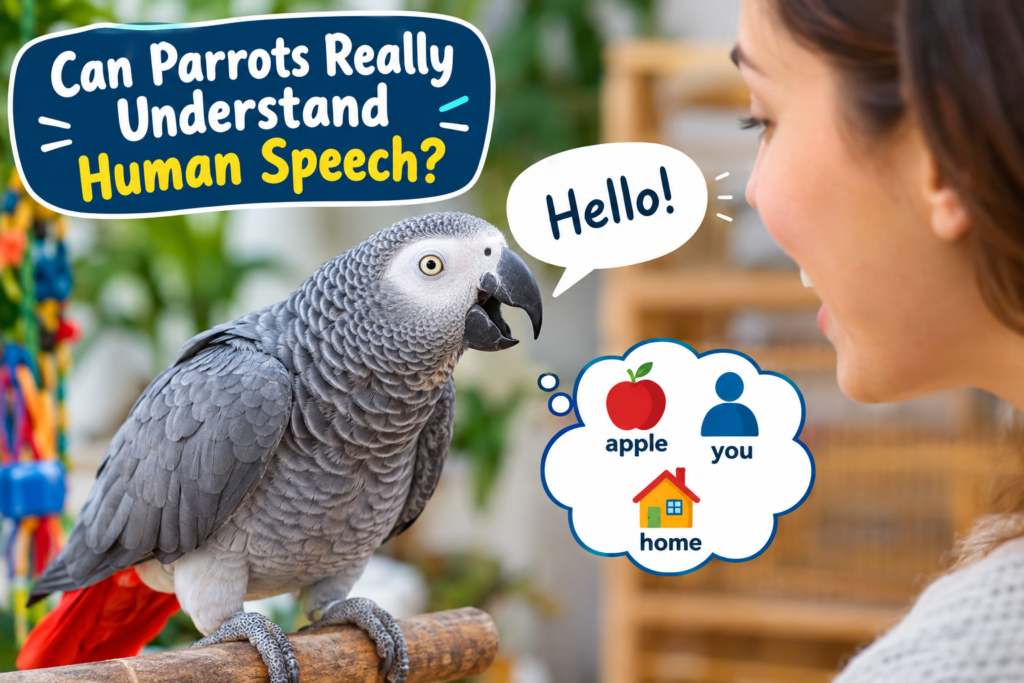
Can parrots really understand human speech? This is one of the most fascinating questions about birds. Many people are amazed when a parrot says “Hello,” calls its owner’s name, or responds to a familiar phrase. These abilities make parrots seem remarkably similar to humans. But does a talking parrot truly understand the meaning of its words, or is it simply copying sounds?
Parrots are intelligent, social birds known for their ability to imitate human voices and other sounds. Some can learn dozens or even hundreds of sounds and phrases. Scientific studies have also shown that certain parrots can associate words with objects, colors, shapes, quantities, and everyday activities.
However, not every parrot understands the words it repeats. Some imitate sounds without knowing what they mean, while others learn to use particular words in meaningful situations. Understanding this difference helps us appreciate how intelligent parrots really are.
In this vlog, we will explore how parrots learn human speech, which species are famous for talking, what scientific research tells us, and how owners can encourage healthy communication with their feathered companions.
Can Parrots Really Understand Human Speech?
The answer is yes, some parrots can understand aspects of human speech, but their understanding is limited and differs from bird to bird.
Parrots do not understand human language in exactly the same way people do. They may learn that a particular word refers to an object, signals an activity, or produces a familiar response. For example, a parrot might learn that the word “apple” is associated with a piece of fruit.
Some parrots can also use learned phrases in appropriate situations. Nevertheless, repeating a sentence does not automatically mean that a bird understands every word in it.
Research on African grey parrots has provided especially interesting evidence. In studies led by animal cognition researcher Irene Pepperberg, a grey parrot named Alex learned to identify objects, colors, shapes, and quantities using spoken labels. His performance suggested that certain parrots can do more than imitate sounds. Source: Applied Animal Behaviour Science.
This research does not mean that parrots possess human-like language abilities. Instead, it shows that their communication and learning abilities are more sophisticated than simple repetition alone would suggest.
How Do Parrots Learn to Speak Like Humans?
Parrots learn human speech through listening, imitation, practice, and social interaction. In the wild, they use vocalizations to communicate with members of their own species. When they live closely with humans, some parrots learn to imitate the sounds they hear around them.
Several factors influence this learning process.
1. Listening and Imitation
Parrots pay attention to familiar sounds in their environment. They may copy greetings, whistles, household noises, telephone sounds, and human words.
When a parrot hears a phrase repeatedly, it may gradually reproduce a similar sound. Practice helps it improve its pronunciation and remember the sound pattern.
2. Social Interaction
Parrots are highly social animals. They often learn vocalizations through interaction with others.
When a person speaks directly to a parrot, responds to its calls, or repeats a familiar phrase, the bird may become more interested in producing that sound. Research suggests that social context can influence both the variety and use of a parrot’s vocalizations.
3. Repetition and Rewards
Positive reinforcement can help parrots learn particular words. For example, when a parrot makes an attempt to say “Hello,” its owner might respond warmly or offer a favorite toy.
Over time, the bird may learn that a particular sound produces a predictable response.
Training should always be gentle. Shouting, frightening, or punishing a parrot for failing to speak can create stress and damage trust.
4. Connecting Words With Experiences
The most interesting learning occurs when a parrot connects a sound with something in its environment.
For example, a bird may learn to say “Good morning” when family members enter the room. Another might use a familiar request when it wants attention.
These examples can indicate contextual learning, although the exact level of understanding varies among individuals.
Which Parrots Are Best at Understanding Human Speech?
Different parrot species have different vocal abilities. Individual birds also vary considerably, so no species guarantees that a parrot will become a good talker.
1. African Grey Parrots
African grey parrots are particularly famous for their vocal learning and cognitive abilities.
Some can imitate human speech with impressive accuracy. Research on Alex demonstrated that a specially trained African grey could use labels for objects, colors, shapes, and quantities.
These findings make African greys especially interesting to scientists studying animal intelligence and communication.
2. Budgerigars
Budgerigars, commonly called budgies, are small, active parrots that can learn to imitate human words and phrases.
Some individuals develop surprisingly large vocabularies. Their voices are often quieter and higher-pitched than those of larger parrots.
3. Amazon Parrots
Many Amazon parrots are known for their clear vocalizations, social personalities, and ability to imitate human speech.
Some learn greetings, short phrases, songs, and household sounds. Their communication skills depend on the individual bird, its environment, and its experiences.
4. Indian Ringneck Parakeets
Indian ringneck parakeets can learn a variety of words and phrases. Some produce speech that sounds remarkably clear.
However, their ability to speak does not mean that every phrase is fully understood. Their learning should be evaluated through their behavior and the context in which they use particular words.
5. Cockatoos
Cockatoos are social birds that can imitate human sounds, whistles, and some spoken phrases.
They often communicate through a combination of vocalizations, body language, and behavior. Some become strongly attached to their caregivers and may use learned sounds to attract attention.
The important point is that a parrot does not need to speak to be intelligent. Quiet birds also have complex needs, social behaviors, and ways of communicating.
Do Parrots Know the Meaning of the Words They Say?
This is the central question behind the mystery of talking parrots.
Some parrots appear to associate specific sounds with particular objects or situations. Others repeat words because they have learned that those sounds attract attention or produce an interesting reaction.
Consider these examples:
- “Hello”: A parrot might use this greeting when someone enters the room, or it might repeat it at unrelated times.
- “Want food?”: A bird may learn to associate a familiar phrase with feeding time.
- “Apple”: A trained parrot might learn to identify an apple among several objects.
- “Come here”: A parrot may associate the phrase with a person approaching or interacting with it.
The first two examples may reflect routine learning, social association, or contextual use. Identifying an object correctly among alternatives provides stronger evidence that the bird has learned a meaningful association.
Scientists must use careful experiments to distinguish genuine understanding from memorization, accidental cues, and simple imitation.
Parrots may understand some words or concepts without understanding the full structure and complexity of human language.
The Amazing Story of Alex the African Grey Parrot
One of the best-known examples of parrot intelligence is Alex, an African grey parrot studied by Dr. Irene Pepperberg.
Over many years of research, Alex learned to identify various objects and distinguish features such as color, shape, and material. He also demonstrated abilities involving quantities and concepts such as “same” and “different.”
These achievements were important because the research used structured questions and tasks to investigate whether Alex’s responses reflected more than the repetition of sounds.
For example, if a bird is asked to identify the color of an object and gives the appropriate label across different objects and situations, that is stronger evidence of learning than simply repeating the word “red.”
Alex’s abilities did not prove that parrots think exactly like humans. Instead, his performance helped scientists recognize that a bird’s brain can support sophisticated forms of learning and communication.
His story remains an important example of why animal intelligence should not be judged only by how closely an animal resembles a human.
How Do Parrots Communicate Without Speaking?
Human words are only one part of a parrot’s communication system.
Parrots also communicate through body movements, facial expressions, calls, and changes in posture. Learning to recognize these signals can help people understand their birds more accurately.
Body Language
A parrot may move its head, change its posture, raise its feathers, or shift its weight depending on its surroundings and emotional state.
However, a single movement rarely reveals exactly what a bird is feeling. Its overall posture, environment, and other behaviors should be considered together.
Contact Calls
In nature, parrots use calls to maintain contact with members of their flock. Companion parrots may call when their caregivers leave the room or respond when they hear familiar voices.
These sounds can be part of their natural social behavior rather than meaningless noise.
Whistling and Other Sounds
Parrots may whistle, chirp, click, or imitate sounds from their environment. Some learn household noises just as readily as spoken words.
These behaviors demonstrate that communication is much broader than the ability to pronounce human language.
Can Parrots Understand Human Emotions?
Parrots can learn to recognize familiar people, routines, vocal patterns, and repeated interactions. Some respond differently when their caregivers speak gently, become excited, or change their usual behavior.
For example, a parrot may approach a familiar person when it hears a welcoming voice or become alert when it hears a sudden loud noise.
However, we should be careful not to assume that a parrot understands every human emotion in the same way another person would.
A bird that says “I love you” may have learned the phrase because it regularly receives attention when it says those words. The phrase can be part of a meaningful social interaction without necessarily carrying the same complex emotional meaning that it carries for a human.
The best approach is to appreciate the bond between humans and parrots while respecting the differences between their minds.
How Can You Teach Your Parrot to Understand Simple Words?
If you live with a parrot, you can encourage communication through patient, positive interactions.
Step 1: Begin With Simple Words
Choose short, useful words such as “hello,” “come,” or the name of a favorite food. Use them consistently in the same general context.
Step 2: Connect Words With Real Experiences
Say “food” when preparing the bird’s meal, or use a greeting when approaching its enclosure. This gives the bird opportunities to associate sounds with familiar events.
Step 3: Use Positive Reinforcement
Reward desired behavior with praise, attention, or a suitable treat. Keep training sessions short and enjoyable.
Step 4: Repeat Naturally
Speak clearly and repeat familiar words during everyday interactions. Avoid forcing the bird to repeat a sound when it is tired, frightened, or uninterested.
Step 5: Observe Its Responses
Notice whether your parrot responds appropriately to a familiar cue across different situations.
For example, does it approach when called, or does it select the named object when offered several choices? Such observations can help you understand what the bird has learned, although they do not establish the full extent of its comprehension.
Step 6: Respect Individual Differences
Some parrots learn many words, while others rarely imitate human speech. Neither outcome determines whether a bird is a good companion or deserves attention and care.
A healthy, trusting relationship is more important than a large vocabulary.
Do All Parrots Understand Human Speech?
No. Parrots differ in their vocal learning abilities, experiences, and responses to human interaction.
Some frequently imitate words but show little evidence of using them meaningfully. Others develop associations between particular sounds and objects or routines. Many parrots never learn to speak human words at all.
Age, individual temperament, social environment, previous learning, and opportunities for interaction may influence how a parrot develops its vocal skills.
It is also important to remember that a bird can understand familiar routines or recognize people without speaking a single human word.
Therefore, owners should not judge their parrots solely by how much they talk.
Interesting Facts About Talking Parrots
Here are some fascinating facts about parrots and human speech:
- Parrots learn sounds by listening to and imitating their surroundings.
- Some African grey parrots have demonstrated the ability to associate spoken labels with objects and visual features.
- Social interaction can influence the sounds parrots learn and when they use them.
- Parrots can imitate sounds other than words, including whistles and household noises.
- A parrot that repeats a phrase does not necessarily understand its full meaning.
- Different individuals within the same species can have very different vocal abilities.
- Parrots communicate naturally with other birds through calls, movements, and social behavior.
- A parrot can be intelligent and communicative even if it never learns to speak human language.
These facts show that parrots are much more than entertaining mimics. They are complex animals with their own social lives and communication systems.
Why Understanding Parrots Matters
Understanding how parrots learn and communicate can improve the way people care for them.
When owners pay attention to their birds’ behavior, they can better recognize signs of interest, discomfort, fear, or a desire for interaction. They can also provide more suitable enrichment, including toys, opportunities to explore, social contact, and activities that encourage natural behavior.
Parrots are intelligent, long-lived animals with demanding care requirements. Anyone considering keeping one should learn about its species-specific diet, housing, social needs, veterinary care, and environmental enrichment.
Most importantly, parrots should never be treated as toys that exist only to entertain people by talking.
Their value lies in their lives, personalities, and natural abilities, whether or not they ever learn a human word.
Frequently Asked Questions (FAQ)
1. Can parrots really understand human speech?
Some parrots can associate spoken words with objects, actions, or familiar situations. However, their understanding varies, and they do not necessarily understand language in the same way humans do.
2. Which parrot is famous for understanding words?
The African grey parrot is particularly well known for research into vocal learning and cognition. Alex, an African grey studied by Irene Pepperberg, demonstrated abilities involving object labels, colors, shapes, and quantities.
3. Do parrots know what they are saying?
Some learn to use particular words in meaningful contexts, while others primarily imitate sounds. A parrot’s ability to repeat a phrase alone does not reveal how much it understands.
4. Can parrots understand Bengali?
Parrots can potentially learn to imitate Bengali words and associate particular sounds with familiar objects, people, or routines. Their success depends on the individual bird and its learning experiences. Speaking Bengali does not automatically mean the bird understands the language as a human speaker would.
5. Can a parrot learn to speak without training?
Some parrots pick up words and sounds through ordinary exposure to people and their environment. Others may need repeated interaction, and many never develop human speech.
6. Are talking parrots smarter than non-talking parrots?
Not necessarily. The ability to imitate human speech is only one aspect of intelligence. A parrot that does not speak may still show complex learning, social behavior, problem-solving, and communication.
Conclusion
Can parrots really understand human speech? Scientific evidence suggests that some parrots can do more than copy human sounds. Under the right conditions, they can learn associations between words and objects, recognize certain features, and use familiar vocalizations in appropriate contexts.
The remarkable abilities of African grey parrots, especially Alex, have helped scientists explore the relationship between vocal imitation, learning, and animal intelligence. At the same time, researchers recognize that repeating words is not the same as mastering human language.