
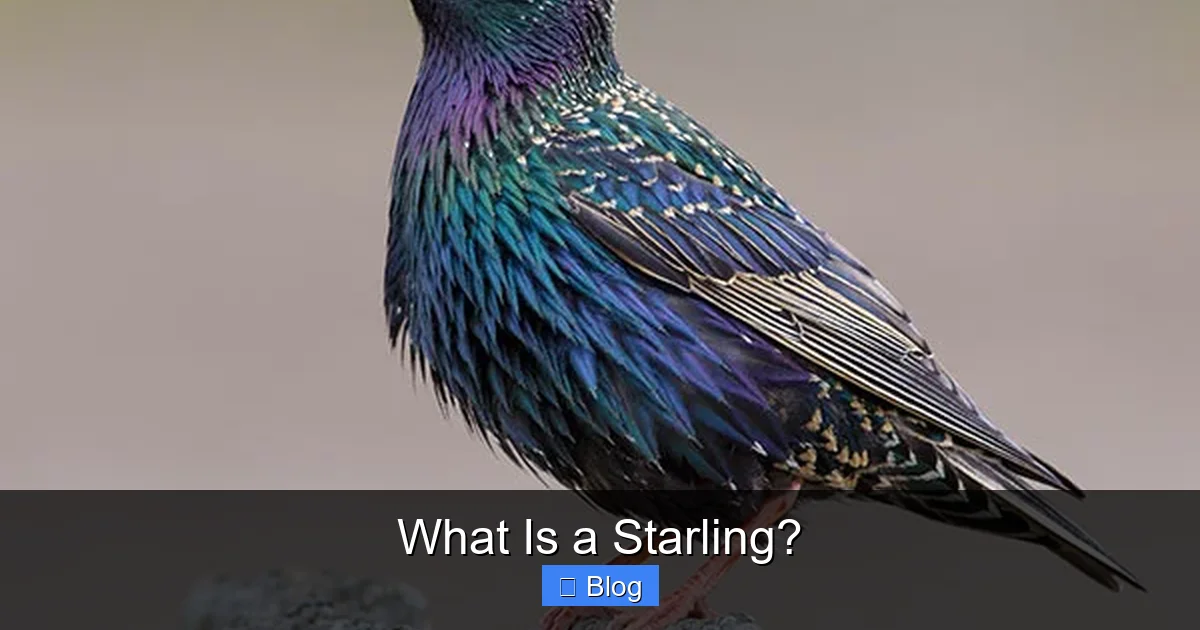
Starlings are incredibly common and fascinating birds, known for their iridescent plumage and spectacular aerial displays called murmurations. Though often considered an invasive species in North America due to their rapid spread and competition with native birds, these highly social birds also play a role in insect control and exhibit complex behaviors. Understanding what is a starling reveals a resilient, adaptable, and often misunderstood creature of the avian world.
Have you ever seen a swirling, shifting cloud of thousands of birds dancing in the sky at dusk? Or perhaps spotted a glossy, dark bird with a short tail confidently strutting across your lawn? Chances are, you’ve encountered a starling. These incredibly common birds are found in many parts of the world, and they certainly leave an impression, whether for their breathtaking aerial acrobatics or their sometimes controversial presence.
Starlings are a fascinating blend of beauty, resilience, and adaptability. While they are often a source of debate due to their invasive status in some regions, there’s no denying their unique characteristics and complex behaviors. But what exactly is a starling? Let’s dive deep into the world of these remarkable birds and uncover what makes them so special, and sometimes, so challenging.
Key Takeaways
- Starling Identification: Starlings are medium-sized passerine birds, famous for their glossy, iridescent dark plumage that changes with the seasons, often appearing speckled in winter.
- Mesmerizing Murmurations: European starlings are renowned for their massive, synchronized flocking displays, known as murmurations, which are a breathtaking sight in the sky.
- Introduced Species Impact: In North America and Australia, European starlings are an invasive species, having a significant impact on native bird populations through competition for nesting sites and food.
- Exceptional Vocalists: Starlings are highly vocal birds, capable of a wide range of calls, whistles, and even mimicking sounds from their environment, including other birds and human speech.
- Adaptable and Intelligent: These birds are incredibly adaptable, thriving in diverse environments from urban centers to farmlands, and display remarkable intelligence in problem-solving and social learning.
- Varied Diet: Starlings are omnivores, consuming a wide array of insects, invertebrates, fruits, seeds, and even human scraps, which contributes to their success in various habitats.
Quick Answers to Common Questions
What is a starling’s defining characteristic?
A starling’s defining characteristic is its glossy, iridescent dark plumage, often speckled in winter, along with its incredible ability to form massive, synchronized flocks known as murmurations.
Are starlings native to North America?
No, European starlings are not native to North America. They were intentionally introduced to New York City in 1890 and have since spread across the continent.
What do starlings eat?
Starlings are omnivores with a diverse diet. They primarily eat insects and other invertebrates, but also consume fruits, seeds, grains, and even human food scraps, making them highly adaptable.
What is a starling murmuration?
A murmuration is a spectacular phenomenon where thousands of starlings fly together in complex, coordinated aerial displays, often at dusk. It’s believed to be a defense mechanism against predators and a way to share information about roosting sites.
Why are starlings considered controversial?
Starlings are controversial due to their invasive status in many regions, particularly North America, where they compete aggressively with native cavity-nesting birds for resources and nesting sites, impacting local biodiversity.
📑 Table of Contents
- What Exactly Is a Starling? Unpacking the Basics
- Physical Characteristics: More Than Just a Little Black Bird
- The Amazing Behavior of Starlings: From Solos to Symphonies
- Habitat and Reproduction: Thriving in Diverse Worlds
- Starlings and Humans: A Complex and Often Controversial Relationship
- Conclusion
What Exactly Is a Starling? Unpacking the Basics
When we talk about “what is a starling,” we’re most often referring to the European starling, scientifically known as Sturnus vulgaris. This species is the most widespread and recognized member of the Sturnidae family, a group of medium-sized passerine birds. Passerine means “perching bird,” which includes more than half of all bird species.
Originally, the European starling called Europe, Asia, and North Africa home. They were a familiar sight in grasslands, woodlands, and human settlements across these continents. However, their story didn’t end there. Thanks to human intervention, starlings are now found on nearly every continent, having been intentionally introduced to places like North America, Australia, New Zealand, and South Africa.
A Global Traveler’s Tale
The journey of the starling to North America is a particularly interesting one, and it helps answer the question of what is a starling doing so far from home. In 1890, a man named Eugene Schieffelin, a Shakespeare enthusiast, decided to introduce every bird mentioned in Shakespeare’s plays to Central Park in New York City. Among the approximately 60 species he released, only two survived and thrived: the house sparrow and, you guessed it, the starling.
From just 100 birds released in 1890 and 1891, the European starling population exploded. Within a century, they had spread across the entire North American continent, from Alaska to Mexico, becoming one of the most numerous bird species. This rapid expansion is a testament to their incredible adaptability and resilience, but it also started a new chapter in their relationship with humans and native wildlife.
Physical Characteristics: More Than Just a Little Black Bird
At first glance, you might just think, “Oh, it’s just a black bird.” But if you take a closer look, you’ll discover that what is a starling physically is much more complex and beautiful than a simple black silhouette. Starlings are compact, medium-sized birds, typically measuring about 7.5 to 9 inches (19-23 cm) in length, with a wingspan of about 12 to 16 inches (31-40 cm).

Visual guide about What Is a Starling?
Image source: i.imgflip.com
Their most striking feature is their plumage. While they appear dark from a distance, up close, their feathers are a marvel of iridescent beauty. They shimmer with metallic greens, purples, and blues, especially when caught in the sunlight. This dazzling effect isn’t due to pigments but rather to the microscopic structure of their feathers, which reflects light in a prism-like way.
The Shifting Colors of a Starling
A starling’s appearance actually changes quite a bit throughout the year. In winter, fresh feathers emerge with pale, whitish tips, giving the bird a heavily speckled appearance. This is a common sight in colder months. As spring approaches and the breeding season begins, these pale tips wear away, revealing the smooth, glossy, intensely iridescent plumage underneath. The effect is almost like the bird has undergone a complete transformation.
Beyond their feathers, starlings have other distinct features. Their beak is slender and pointed, changing color with the seasons: bright yellow during the breeding season (spring and summer) and darkening to a duller blackish-brown in winter. Their legs are a reddish-pink, and their short tail is another identifying characteristic. This combination of size, shape, and especially their iridescent, speckled plumage helps distinguish them from other dark birds like common grackles or blackbirds, which often have longer tails and different iridescence patterns.
The Amazing Behavior of Starlings: From Solos to Symphonies
Starlings are incredibly social birds, and their behavior is often what captures people’s attention the most. They are rarely seen alone, preferring to forage, roost, and fly in groups, sometimes numbering in the tens of thousands. This social nature contributes to some of their most iconic and visually stunning behaviors.
Mesmerizing Murmurations
Perhaps the most famous starling behavior is the “murmuration.” This is the breathtaking phenomenon where thousands, sometimes even hundreds of thousands, of starlings fly together in a highly synchronized, ever-changing aerial ballet. The flock twists, turns, expands, and contracts as one giant, fluid entity, creating mesmerizing shapes against the sky, especially at dusk. It’s truly one of nature’s most spectacular shows.
Scientists believe murmurations serve several purposes. A primary one is predator avoidance. Flying in such a dense, unpredictable mass makes it incredibly difficult for a hawk or falcon to single out and catch an individual starling. The sheer number and constant movement confuse predators. Murmurations also help starlings conserve energy, share warmth, and exchange information about good feeding grounds or safe roosting sites.
Masters of Mimicry and Song
Starlings are also exceptional vocalists and highly intelligent. They have a surprisingly wide range of calls, whistles, clicks, and rattles. What is a starling’s most impressive vocal trick? Its ability to mimic other sounds! Starlings are expert mimics and can imitate the calls of dozens of other bird species, including hawks, curlews, and even house cats. Some have even been known to pick up snippets of human speech, car alarms, or telephone rings. This mimicry is thought to play a role in courtship and demonstrating vocal prowess to potential mates.
When not performing aerial displays or mimicking, starlings are busy foraging. They are ground feeders, often seen walking or running across lawns and fields, probing the soil with their beaks. Their strong neck muscles allow them to open their beaks while it’s in the ground, effectively widening a hole to search for prey. Their diet is incredibly varied, making them omnivores. They primarily eat insects and other invertebrates like earthworms and spiders, especially during the breeding season when protein is essential for their young. However, they also consume a significant amount of fruits, berries, seeds, and even human food scraps, which is a major factor in their success in urban environments.
Habitat and Reproduction: Thriving in Diverse Worlds
A key aspect of understanding what is a starling is appreciating its incredible adaptability to various habitats. While they originated in open woodlands and farmlands, starlings have readily embraced human-modified landscapes. They thrive in urban centers, suburban neighborhoods, agricultural areas, and even industrial zones. As long as there’s a reliable food source and suitable nesting sites, a starling can make itself at home.
Raising a Starling Family
Starlings are cavity nesters, meaning they prefer to build their nests in enclosed spaces rather than in open trees. This preference makes them fierce competitors with native cavity-nesting birds, especially in areas where natural tree holes are scarce. They’ll readily use abandoned woodpecker holes, natural tree cavities, crevices in buildings, and even human-made nest boxes intended for species like bluebirds, woodpeckers, and flickers. This competition for prime real estate is one of the main reasons starlings are considered a problematic invasive species in North America.
The nesting process is a busy affair. Both male and female starlings participate in building the nest, often using grass, twigs, leaves, and sometimes even feathers or string. Females typically lay a clutch of 4 to 6 pale blue or greenish-blue eggs. Incubation lasts about 12 days, with both parents taking turns. Once the chicks hatch, they are altricial, meaning they are born naked, blind, and completely dependent on their parents for food and warmth. Both parents work tirelessly to feed the hungry youngsters a diet rich in insects.
The young starlings, called fledglings, typically leave the nest about 21 days after hatching. They often remain with their parents for a short period, learning foraging skills, before joining larger flocks of other juvenile starlings. What is a starling’s reproductive success? Highly impressive. They often raise two, sometimes even three, broods in a single breeding season, contributing significantly to their booming populations. This high reproductive rate, coupled with their adaptability and opportunistic nesting habits, allows them to quickly colonize new areas and maintain large numbers.
Starlings and Humans: A Complex and Often Controversial Relationship
The relationship between starlings and humans is undeniably complex, swinging between admiration and frustration. On one hand, starlings are beautiful birds capable of awe-inspiring displays and fascinating vocalizations. On the other hand, their rapid proliferation and impact on ecosystems have made them a significant concern in many parts of the world.
Balancing Coexistence
In regions where they are an introduced species, particularly North America, starlings are often viewed as pests. Their aggressive competition for nesting sites can displace native cavity-nesting birds, leading to declines in species like Eastern Bluebirds, Red-headed Woodpeckers, and Purple Martins. This ecological impact is a major reason why many conservation organizations advocate for starling management.
Economically, starlings can also cause problems. Large flocks can consume agricultural crops, especially fruits like cherries, grapes, and apples, leading to significant financial losses for farmers. Their massive roosts in urban areas can create considerable noise, and their droppings can accumulate, damaging property, contaminating food and water sources, and potentially spreading diseases. This combination of ecological and economic impacts leads to extensive management efforts, including trapping, deterrents, and even population control measures.
However, it’s also important to consider the other side of the coin. Starlings do provide some benefits. They consume a vast number of insect pests, including cutworms, grasshoppers, and beetles, which can be helpful to agriculture in some contexts. And, of course, there’s the sheer wonder of their murmurations, which are a powerful reminder of nature’s beauty and complexity. For bird watchers and nature enthusiasts, witnessing a murmuration is an unforgettable experience, an artistic expression of collective behavior that few other species can match.
Understanding what is a starling means acknowledging both their positive and negative attributes. They are not inherently “good” or “bad” but rather a species acting within its biological imperatives: to survive, reproduce, and thrive. Their success in a wide range of environments, even those heavily altered by humans, speaks volumes about their intelligence, resilience, and adaptability. Our challenge is to find ways to coexist with them, managing their numbers where necessary to protect native species and agricultural interests, while still appreciating their unique place in the avian world.
Conclusion
So, what is a starling? It’s a small, iridescent bird with a big personality and an even bigger story. From its humble origins in Europe to its global dominance, the starling epitomizes adaptability and survival. We’ve explored its dazzling plumage, its iconic murmurations, its clever mimicry, and its surprising capacity to thrive in diverse environments.
While their impact as an invasive species in places like North America presents undeniable challenges for native bird populations, it also highlights the incredible power of a species to adapt and persist. Whether you view them as a pest, a marvel, or something in between, the starling undeniably adds a vibrant, if sometimes controversial, thread to the tapestry of our natural world. The next time you spot one, take a moment to observe its iridescent sheen, listen to its varied calls, and perhaps, if you’re lucky, witness the breathtaking spectacle of a murmuration. You’ll be looking at one of nature’s true survivors.
Frequently Asked Questions
How long do starlings live?
In the wild, starlings typically live for about 2-3 years, although some individuals can survive much longer. The oldest recorded starling lived for over 15 years, demonstrating their potential longevity in ideal conditions.
Can starlings mimic human speech?
Yes, starlings are renowned for their vocal mimicry. While they are more commonly known to imitate other bird calls, they are capable of learning and reproducing various sounds from their environment, including parts of human speech, whistles, and mechanical noises, though this is less common.
Are starlings protected by law?
In North America, European starlings are not protected by federal laws like the Migratory Bird Treaty Act because they are an introduced species. This means they can be managed or removed without special permits in most cases, unlike native bird species.
What is the difference between a starling and a blackbird?
While both are dark-colored birds, starlings are generally smaller and have a compact body with a shorter tail. Their plumage is distinctively iridescent and often speckled in winter, whereas blackbirds (like the Common Grackle or Red-winged Blackbird) have longer tails and often a more uniformly dark, less iridescent sheen, though grackles can have iridescence.
Do starlings migrate?
European starlings are partial migrants. Many populations in northern Europe and Asia migrate south for the winter to find warmer climates and more abundant food, while those in milder climates or introduced populations (like in North America) may be resident or undertake shorter, local movements.
What kind of nests do starlings build?
Starlings are cavity nesters, meaning they prefer to build their nests in existing holes or enclosed spaces rather than open nests in trees. This includes natural tree cavities, abandoned woodpecker holes, crevices in buildings, and even human-made nest boxes, which they often aggressively take over from native birds.