

Have you ever been serenaded by mysterious chirps after the sun sets, wondering what birds chirp at night? Many species extend their vocalizations into the twilight hours for various fascinating reasons, including territorial defense, attracting mates, or responding to environmental cues like light pollution. This article unravels the identities of these dedicated nocturnal singers and helps you understand why they add a unique soundtrack to our evenings.
What Birds Chirp at Night?
Imagine this: The sun has dipped below the horizon, painting the sky with hues of orange and purple. A hush falls over your neighborhood, but then, a distinct sound pierces the quiet. A beautiful, complex song, or perhaps a series of rapid chirps, floats through the night air. You pause, listen intently, and a question naturally pops into your mind: “What birds chirp at night?”
It’s a common mystery, isn’t it? Most birds are known for their vibrant dawn choruses, waking us up with their cheerful melodies. But some fascinating feathered friends defy this norm, choosing to serenade us under the moon and stars. These nocturnal vocalizers add a touch of magic to our evenings, but they also spark curiosity. Are they lost? Are they confused? Or is there a specific, compelling reason for their nighttime performances?
In this article, we’re going to embark on a journey into the world of nocturnal birdsong. We’ll explore the reasons behind this unique behavior, introduce you to some of the most common night chirpers, and even give you tips on how to identify their captivating calls. Get ready to discover the secret lives of the birds that chirp at night!
Key Takeaways
- Variety of Reasons: Birds chirp at night due to breeding, territorial defense, light pollution, noise masking, and even confusion.
- Common Night Singers: Species like American Robins, European Robins, Nightingales, Mockingbirds, and various Nightjars (e.g., Whip-poor-wills) are frequent nocturnal vocalizers.
- Environmental Influences: Artificial light (light pollution) and urban noise often prompt diurnal birds to shift their singing to quieter, darker hours.
- Identification Tips: Use careful listening for patterns and quality, leverage technology like bird identification apps (e.g., Merlin Bird ID), and learn about local species to identify nocturnal calls.
- Beyond Mating Calls: While attracting a mate is a primary reason, night chirping also serves to assert dominance, warn off rivals, and communicate general well-being.
- Appreciate the Phenomenon: Nocturnal bird songs offer a unique and magical connection to nature, reminding us of the hidden life bustling even after dark.
Quick Answers to Common Questions
Are all night-chirping birds nocturnal?
Not necessarily. While true nocturnal birds like Nightjars are active at night, many common day-active birds like Robins or Mockingbirds may also chirp at night, often influenced by factors like light pollution or breeding season intensity.
Why do Robins chirp so much at night?
American and European Robins frequently chirp at night, primarily due to artificial light pollution confusing their internal clocks, making them perceive it as dawn. They also sing to defend territory or attract mates during peak breeding season.
Can light pollution really make birds sing at night?
Yes, absolutely! Artificial light at night (ALAN) can disrupt birds’ natural circadian rhythms, causing them to extend their daytime activities, including singing, into the night hours, mistaking artificial light for natural twilight or dawn.
Is it possible to identify night bird calls without seeing the bird?
Yes, it is very possible! By carefully listening to the patterns, pitch, rhythm, and quality of the song, and using modern bird identification apps like Merlin Bird ID, you can often accurately identify what birds chirp at night.
Do baby birds chirp at night?
Baby birds typically don’t “chirp” in the complex song sense at night, but they might make soft peeping or begging calls if they are hungry, cold, or feel insecure in the nest. These are usually much softer and less structured than an adult bird’s song.
📑 Table of Contents
Why Do Birds Sing at Night? The Mystery Unraveled
The idea of birds chirping after dark might seem unusual, but there are several compelling reasons why some species become active vocalizers once the sun goes down. It’s not always about confusion; often, it’s a strategic move in the intricate game of survival and reproduction.
The Call of Love and Territory
For many birds, especially during the breeding season, singing is a serious business. It’s how males attract mates and how they declare their territory to rival males. Sometimes, the competition is so fierce during the day that birds might extend their vocalizations into the night. A male might chirp at night to ensure his song is heard above the daytime hustle and bustle, securing a partner or warding off competitors when other birds are less active. This extra effort can make all the difference in the breeding success of birds that chirp at night.
Light Pollution’s Lure
One of the most significant modern factors influencing nocturnal bird song is artificial light. Streetlights, house lights, and general urban glow can confuse birds. They might mistake the artificial illumination for dawn or twilight, prompting them to start their daily routines—including singing—at inappropriate times. This is particularly true for birds that typically sing at dawn or dusk, blurring the lines between day and night for them. When birds chirp at night in brightly lit areas, it’s often a direct response to our own human-made environment.
Escaping Daytime Noise
Imagine trying to have an important conversation in a very loud room. That’s what it can be like for birds in noisy urban or suburban environments during the day. Traffic, construction, human chatter, and even other bird species can create a cacophony that makes it hard for a bird’s song to travel far or be properly heard by a potential mate or rival. By shifting their vocalizations to the quieter night hours, birds can ensure their messages are clearer and carry further. This strategy allows their vital communications to stand out, highlighting why some birds chirp at night.
Moonlit Confusion and Other Factors
Sometimes, birds might simply be disoriented. A particularly bright full moon can occasionally trick a bird into thinking it’s lighter than it is, triggering a song. Other factors, like sudden disturbances in the night (a predator, a loud noise), can also cause a bird to react with a sudden burst of chirping. While less common than the other reasons, simple confusion or an alarm response can also explain why birds chirp at night.
Meet the Nocturnal Choristers: What Birds Chirp at Night?
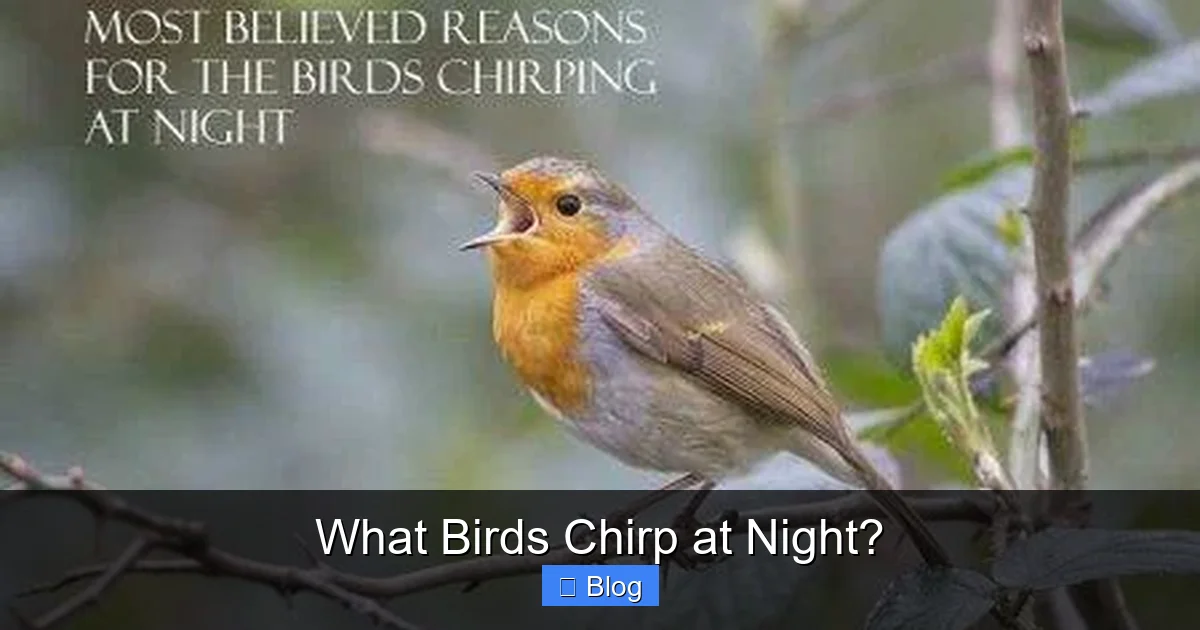
Visual guide about What Birds Chirp at Night?
Image source: birdswave.com
So, which specific birds are the most likely culprits behind those mysterious nighttime melodies? While many birds *can* occasionally chirp at night due to the reasons mentioned, some species are well-known for their regular nocturnal serenades.
The Iconic Robin (American and European)
When people ask, “What birds chirp at night?”, the Robin is often one of the first answers. Both the American Robin and its European cousin are famous for their dawn choruses, but they are equally notorious for singing long after sunset, sometimes well into the night. Their complex, flutey, and often rambling songs are unmistakable. They are especially prone to night singing in urban areas where light pollution is prevalent, confusing them into thinking it’s still daytime or early morning. You’ll often hear their cheerful “cheerily, cheer up, cheer up, cheerily, cheer up” well into the evening.
The Legendary Nightingale
The Nightingale, particularly the Common Nightingale (Luscinia megarhynchos), is perhaps the most famous nocturnal singer in the world, revered in poetry and folklore. Its song is incredibly rich, varied, and powerful, often described as one of the most beautiful bird songs. Unlike many other night singers, the Nightingale’s nocturnal serenades aren’t just a byproduct of light pollution; it’s a natural part of their behavior, especially during the spring breeding season. If you’re in its range (primarily Europe, parts of Asia, and North Africa), listening for a Nightingale’s complex trills, whistles, and deep throaty notes is a true treat. They are the quintessential birds that chirp at night.
The Mimicking Mockingbird
The Northern Mockingbird is a true vocal virtuoso. Not only does it have an incredibly diverse repertoire of its own songs, but it’s also famous for mimicking the calls and songs of other birds, and even other animals or human-made sounds. Mockingbirds are highly territorial and can sing both day and night, especially during the breeding season. Their nocturnal performances can be incredibly long and varied, making them one of the most intriguing birds that chirp at night. You might hear them repeat phrases three or more times before switching to a new imitation.
Enigmatic Nightjars (Whip-poor-wills, Nighthawks)
Nightjars are a fascinating group of nocturnal birds known for their cryptic plumage and distinctive, often repetitive calls that carry far through the night. They are true nocturnal birds, meaning they are active at night and rest during the day.
* ***Whip-poor-will:*** This bird is named for its loud, repetitive, and unmistakable call: “whip-poor-will!” repeated endlessly, sometimes for hours on end, at dusk and dawn, and often through the night, especially on moonlit nights. They are found in North and Central America.
* ***Common Nighthawk:*** While not typically a “chirper,” its distinctive “peent” call and aerial displays are common sounds of the summer night sky in many parts of North America.
* ***European Nightjar:*** Similar to its American cousins, the European Nightjar has a distinctive churring call that resonates through twilight woodlands.
These are true examples of birds that chirp at night, actively adapted to the dark hours.
Other Occasional Night Chirpers
While the above are the most common and consistent night singers, other species might occasionally join the nocturnal chorus:
* ***Song Thrushes:*** Similar to Robins, these European birds are known for their beautiful, repetitive, and varied songs, and can sometimes be heard singing after dark, particularly in spring.
* ***Owls:*** While owls don’t “chirp,” they are undoubtedly prominent nocturnal vocalizers. Their hoots, screeches, and calls are a quintessential sound of the night. If you hear a hoot, it’s likely an owl, not a chirping bird, but they are still part of the nocturnal soundscape.
* ***Cuckoos:*** The familiar “cuckoo-cuckoo” call of the Common Cuckoo can sometimes be heard well into the night, especially when males are trying to attract mates.
* ***Various Sparrows and Finches:*** In response to urban light pollution or disturbances, some sparrows or finches might occasionally emit short chirps or alarm calls at night.
Understanding which birds chirp at night often comes down to knowing your local species and their particular habits.
Environmental Factors Shaping Nighttime Vocalizations
The decision (or instinct) for a bird to chirp at night isn’t just about species-specific behavior; it’s also heavily influenced by the world around them. Our changing environment plays a big role in when and where we hear birds singing after dark.
Urban Glow: The Impact of Artificial Light
We’ve touched on this, but it’s worth emphasizing. Artificial light at night (ALAN), commonly known as light pollution, is a massive disruptor. Streetlights, floodlights, and even the glow from cities can extend perceived “daytime” for birds. This tricks their internal clocks (circadian rhythms), making them believe dawn is approaching earlier or that it’s simply a longer day. As a result, birds that chirp at night in urban or suburban settings are often responding to this human-made light, shifting their singing patterns to cope with an altered environment. It’s a key reason why you might hear an American Robin singing at 11 PM under a streetlight.
Quieter Hours: Responding to Noise Levels
Cities are loud places during the day. The constant rumble of traffic, construction, and human activity creates a high level of background noise. For birds, sound is crucial for communication – attracting a mate, defending territory, or warning of danger. If their calls are drowned out during the day, extending their singing into the relatively quieter hours of the night becomes a smart strategy. It’s a way to ensure their vital messages are heard. So, when birds chirp at night, they might simply be seeking a more acoustically advantageous time slot.
Seasonal and Climatic Influences
The breeding season is overwhelmingly the most common time to hear birds chirp at night. Spring and early summer are when most birds are focused on finding a mate, building nests, and raising young. This heightened urgency drives many species to vocalize more frequently and for longer durations, including into the night. Milder, clearer nights are also more conducive to singing. Birds are less likely to sing in harsh weather conditions, regardless of the time of day. So, a warm, still spring evening is your best bet for hearing a rich nocturnal chorus.
Decoding the Night’s Symphony: How to Identify Nocturnal Bird Sounds
It’s one thing to hear a bird chirp at night; it’s another to know *what* bird it is! Identifying nocturnal calls can be a fun challenge. Here are some tips to help you become a master of the night’s avian soundscape.
Listen for Patterns and Quality
Each bird species has a unique vocal signature. Pay attention to:
- Repetition: Does the bird repeat a phrase over and over, like a Whip-poor-will? Or does it sing a long, varied, and complex song like a Nightingale or Mockingbird?
- Pitch and Tone: Is the sound high-pitched and sharp, or low and hooting? Is it clear and flutey, or harsh and scratchy?
- Rhythm and Tempo: Is the song fast and energetic, or slow and deliberate?
- Duration: How long does each phrase last? How long does the bird sing continuously?
Listening carefully to these details will give you strong clues about what birds chirp at night in your area.
Leverage Technology: Bird ID Apps
We live in a fantastic age for birding! There are several excellent smartphone apps that can help you identify bird sounds, even at night.
- Merlin Bird ID by Cornell Lab of Ornithology: This free app has a “Sound ID” feature that listens to live bird sounds and suggests likely species. It’s incredibly accurate and user-friendly, making it a powerful tool for identifying birds that chirp at night.
- Chirp! Bird Song Identifier: Another popular app that helps identify bird calls.
- Audubon Bird Guide: Offers a comprehensive database of bird calls and songs.
Simply open the app, hold your phone in the direction of the sound, and let the technology do its magic. It’s an amazing way to learn what birds chirp at night without needing to see them.
Observe and Learn Local Species
Knowing which birds are common in your specific region is a huge advantage. If you live in North America, an American Robin is a much more likely night singer than a Nightingale. Similarly, in Europe, the European Robin and Nightingale are strong contenders. Learning about the typical habitats and behaviors of local species will narrow down your options significantly when trying to figure out what birds chirp at night. Local birding guides or websites for your state or country can be invaluable resources.
Enjoying the Nighttime Avian World Responsibly
Listening to birds chirp at night is a wonderful way to connect with nature and experience a different side of the avian world. However, it’s important to do so responsibly to avoid disturbing the birds.
Ethical Listening Practices
When trying to identify or simply enjoy nocturnal bird songs:
- Maintain Distance: If you’re trying to spot a bird, use binoculars from a distance. Never approach a nesting bird or try to flush it out for a better look, especially at night.
- Minimize Light: Avoid shining bright flashlights directly at birds. If you need light for walking, use a red-light filter, which is less disruptive to wildlife.
- Be Quiet: Speak softly or remain silent. Loud noises can easily disturb nocturnal birds.
- Respect Private Property: Only listen from public areas or with permission if you are near private land.
Contributing to Citizen Science
If you become adept at identifying what birds chirp at night, you can contribute to citizen science projects! Websites and apps like eBird (also by Cornell Lab of Ornithology) allow you to report your sightings and sound identifications. This data helps scientists track bird populations, understand migration patterns, and study the effects of environmental changes like light pollution. Your observations, even from your backyard, can make a real difference!
Conclusion
The world of birds that chirp at night is a captivating realm, filled with mystery, adaptation, and beautiful songs. Whether it’s a Robin confused by a streetlight, a Nightingale performing its ancient serenade, or a Whip-poor-will proclaiming its territory under a full moon, each nocturnal vocalization tells a story.
By understanding *why* birds sing at night and learning to identify their unique calls, you can deepen your appreciation for the natural world that continues to thrive even after we’ve tucked ourselves into bed. So, the next time you hear a mysterious melody drifting through the darkness, pause, listen, and remember the fascinating birds that chirp at night, sharing their secret symphony with the quiet hours. Happy listening!
Frequently Asked Questions
Which bird is famous for singing at night?
The Nightingale, particularly the Common Nightingale, is arguably the most famous bird renowned for its powerful and beautiful songs performed after dark. Its nocturnal serenades have been celebrated in literature and music for centuries.
Do birds chirp at night when it’s cold?
Generally, birds are less likely to chirp at night when it’s cold. Milder temperatures are more conducive to singing, especially during the breeding season. Severe cold makes birds conserve energy rather than expend it on vocal displays.
What is the difference between an owl’s hoot and a bird’s chirp at night?
An owl’s hoot is typically a deeper, resonant, often mournful or eerie sound, used for territorial marking or communication between mates. A “chirp” from a nocturnal singing bird, on the other hand, is usually a more varied, higher-pitched, and often melodious vocalization, primarily for attracting mates or defending territory.
Are night-chirping birds bothered by humans?
Birds that chirp at night can certainly be bothered by humans, especially if approached too closely, illuminated with bright lights, or subjected to loud noises. It’s important to observe them from a distance and minimize disturbance to their natural behaviors.
Can I attract night-chirping birds to my yard?
While you can’t guarantee attracting specific nocturnal singers, you can create a bird-friendly yard that might encourage them. This includes providing native plants for food and shelter, a clean water source, and most importantly, reducing light pollution in your yard to avoid confusing them or disrupting their natural behaviors.
Is night chirping a sign of distress for birds?
Not usually. While a sudden, short burst of chirps could be an alarm call if a bird is disturbed, regular, sustained night chirping is typically a natural behavior related to breeding, territorial defense, or a response to environmental cues like light and noise pollution. It’s part of their normal communication strategy.