
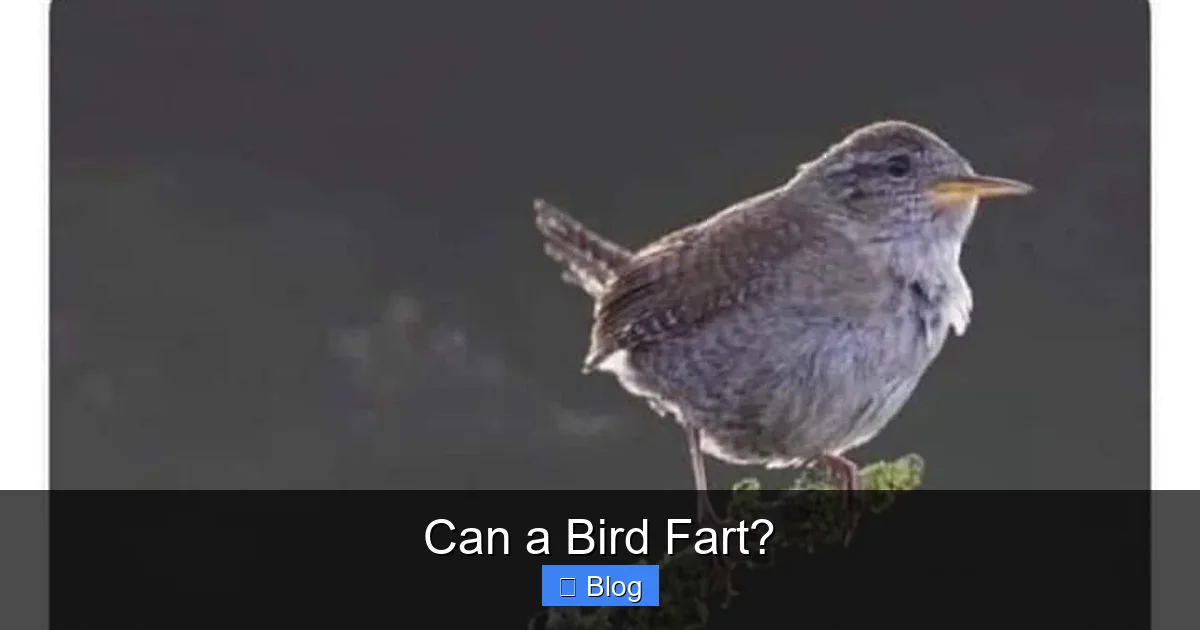
Ever pondered the peculiar question, “can a bird fart?” The simple answer is almost universally no. Unlike mammals, birds possess an incredibly efficient and rapid digestive system that leaves little time for fermenting bacteria to produce significant gas. Their unique anatomy and diet mean avian flatulence is virtually non-existent, making the phenomenon of a “bird fart” a rare, if not impossible, occurrence.
Ah, the humble fart. It’s a natural, albeit sometimes embarrassing, part of life for many creatures on Earth. From humans to dogs, cows, and even some insects, passing gas is a common byproduct of digestion. But have you ever paused to wonder about our feathered friends? It’s a question that often pops up in curious minds: can a bird fart?
It might sound like a silly query, something you’d jokingly ask at a dinner party, but it’s actually a fascinating dive into avian biology. When we think about birds, we imagine graceful flight, melodious songs, and perhaps the occasional messy dropping. But do they ever let out a little toot? The idea of a tiny robin letting one rip seems almost comical, yet the underlying science behind it is quite compelling.
In this comprehensive article, we’re going to unravel the mystery of avian flatulence. We’ll explore the unique intricacies of a bird’s digestive system, compare it to our own gas-producing processes, and ultimately answer the age-old question: do birds fart? Prepare to have your curiosity satisfied as we journey into the world of bird guts and discover why the concept of a “bird fart” is mostly a non-starter.
Key Takeaways
- Efficient Digestion: Birds have an incredibly fast and efficient digestive system, processing food so quickly that there’s little time for significant gas-producing bacterial fermentation.
- Low Fiber Diet: Most bird diets are naturally low in indigestible fiber, which is a primary source of gas production in mammals. This reduces the amount of material available for fermentation.
- Anatomical Differences: Birds lack the muscular sphincter control that mammals have, which allows them to store and expel gas as a distinct “fart” from their cloaca, a multi-purpose exit.
- Minimal Gas Production: Even if some gas is produced through digestion, it’s typically in very small amounts and is either absorbed into the bloodstream or expelled silently along with droppings without creating a noticeable “fart.”
- Cloacal Vent: The bird’s cloaca is a shared exit for digestive waste, urine, and reproductive functions. It is not designed for isolated, controlled gas expulsion.
- Myth vs. Reality: The concept of a bird fart is largely a myth, stemming from human comparisons to our own digestive processes. Birds simply don’t have the biological conditions or mechanisms for it.
- Health, Not Farts: Any unusual sounds or smells from a bird are far more likely to indicate digestive sounds, normal droppings, or potentially a health issue, rather than a “bird fart.”
Quick Answers to Common Questions
Can pet birds like parrots or canaries fart?
No, pet birds like parrots, canaries, or finches are unlikely to fart for the same reasons wild birds don’t: their efficient digestive systems prevent significant gas buildup.
Do birds have the bacteria in their gut to produce gas?
Birds do have gut bacteria, but their populations and digestive environment are different from mammals. The rapid transit of food and typically low-fiber diet means there’s little opportunity for gas-producing bacterial fermentation.
What if I hear a strange sound from my bird’s rear end?
It’s highly unlikely to be a fart. Strange sounds from a bird’s cloacal area are more likely digestive gurgles, sounds related to defecation, or potentially a sign of a health issue requiring veterinary attention.
Do baby birds fart?
No, baby birds also do not fart. Their digestive systems are also designed for rapid and efficient processing of food, especially as they grow quickly and need to maintain a light body weight for flight development.
Are there any exceptions, like birds that eat very gassy foods?
While theoretical, it’s extremely rare. Even if a bird consumes something that might produce a tiny bit of gas, their digestive speed and anatomical design mean it wouldn’t be expelled as a distinct, audible fart like a mammal’s.
📑 Table of Contents
The Avian Digestive System: A Speed Demon
To understand whether a bird can fart, we first need to take a peek inside their remarkable digestive system. Birds are built for flight, and efficiency is their middle name. Everything about their anatomy, from hollow bones to a super-fast metabolism, is geared towards being lightweight and energetic. Their digestive system is no exception; it’s a masterclass in rapid processing.
From Beak to Cloaca: A Whistle-Stop Tour
Let’s follow a morsel of food on its journey through a bird. When a bird pecks up a seed or a worm, it passes down the esophagus into the crop. This is essentially a temporary storage pouch, allowing the bird to eat quickly and digest later, especially useful for parents feeding chicks or for foraging in dangerous areas. Think of it as a pre-stomach pantry.
Next, the food moves into the proventriculus, which is the glandular stomach. Here, strong digestive acids and enzymes begin to break down the food chemically. Think of it as the chemical digestion stage, where the heavy-duty breakdown process truly begins. This is where food starts to liquefy.
After the proventriculus, the food enters the gizzard, or muscular stomach. This is where the magic of mechanical grinding happens. Birds, lacking teeth, rely on their powerful gizzard, often aided by swallowed grit (small stones), to physically pulverize tough foods like seeds, nuts, or insect exoskeletons. This mechanical breakdown is absolutely crucial for quick and thorough digestion, preparing the food for nutrient absorption.
Intestines and Absorption: A Short and Sweet Path
Once thoroughly ground, the partially digested food moves into the small and large intestines. This is where most of the nutrient absorption occurs. Compared to mammals, a bird’s intestines are relatively short, especially the large intestine. This shortness is another adaptation for flight – less weight to carry around, and a faster transit time means less opportunity for fermentation to occur.
Finally, any remaining waste products, along with uric acid (the bird equivalent of urine, which is pasty white) and reproductive cells, collect in a single chamber called the cloaca. This versatile opening serves as the exit point for everything. And here’s where the “can a bird fart” question really comes into play, as we consider gas expulsion. This single exit point is key to understanding why a traditional bird fart is unlikely.
Why So Fast? Metabolism and Weight
The entire digestive process in a bird, from ingestion to excretion, can be incredibly rapid. For small birds like hummingbirds, it might be mere minutes. For larger birds, it could be a few hours. This speed is vital. Carrying a lot of undigested food or waste adds weight, which makes flying harder and requires more energy. So, birds are designed to extract nutrients quickly and eliminate waste efficiently, keeping them light on their feet (and wings!). This rapid transit time is a major factor in our quest to understand if birds fart and is a primary reason why avian flatulence is so rare.
Gas Production in Digestion: Why We Fart
To really grasp why a bird might not fart, let’s briefly look at why humans and many other mammals do. The vast majority of gas (flatus) produced in the mammalian digestive system comes from one main source: the fermentation of undigested food by bacteria in the large intestine. When we eat foods rich in complex carbohydrates, fiber, or certain sugars that our own enzymes can’t break down, these compounds travel to the large intestine. There, a thriving community of gut bacteria gets to work, breaking them down and, in the process, producing various gases like methane, hydrogen, and carbon dioxide.
Visual guide about Can a Bird Fart?
Image source: webstockreview.net
The Role of Diet and Gut Bacteria
Think about foods notorious for causing gas: beans, broccoli, lentils. These are all high in complex carbohydrates and fiber. When these substances reach our large intestine, our gut flora feasts on them, generating gas. This gas then builds up pressure, and when released, voilà – a fart!
Now, let’s contrast this with a typical bird’s diet. Most birds consume foods that are highly digestible and relatively low in fermentable carbohydrates and indigestible fiber. Seeds, fruits, nectar, insects, and small vertebrates are processed very efficiently. While birds do have gut bacteria, their populations and their digestive environment are very different from ours. The speed of digestion also means food spends much less time in the intestines, further limiting the opportunity for extensive bacterial fermentation.
So, the two main ingredients for a good, gassy fart – plenty of undigested, fermentable food and a robust, slow-acting bacterial community – are largely absent or significantly reduced in the typical avian digestive system. This significantly lowers the likelihood of a bird fart.
Do Birds Have the “Mechanism” to Fart?
Even if some gas were to be produced in a bird’s digestive tract, the next question is: do they have the anatomical ability to expel it as a distinct “fart”? This brings us back to the cloaca.
The Cloaca: A Jack-of-All-Trades Opening
As we discussed, the cloaca is a single, multi-purpose opening for digestive waste, urine, and reproduction. In mammals, we have separate systems. We have an anus with a muscular sphincter that allows for controlled release of gas and feces. This sphincter muscle can contract to hold gas in or relax to let it out with a specific sound and force.
Birds, however, don’t have this specialized anal sphincter. Their cloaca is essentially a vent that opens to expel waste. It’s generally not designed for the isolated, controlled release of gas. When a bird defecates, the cloaca simply opens to allow the waste to pass. If any gas were present, it would likely escape silently and simultaneously with the droppings, without the distinct sound or force we associate with a “bird fart.” There’s no mechanism for a bird to “hold it in” or intentionally pass gas in the same way a mammal would.
No Pressure Buildup, No Fart
The entire avian digestive system, from the gizzard’s grinding action to the short intestines and rapid transit, is optimized to prevent significant gas buildup. There’s simply not enough time or fermentable material for the internal pressure needed to produce an audible or noticeable bird fart. Imagine a high-speed train – it’s designed to get passengers from A to B as quickly and smoothly as possible, not to linger at stations or produce a lot of exhaust along the way. A bird’s gut is much the same.
What Happens to Gas in Birds?
So, if birds don’t really fart, what happens to any tiny amount of gas that might be generated during their digestion? It’s a valid question. Even with an efficient system, some minimal gas production is theoretically possible. Here are a few ways birds handle it:
Absorption into the Bloodstream
Any small quantities of gas that do form in the bird’s intestines are likely absorbed into the bloodstream through the intestinal walls. Once in the bloodstream, these gases (like carbon dioxide) would be transported to the lungs and simply exhaled through breathing. This is a common physiological process, not unique to birds, where the body reabsorbs gases from the gut.
Expelled with Droppings (Silently)
As mentioned, if there’s any residual gas when a bird evacuates its cloaca, it would simply escape passively along with the feces and uric acid. Given the rapid transit and low gas production, this would be a silent, unnoticeable event, hardly qualifying as a traditional “bird fart.” There’s no build-up of pressure to create an expulsion noise.
Minimal Production Means No Problem
The most important point here is that the overall production of gas in a bird’s digestive system is extremely low. It’s not a question of them “holding it in” or having a special way to process large amounts of gas; it’s that large amounts of gas are simply not produced in the first place. Their diet, incredibly fast metabolism, and unique digestive anatomy work in harmony to minimize gas-generating conditions. So, the concept of a bird fart becomes practically impossible due to these fundamental biological realities.
Unusual Sounds and Smells: What You Might Be Hearing/Smelling Instead
Sometimes, bird owners or observers might report hearing or smelling something unusual from their feathered companions and wonder if it’s a bird fart. Let’s look at what these might actually be.
Normal Digestive Noises
Just like humans, birds can have internal digestive noises. The movement of food through the crop, proventriculus, and gizzard, and the contractions of the intestines, can sometimes produce gurgling or rumbling sounds. These are simply sounds of a healthy, active digestive system at work, not gas being expelled. They’re usually very subtle and wouldn’t typically be mistaken for flatulence.
Smelly Droppings
Bird droppings, especially from certain diets or if a bird is unwell, can certainly have an odor. The smell comes from the waste products themselves, including ammonia from the uric acid and any bacteria present in the feces. This isn’t gas being expelled from the cloaca as a fart; it’s the natural smell associated with their waste. If the smell is particularly foul or unusual, it could be a sign of a health issue, such as an infection or dietary problem, and not indicative of avian flatulence.
Air Sacs and Respiratory Sounds
Birds have a unique respiratory system that includes air sacs throughout their body. Sometimes, sounds can come from these air sacs, especially if a bird is startled, stressed, or experiencing a respiratory issue. These sounds might be mistaken for digestive noises, but they are related to breathing and not gas from the digestive tract. A “whoosh” or “hiss” could be a bird rapidly expelling air, which is very different from a digestive fart.
Vocalizations and Other Body Noises
Birds make a huge variety of sounds – chirps, squawks, whistles, clicks. Sometimes, in specific postures or during certain activities, these sounds might be misinterpreted. For example, some birds might make a soft clicking noise when stressed or preening. These are vocalizations or body movements, not a bird fart. Always observe the full context if you hear an unusual sound.
Conclusion: The Short Answer is (Mostly) No
So, after our deep dive into the fascinating world of avian digestion and physiology, we can confidently say that the answer to “can a bird fart?” is overwhelmingly no. While the idea of a tiny bird letting out a comical toot might spark a smile, the biological reality is that birds are simply not equipped for it. Their super-efficient, rapid digestive systems, low-fiber diets, and unique anatomy preclude the conditions necessary for producing and expelling a traditional “bird fart.”
The absence of significant fermentable material, combined with an incredibly fast digestive transit time, means there’s little opportunity for gas-producing bacteria to thrive. Furthermore, the bird’s cloaca, a multi-purpose vent, lacks the specialized sphincter control required for the distinct, controlled release of gas that we associate with flatulence in mammals. Any minuscule gas produced is either absorbed into the bloodstream or silently expelled along with droppings, making avian flatulence a non-event.
So, the next time you marvel at a bird soaring through the sky or singing from a branch, rest assured they’re not secretly holding back a gaseous surprise. Their systems are streamlined for flight and efficiency, leaving no room for such earthly digestive eccentricities. The mystery of the “bird fart” is solved – it’s largely a myth, and our feathered friends remain wonderfully un-farty!
🎥 Related Video: Do Birds Fart? 🐦😂🙈 | Fact Friday #28
📺 Wondered ?
We humans fart, but how about birds? #wondered #factfriday Have a great day 😀 Follow Wondered: Twitter: …
Frequently Asked Questions
Do birds produce methane or other gasses in their digestive system?
Birds produce very minimal amounts of digestive gases like methane or carbon dioxide. Their fast metabolism and diet, which is typically low in fermentable carbohydrates and fiber, significantly reduce the opportunity for extensive bacterial fermentation that leads to gas production.
Why is a bird’s digestive system so different from a human’s?
A bird’s digestive system is highly adapted for flight and efficiency. It’s shorter, processes food much faster, and uses a gizzard for mechanical grinding instead of teeth. This minimizes weight and ensures rapid nutrient extraction, unlike the slower, more complex mammalian system.
Could a bird ever get too much gas and feel bloated?
Significant gas buildup leading to bloating is extremely uncommon in healthy birds due to their digestive design. If a bird appears bloated, it’s almost always a symptom of a serious underlying health condition, such as an infection, organ enlargement, or fluid retention, rather than digestive gas.
What happens if a bird eats something that humans find gassy, like beans?
Even if a bird ingests something like beans, which are gassy for humans, their rapid digestive transit time means the food doesn’t stay in the gut long enough for significant bacterial fermentation to occur. The small amount of gas produced would likely be absorbed or pass unnoticed.
Is there any scientific evidence of a bird farting?
No, there is virtually no scientific evidence or documented cases of birds producing a distinct, audible “fart” akin to mammalian flatulence. Research into avian physiology consistently points to their digestive systems preventing this phenomenon.
If I smell something foul from my bird, is it a fart?
No, if you smell something foul from your bird, it is almost certainly not a fart. It is much more likely to be the smell of their droppings, which can vary with diet, or a sign of an underlying health issue or infection that requires veterinary attention.