
Far from being colorblind, birds possess extraordinary vision, often seeing a spectrum far richer than humans. Unlike us, many birds are tetrachromatic, meaning they have four types of cone cells in their eyes, enabling them to perceive not only the colors we see but also ultraviolet (UV) light. This advanced color perception is crucial for their survival, playing vital roles in communication, foraging, and mate selection, proving that birds are indeed not colorblind.
Step into any garden, forest, or coastline, and you’ll be greeted by a dazzling display of avian beauty. From the iridescent shimmer of a hummingbird’s gorget to the vibrant scarlet of a cardinal, birds are nature’s living rainbows. Yet, despite this riot of color, a common misconception persists: are birds colorblind? For many years, it was a widely held belief, perhaps rooted in our own human-centric view of the world. We often assume that what we see is the full picture, but when it comes to vision, the truth about birds is far more extraordinary and complex than we might imagine.
The idea that birds might be colorblind often stems from comparing their eyes to those of mammals, many of whom, like dogs, have limited color perception. However, birds belong to a distinct lineage with unique evolutionary adaptations, particularly when it comes to their senses. The reality is that not only are birds not colorblind, but many species boast a visual prowess that puts our own to shame, allowing them to perceive a world teeming with colors and patterns that are entirely invisible to the human eye. Prepare to have your understanding of the avian world fundamentally transformed!
This article will delve deep into the fascinating science behind bird vision, dispelling the myth that birds are colorblind and exploring the incredible capabilities of their eyes. We’ll uncover how they see, why their vision is so different from ours, and how this enhanced color perception plays a crucial role in every aspect of their lives, from finding food to attracting a mate. So, let’s embark on a journey to truly understand the vibrant, unseen world of our feathered friends.
Key Takeaways
- Birds are NOT colorblind: This is a pervasive myth. Birds generally possess superior and more complex color vision compared to humans, often perceiving a wider spectrum.
- Tetrachromatic Vision: Many bird species have four types of cone cells in their eyes, allowing them to see red, green, blue, and crucially, ultraviolet (UV) light, unlike our trichromatic (red, green, blue) vision.
- UV Perception is Crucial: The ability to see UV light is vital for birds, aiding in everything from finding food and identifying ripe fruits to recognizing mates and rivals through UV-reflective plumage patterns.
- Color for Communication: Birds extensively use color in their social interactions. Vibrant hues and UV patterns signal health, fitness, territorial claims, and sexual attractiveness, helping them attract mates.
- Enhanced Foraging: Their sophisticated color vision helps birds locate specific food sources, such as nectar guides on flowers or camouflaged insects, which might be indistinguishable to human eyes.
- Survival Advantage: Superior color perception provides a significant evolutionary advantage, improving their chances of successful reproduction, predator avoidance, and overall survival in diverse environments.
- A Different Visual World: The avian visual world is profoundly richer and more complex than the human experience, highlighting the incredible diversity of sensory perception in the animal kingdom.
Quick Answers to Common Questions
Are all bird species tetrachromatic?
No, while many are, there’s variation. Some nocturnal birds, like owls, might have reduced color vision and rely more on rod cells for excellent low-light sensitivity, similar to how humans struggle to distinguish colors in the dark.
Can humans ever see UV light?
No, typically the human lens filters out UV light, preventing it from reaching the retina. While some rare conditions or after cataract surgery, some individuals might perceive a limited amount of UV light, it’s not a normal human ability.
Does a bird’s age affect its color vision?
Like humans, a bird’s vision can decline with extreme old age, but generally, their color perception remains robust throughout their prime. Some species might even develop more vibrant UV reflective plumage as they mature.
Do birds use color to avoid dangers?
Yes, color plays a significant role in both predator avoidance and detection. Birds use camouflage, often incorporating UV-reflective patterns, to blend into their surroundings, and can also perceive the warning colors of dangerous species.
Is bird vision static, or can it adapt?
Bird vision is highly adapted to their specific ecological niche. For instance, birds hunting at dawn or dusk will have different visual adaptations (e.g., more rods) than those foraging in bright sunlight, which might have more specialized cone types for color discrimination.
📑 Table of Contents
- The Avian Eye: A Symphony of Sensation
- Beyond Our Spectrum: The Power of Tetrachromacy and UV Vision
- Color as a Language: How Birds Communicate Through Pigment
- A Feast for the Eyes: Color in Foraging and Survival
- Peeking into the Avian Brain: Scientific Discoveries
- Enhancing Our Understanding: Implications for Bird Enthusiasts and Conservation
The Avian Eye: A Symphony of Sensation
To understand why the answer to “are birds colorblind?” is a resounding “no,” we first need to appreciate the intricate design of the avian eye. Bird eyes are marvels of evolution, highly adapted to their aerial lifestyles and diverse ecological niches. While they share some basic components with human eyes, it’s the subtle yet profound differences that unlock their superior color perception.
Rods and Cones: The Building Blocks of Vision
Like humans, bird retinas contain two main types of photoreceptor cells: rods and cones. Rods are responsible for vision in low light conditions, detecting movement and shades of grey. Cones, on the other hand, are responsible for color vision and require brighter light. The distribution and types of these cells are where the avian advantage truly lies.
Humans are primarily “trichromats,” meaning we have three types of cone cells, each sensitive to a different range of light wavelengths—roughly corresponding to red, green, and blue. Our brains then combine these signals to create the vast array of colors we perceive. This system allows us to see millions of colors, which we often consider quite good. But for many birds, “good” isn’t enough; they need “extraordinary.”
The Avian Advantage: More Cones, More Colors
The critical difference that debunks the “are birds colorblind?” myth is that most birds are “tetrachromats.” This means they possess not three, but four types of cone cells. While one of these cones is sensitive to red, another to green, and a third to blue, the fourth cone is specifically tuned to the ultraviolet (UV) spectrum of light. This UV cone is the secret ingredient that allows birds to see a whole dimension of color that is utterly invisible to us.
Beyond having an extra cone type, bird cone cells often contain oil droplets pigmented with carotenoids. These tiny, colored oil droplets act like miniature filters, refining the light that reaches each cone type. This filtering system enhances color discrimination, making colors appear more saturated and distinct, and helping birds detect subtle differences in shades. Imagine looking at a rainbow and being able to distinguish thousands more hues than you currently can – that’s closer to the avian experience. So, far from being colorblind, birds are seeing a world of unimaginable vibrancy!
Beyond Our Spectrum: The Power of Tetrachromacy and UV Vision
The concept of tetrachromacy is central to understanding why the notion that birds are colorblind is so far from the truth. It’s not just that birds see more colors; they perceive an entirely different range of light, particularly ultraviolet light, which fundamentally alters their visual landscape.
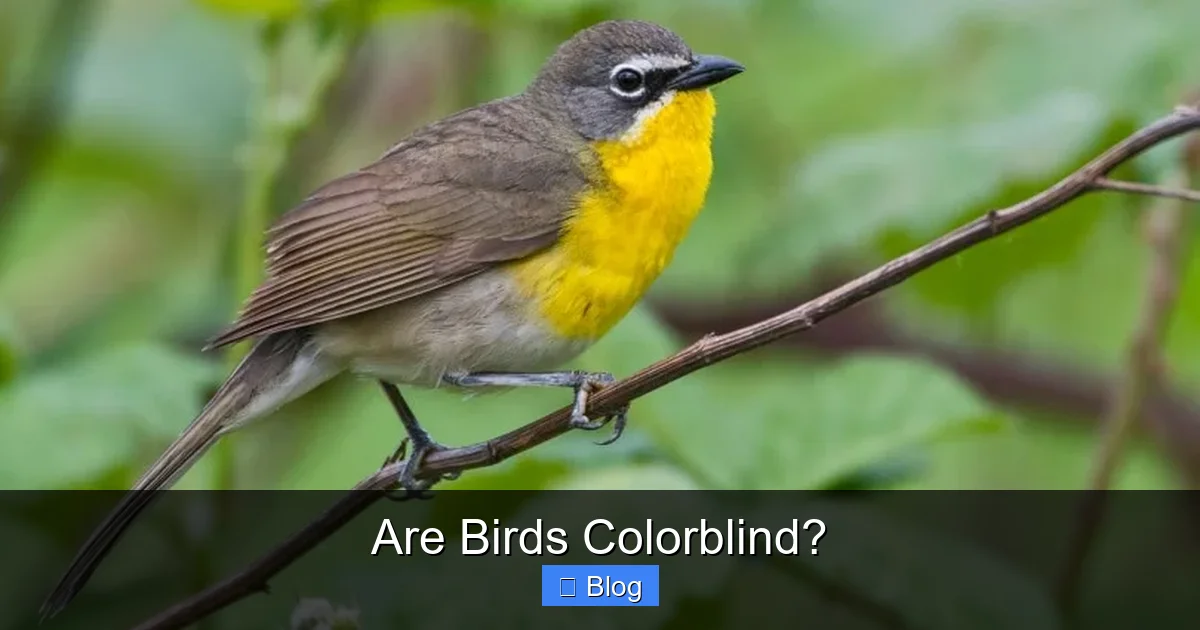
Visual guide about Are Birds Colorblind?
Image source: opticsmag.com
What is Tetrachromacy?
As we’ve touched upon, tetrachromacy means having four primary types of cone cells in the retina. For birds, these four types are typically sensitive to long-wavelength (red), medium-wavelength (green), short-wavelength (blue), and very short-wavelength (UV) light. This extra dimension of color perception means that a bird’s brain isn’t just mixing red, green, and blue; it’s incorporating UV information, creating entirely new color categories that have no direct human equivalent. We can only intellectually grasp the concept; we can never truly experience it.
Think about it this way: for a human, seeing color is like listening to a song played with three instruments. For a bird, it’s like listening to the same song, but with a fourth, unique instrument added, creating harmonies and melodies we can’t even conceive. This richer palette means that colors we perceive as plain or uniform might appear as complex, patterned, and multifaceted to a bird.
Unveiling the Ultraviolet World
The ability to see ultraviolet (UV) light is perhaps the most astonishing aspect of avian vision. To us, UV light is outside the visible spectrum – we might experience its effects as a sunburn, but we can’t see it. For many birds, however, UV light is as visible and as important as red or blue. This means that objects that look plain to us might glow or display intricate patterns under UV light to a bird. For example, some flowers have “nectar guides” – UV-reflective patterns that point insects and birds towards the pollen and nectar, invisible to the human eye but brightly guiding to a bird.
This UV sensitivity isn’t just an interesting quirk; it’s a vital survival tool. It’s a compelling argument against the idea that birds are colorblind. Their world is painted with UV colors that serve practical purposes, from communication to foraging.
Why UV Vision Matters for Birds
The practical implications of UV vision are profound. It allows birds to:
- Find Food: Many fruits and berries reflect UV light differently when ripe, making them stand out against unripe ones or foliage. This helps birds locate their next meal efficiently.
- Communicate with Mates: As we’ll discuss further, UV patterns on feathers can signal health, genetic quality, and attractiveness to potential mates.
- Spot Prey: Some insects or small rodents have urine trails that reflect UV light, which raptors can use to track them.
- Avoid Predators: Conversely, some predators might blend in better or stand out more based on UV reflectivity, aiding in either camouflage or detection.
- Navigate: Birds might use patterns of polarized UV light in the sky for navigation, especially during long migrations.
The world for a bird is not just bright; it is incredibly detailed and information-rich, all thanks to their extraordinary color vision, which completely refutes the notion that birds are colorblind.
Color as a Language: How Birds Communicate Through Pigment
If you’ve ever watched birds interact, you’ll know that their lives are full of complex social signals. From elaborate dances to intricate songs, communication is key. But what about color? The idea that birds are colorblind would make their vibrant plumage seem purely decorative. In reality, color is a highly sophisticated language, particularly when it comes to attracting mates and establishing social hierarchies.
Attracting Mates: The Irresistible Glow
One of the most striking roles of color in the avian world is sexual selection. Male birds, in particular, often sport dazzling plumages to woo females. Think of a peacock’s magnificent tail, a cardinal’s fiery red, or a male superb fairy-wren’s electric blue. These colors are not just for human admiration; they are critical advertisements for a potential mate.
The critical factor here, which further disproves that birds are colorblind, is the UV component. What might appear as a uniform color to us could be a complex pattern of UV reflectivity to a female bird. For instance, a male blue tit appears uniformly blue to humans, but to a female blue tit, his crown might emit strong UV signals, indicating his fitness. Females often prefer males with brighter, more UV-reflective plumage, as these colors can be honest signals of good health, a strong immune system, or superior foraging abilities.
Signaling Health and Status
Beyond immediate mating appeals, color also communicates general health and social status. Birds that are stressed, sick, or malnourished often exhibit duller plumage because they lack the resources to produce vibrant pigments, such as carotenoids. A bird with bright, rich colors is essentially broadcasting, “I am healthy, I can find plenty of food, and I am a strong individual.” This makes them more desirable as mates and might even deter rivals.
The intensity and specific hues can also indicate age or dominance within a flock. Older, more experienced birds might display slightly different coloration or a more pronounced UV signature, signaling their seniority to younger birds. So, when asked, “Are birds colorblind?”, the answer is a categorical no, because their very social fabric is woven with threads of color.
Territorial Displays and Warning Signals
Color is also instrumental in territorial defense. A male bird proudly displaying his vibrant plumage isn’t just showing off; he’s often sending a clear message to rivals: “This is my territory, and I am strong enough to defend it.” The visual impact of their colors, enhanced by their superior vision, helps establish boundaries and reduce direct conflict.
Furthermore, some birds use bold colors as a warning. Mimicking the bright, contrasting patterns of venomous insects or dangerous animals, these “aposematic” colors signal to predators, “I am toxic or dangerous, stay away!” While humans recognize these warning colors, birds, with their sharper color discrimination, are even better equipped to interpret these crucial signals, once again showcasing that birds are definitely not colorblind.
A Feast for the Eyes: Color in Foraging and Survival
The ability to see a wide spectrum of colors, including UV light, is not just for show or attracting partners; it’s a fundamental tool for survival. Foraging for food, identifying dangers, and staying hidden are all profoundly influenced by a bird’s extraordinary color vision. This aspect further solidifies why asking, “Are birds colorblind?” misunderstands their sophisticated sensory world.
Finding Food: Ripe Fruits and Nectar Guides
Imagine trying to find a ripe berry amongst a cluster of green leaves if all you saw were shades of grey. For birds, this isn’t an issue. Their enhanced color vision allows them to easily distinguish between ripe and unripe fruits. Many fruits undergo significant color changes as they ripen, often becoming brighter and more distinctly colored in the visible spectrum. But even more subtly, their UV reflectivity can change, making a ripe fruit literally glow to a bird’s eye.
The same applies to flowers. Many flowers have intricate “nectar guides” – patterns or stripes that are highly reflective of UV light. These guides are invisible to humans but act like illuminated arrows for birds, guiding them directly to the nectar-rich parts of the flower. Hummingbirds, for example, are highly attracted to red and UV-rich flowers, which are often rich in the nectar they seek. This precision in foraging is a direct result of their advanced color perception, making it clear that birds are not colorblind.
Hunting and Pest Control: Spotting the Unseen
For predatory birds, color vision can be a critical advantage. While some raptors rely heavily on acute spatial resolution (sharpness of vision) to spot distant prey, color can also play a role. As mentioned earlier, some voles and mice leave urine trails that are visible under UV light. Kestrels and other birds of prey have been shown to use these UV trails to locate their prey, even when the animals themselves are hidden. This ability turns an otherwise invisible signal into a clear path to a meal, showcasing a practical application of their non-colorblind vision.
Insectivorous birds also benefit immensely. Many insects, while camouflaged to human eyes against bark or foliage, might have subtle color differences or UV patterns that make them stand out to a bird. This makes foraging for tiny, fast-moving prey a much more efficient process.
Camouflage and Predator Avoidance
Conversely, color vision is equally important for avoiding becoming prey. Many birds rely on camouflage to blend into their surroundings. Their plumage patterns are often designed not just for human-visible colors but also for UV reflectivity, allowing them to perfectly disappear into the natural UV landscape of leaves and bark. If birds were colorblind, this intricate camouflage would be irrelevant. However, predators with similar advanced color vision also benefit from this, leading to an evolutionary arms race where color perception is key for both hunter and hunted.
Understanding these practical aspects of avian survival unequivocally answers the question, “Are birds colorblind?” with a firm negative. Their lives are deeply intertwined with the vibrant, multi-spectral world they perceive.
Peeking into the Avian Brain: Scientific Discoveries
For centuries, the intricacies of bird vision remained largely a mystery. Early observations were often limited by human perception, leading to the erroneous conclusion that birds are colorblind. However, advances in scientific research, particularly over the last few decades, have dramatically unveiled the true complexity and superiority of avian color vision.
Historical Misconceptions and Modern Revelation
The assumption that birds might be colorblind likely stemmed from the observation that many mammals have limited color vision. Since birds are often studied in contexts designed for human perception (e.g., how they react to human-visible colors), the full scope of their vision was missed. Scientists simply didn’t have the tools to detect UV light or understand tetrachromacy in living organisms.
The turning point came with technological advancements. The development of spectrometers that could measure UV reflectance from feathers, plants, and other natural objects, combined with electrophysiological studies on bird retinas, provided irrefutable evidence of their unique visual capabilities. Behavioral experiments, where birds were trained to choose between stimuli that differed only in their UV reflectance, cemented the understanding that UV light is indeed part of their perceived color spectrum.
Research Methods: From Behavioral Studies to Spectroscopy
Modern research into avian color vision employs a variety of sophisticated techniques:
- Spectrophotometry: This technique measures the exact wavelengths of light reflected from feathers, flowers, fruits, and other objects. By comparing these measurements with human perception, scientists can model what these objects might look like to a bird with UV vision.
- Behavioral Experiments: Birds are often trained in controlled environments to make choices based on color stimuli. For example, they might be presented with two identical-looking objects (to humans), one of which reflects UV light. If the bird consistently chooses the UV-reflective object for a reward, it indicates that they perceive the difference.
- Electrophysiology: Researchers can record the electrical responses of individual cone cells in a bird’s retina to different wavelengths of light, directly confirming the presence and sensitivity of the four cone types, including the UV-sensitive one.
- Modeling Avian Vision: Using the data from these studies, scientists create mathematical models to predict how birds perceive complex scenes, helping us better visualize their multi-dimensional color world.
These scientific endeavors have collectively painted a picture of avian vision that is far richer and more nuanced than previously imagined, definitively answering the question “are birds colorblind?” with a resounding “no” and instead, presenting them as masters of color.
Enhancing Our Understanding: Implications for Bird Enthusiasts and Conservation
Understanding that birds are not colorblind, but rather possess a superior color vision including the UV spectrum, has profound implications. It changes how we observe them, how we interact with them, and how we approach their conservation. It encourages us to look at the natural world with renewed curiosity and respect for avian senses.
Bird Watching with New Eyes
For bird watchers, this knowledge opens up a whole new dimension of appreciation. When you see a plain-looking female bird, remember that she might appear vibrantly patterned or subtly alluring to a male bird due to her UV reflectivity. The subtle differences between species that look similar to us might be glaringly obvious to birds. This understanding encourages us to look beyond our own limitations and appreciate the visual cues that birds themselves use. It adds another layer of wonder to observing their behaviors, courtship rituals, and foraging strategies.
It also reminds us that when we try to attract birds to our gardens, the colors we choose for feeders, flowers, and even bird baths might be perceived very differently by our feathered visitors. Opting for plants known to be attractive to birds, often those that reflect UV light in specific patterns, can enhance our backyard birding experience.
Conservation Efforts and Habitat Design
The realization that birds are not colorblind has direct, practical applications in conservation. For example, bird collisions with windows are a major problem. Windows are transparent to visible light but can be highly reflective of UV light, potentially appearing as open sky or continuous habitat to a bird. By applying UV-reflective patterns to windows that are visible to birds but largely invisible to humans, we can make glass surfaces more apparent to them, significantly reducing deadly collisions. This is a brilliant example of how understanding avian vision can directly save lives.
Furthermore, understanding their color preferences can help in habitat restoration projects. When planting new areas, selecting native plant species that provide specific visual cues (beyond just human-visible colors) for foraging or nesting can make these habitats more effective and attractive to target bird species. This deeper insight into avian sensory ecology allows us to design more bird-friendly environments, moving beyond human assumptions and embracing their unique perception of the world.
In conclusion, the question “Are birds colorblind?” can now be definitively answered. Far from it, birds are masters of color, possessing a visual system that often surpasses our own in its complexity and range. Their tetrachromatic vision, with its sensitivity to ultraviolet light, reveals a world of hidden beauty and crucial information, vital for communication, foraging, and survival. As we continue to unravel the mysteries of the avian eye, we gain a deeper appreciation for the rich sensory tapestry of life on Earth. So next time you see a bird, remember that it’s likely perceiving a spectrum of color we can only dream of, living in a world far more vibrant than our own.
🎥 Related Video: POV: Fall Color Blindness
📺 Fraser Eye Care Center
Ever wondered how colorblindness changes the world around us? We took to the nature trails to show you how different …
Frequently Asked Questions
How do birds see colors differently from humans?
Birds typically have a broader color spectrum perception than humans. While humans have three types of color-sensing cones (red, green, blue), many birds possess a fourth cone type, extending their vision into the ultraviolet (UV) range. This allows them to see colors and patterns that are completely invisible to us.
What is tetrachromacy in birds?
Tetrachromacy refers to the presence of four types of cone cells in the retina, each sensitive to a different range of light wavelengths. For many birds, these cones detect red, green, blue, and ultraviolet light, giving them a vastly richer and more detailed color experience than our trichromatic vision.
Why is UV vision important for birds?
UV vision is incredibly important for various avian behaviors. It helps birds identify ripe fruits and nectar guides on flowers, distinguish between mates and rivals based on UV reflective plumage, and even spot camouflaged prey or predators that have specific UV patterns. It’s a critical tool for survival.
Do nocturnal birds see color?
Nocturnal birds, like owls, generally have excellent low-light vision due to a high density of rod cells, but their color vision is often less developed than diurnal (day-active) birds. While they might perceive some colors, their world is likely less vibrant and more focused on shades of gray and overall light intensity for navigation and hunting.
How does color perception influence bird mating rituals?
Color perception is central to bird mating rituals. Males often display brilliant, UV-reflective plumage to attract females, as these colors can signal health, genetic fitness, and territorial dominance. Females use these visual cues to select the strongest and most suitable mates, ensuring successful reproduction and continuation of their lineage.
Can we use bird color vision knowledge to help birds?
Absolutely! Understanding how birds see color can inform conservation efforts, such as designing bird-safe windows that reflect UV light to make them visible to birds, thus preventing collisions. It also helps us create more effective and attractive feeders, choose appropriate plants for bird-friendly gardens, and better understand their natural behaviors and needs for habitat preservation.