
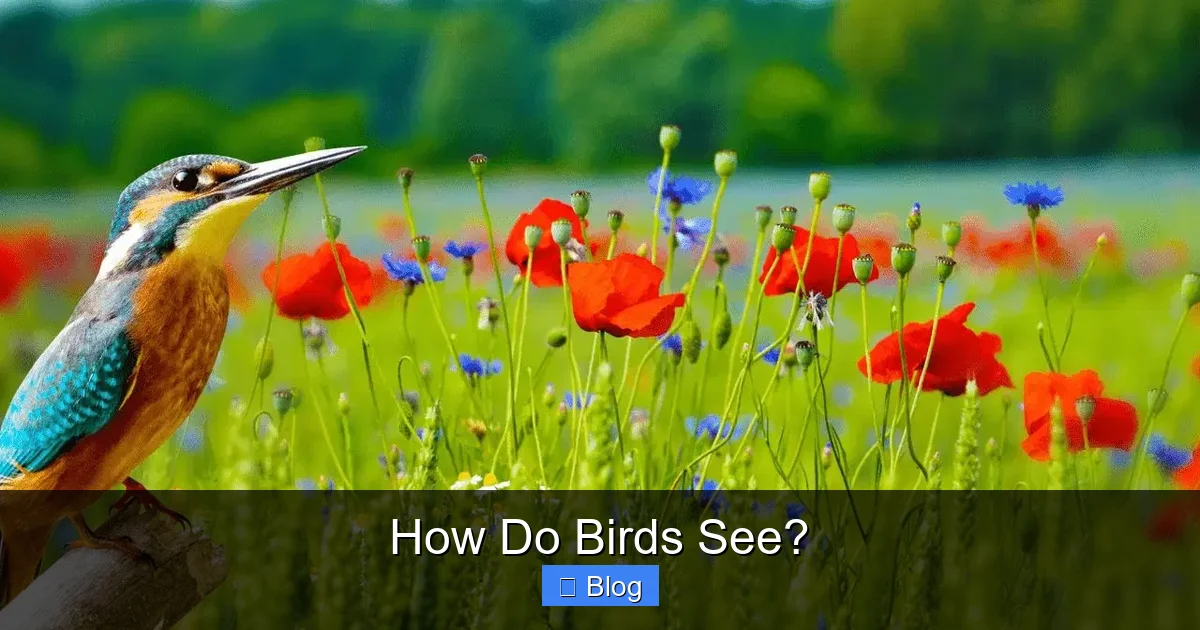
Birds possess truly remarkable vision, far surpassing human capabilities in many ways. Their eyes are specially adapted for their unique lifestyles, allowing them to see a broader spectrum of colors, including ultraviolet light, detect rapid movements with incredible speed, and maintain sharp focus over vast distances. Understanding how birds see helps us appreciate their incredible feats of navigation, hunting, and communication in a world invisible to us.
How Do Birds See?
Have you ever watched a hawk circling high above, seemingly spotting a tiny mouse in the tall grass? Or perhaps marveled at a hummingbird zipping through a garden, effortlessly navigating among flowers? These incredible feats often leave us wondering: just how do birds see the world? The truth is, their vision is nothing short of spectacular, often putting our own human eyesight to shame. Birds possess a visual system that is wonderfully complex and exquisitely adapted to their unique lives, allowing them to perceive a world that is, in many ways, beyond our imagination.
For us, seeing is believing, and we rely heavily on our sense of sight to interpret our surroundings. But what if your world was painted with colors you couldn’t even conceive? What if you could pause time with your eyes, catching every minute flutter of a gnat’s wing? This is the reality for many birds. Their eyes aren’t just scaled-down versions of ours; they are marvels of evolution, equipped with specialized features that grant them superpowers of perception. From navigating vast migratory routes to spotting a hidden insect on a leaf, how birds see underpins almost every aspect of their survival.
Join us on a fascinating journey to explore the intricacies of avian vision. We’ll dive into the anatomy of their eyes, uncover their ability to see colors we can’t, understand their incredible sharpness and speed of sight, and discover how their varied lifestyles have led to unique visual adaptations. By the end, you’ll gain a whole new appreciation for the vibrant, dynamic, and often invisible world that birds inhabit. So, let’s lift the veil and truly understand how do birds see!
Key Takeaways
- Tetrachromatic Vision: Unlike humans who are trichromatic (seeing red, green, blue), most birds are tetrachromatic, meaning they have four types of cone cells. This allows them to perceive a spectrum of colors invisible to us, including ultraviolet (UV) light.
- Superior Visual Acuity: Many birds, especially raptors, boast significantly sharper vision than humans. They can spot prey from immense heights, thanks to a higher density of photoreceptor cells and specialized foveas in their eyes.
- Faster Flicker Fusion Rate: Birds process visual information much faster than humans, enabling them to perceive rapid movements as distinct events rather than blurs. This is crucial for navigating through complex environments, catching insects, or escaping predators.
- Variable Eye Placement and Field of View: The placement of a bird’s eyes determines its field of view. Predators often have more frontal eyes for better binocular vision and depth perception, while prey animals tend to have eyes on the sides for a wider, panoramic view to detect threats.
- Specialized Adaptations for Lifestyles: Avian vision isn’t uniform; it’s highly adapted to a bird’s specific needs. Nocturnal birds like owls have large eyes with numerous rod cells for excellent low-light vision, while seabirds have adaptations to see clearly both in air and water.
- UV Vision for Communication and Foraging: UV light perception plays a vital role in birds’ lives, influencing mate selection (plumage patterns visible only in UV), foraging for food (UV-reflective fruits, urine trails), and identifying species.
Quick Answers to Common Questions
Do birds see in color?
Yes, most birds see in color, and many species can perceive an even broader spectrum of colors than humans, including ultraviolet (UV) light, thanks to their tetrachromatic vision.
Are birds’ eyes bigger than their brains?
In many bird species, especially owls and some raptors, their eyes are proportionally very large and can indeed weigh more than their brains, optimizing for exceptional vision.
Can birds see at night?
While most birds are diurnal, nocturnal birds like owls have specialized eyes with a high concentration of rod cells and large pupils, allowing them to see very well in extremely low light conditions.
Why do some birds have eyes on the sides of their heads?
Birds with eyes on the sides of their heads, such as pigeons, have a wider, almost panoramic field of view, which is crucial for detecting predators from multiple directions, though it reduces their binocular vision.
Do birds see the world in slow motion?
Not exactly slow motion, but birds have a much higher flicker fusion rate than humans. This means they process visual information much faster, perceiving rapid movements as distinct events rather than blurs, which helps them navigate and hunt.
📑 Table of Contents
- The Basic Structure of a Bird’s Eye: More Than Meets Our Eye
- Seeing in Full Color – and Beyond: Tetrachromatic Vision
- Sharpness and Speed: Acuity and Flicker Fusion Rate
- Field of View: Panoramic vs. Binocular Vision
- Special Adaptations for Different Lifestyles
- Beyond the Eye: How Birds Use Vision in Their World
- Conclusion: A World Beyond Our Sight
The Basic Structure of a Bird’s Eye: More Than Meets Our Eye
At first glance, a bird’s eye might not look dramatically different from ours, but underneath the surface, there are profound distinctions. Bird eyes are often much larger in proportion to their heads than human eyes. In fact, for many birds, their eyes can make up a significant percentage of their head weight, sometimes even more than their brain! This large size allows for a bigger image to be projected onto the retina, which is crucial for high-resolution vision.
Anatomy That Aids Avian Vision
The fundamental components are similar to ours: a lens, retina, iris, and pupil. However, the details are where the magic happens. Bird eyes are generally less spherical than human eyes, often being flatter (like a falcon’s) or even tubular (like an owl’s). This shape influences how light is focused and can provide different advantages. For instance, tubular eyes allow for a larger lens and more light-gathering ability, essential for nocturnal predators.
One unique feature is the pecten oculi, a comb-like, pleated structure that projects from the retina into the vitreous humor. While its exact function is still debated, it’s believed to supply nutrients to the retina (which is avascular in birds, meaning it lacks blood vessels), reduce glare, help with internal temperature regulation, and possibly even assist in detecting motion.
Another fascinating adaptation is the presence of scleral ossicles – a ring of tiny bones in the sclera (the white part of the eye). These bony plates help to support and protect the large, often immobile avian eye, allowing birds to withstand pressure changes during flight and aiding in focusing.
Seeing in Full Color – and Beyond: Tetrachromatic Vision
When you consider how birds see, one of the most astonishing differences from human vision is their ability to perceive colors. Most humans are trichromatic, meaning we have three types of cone cells in our retinas that are sensitive to red, green, and blue light. Birds, however, are typically tetrachromatic.
The Marvel of UV Perception
What does tetrachromatic mean for how birds see? It means they have a fourth type of cone cell, sensitive to ultraviolet (UV) light. This opens up an entire spectrum of colors that are utterly invisible to us. Imagine seeing a world with billions more shades than you currently perceive – that’s a glimpse into the avian visual experience. This UV vision isn’t just a novelty; it’s a vital tool for survival.
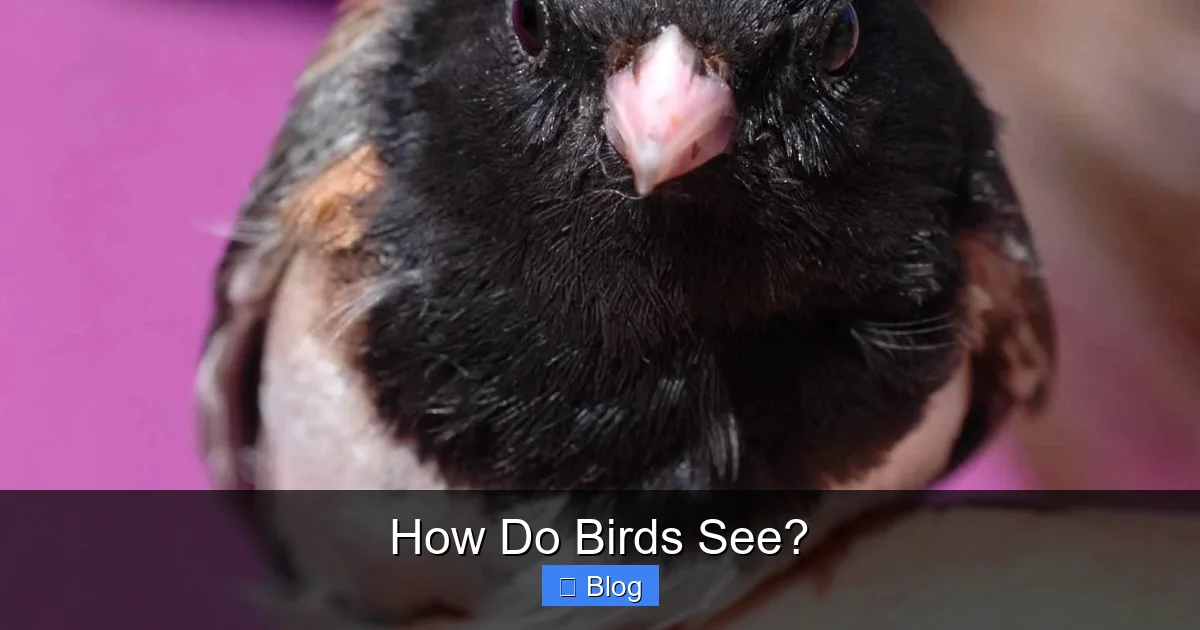
Visual guide about How Do Birds See?
Image source: toughlittlebirds.files.wordpress.com
- Mate Selection: Many bird species display plumage patterns that are only visible in UV light. What might look like a plain brown feather to us could be a dazzling display of UV patterns to a potential mate, signaling health and genetic fitness. For example, blue tits use UV reflection in their crown feathers to assess potential partners.
- Foraging: UV vision helps birds find food. Some fruits and berries reflect UV light, making them stand out against foliage. Nectar guides on flowers, invisible to us, can glow in UV to direct pollinators. Even the urine trails of voles, often reflecting UV, can guide a hunting kestrel to its prey.
- Species Recognition: Different bird species often have distinct UV signatures, allowing them to differentiate between their own kind and others, even if they look similar to our eyes.
Furthermore, each cone cell in a bird’s eye contains an oil droplet. These oil droplets act like tiny color filters, further enhancing color discrimination and sensitivity. They can filter out specific wavelengths, making colors even purer and more vibrant, which is crucial for detailed visual tasks like distinguishing subtle differences in foliage or prey coloration.
Sharpness and Speed: Acuity and Flicker Fusion Rate
Beyond color, how birds see also involves extraordinary sharpness and speed. Many birds boast visual acuity far superior to ours, and they can process visual information at a rate that would make our heads spin.
Unparalleled Visual Acuity
Visual acuity refers to the sharpness of vision, or how clearly one can see fine details. While human acuity is often measured at 20/20, many raptors like eagles and hawks have vision estimated at 20/5 or even 20/2. This means what we see clearly at 5 feet, they can see clearly at 20 feet! How do birds see with such incredible detail?
- High Density of Photoreceptors: Their retinas are packed with a much higher density of photoreceptor cells (rods and cones) than ours. More light-sensitive cells mean more detailed information is sent to the brain.
- Two Foveas: Many birds, especially birds of prey, have two foveas (areas of sharpest vision) in each eye, compared to our single fovea. One fovea provides excellent monocular vision (one eye focused on an object), while the other is positioned for binocular vision, allowing for precise depth perception when both eyes converge on a target.
- Magnifying Power: The large size of a bird’s eye and its lens structure can also contribute to a kind of telephoto effect, effectively magnifying distant objects.
Processing Visual Information at Hyperspeed
Have you ever noticed how a ceiling fan appears as a blur when it’s spinning fast? That’s because our “flicker fusion rate” – the speed at which our brains can distinguish individual flashes of light – is relatively low (around 60 Hertz or cycles per second). Anything faster blurs into continuous motion. For birds, particularly those that fly through dense environments or hunt fast-moving insects, this rate is much higher, often exceeding 100 Hertz, and for some species, up to 140 Hertz!
This means how birds see the world is like watching a slow-motion film compared to our regular speed. A hummingbird darting between flowers perceives each beat of its wings as a distinct event, not a blur. This ability is vital for:
- Navigating Complex Environments: Flitting through dense branches or crowded airspace requires rapid processing of spatial information to avoid collisions.
- Hunting and Catching Prey: Imagine trying to catch a tiny fly mid-air if it’s just a streak. A high flicker fusion rate allows insectivorous birds to track and intercept even the fastest insects with precision.
- Escaping Predators: Quickly detecting and reacting to the rapid approach of a predator.
Field of View: Panoramic vs. Binocular Vision
The placement of a bird’s eyes on its head offers significant clues about its lifestyle and how birds see their surroundings. This placement dictates their field of view and how well they perceive depth.
Eyes on the Sides for a Panoramic View
Most prey animals, such as pigeons, chickens, and many songbirds, have eyes positioned on the sides of their heads. This provides an almost panoramic field of view, often close to 360 degrees. This wide peripheral vision is a crucial survival mechanism, allowing them to detect predators approaching from almost any direction without moving their heads.
The trade-off, however, is reduced binocular vision. Binocular vision occurs when both eyes focus on the same object, and the slight difference in the images from each eye allows the brain to calculate depth and distance. With eyes on the sides, the overlap between the fields of view is minimal, leading to poorer depth perception straight ahead. This is why you often see pigeons bobbing their heads – they’re using motion parallax to gain depth information.
Frontal Eyes for Precise Binocular Vision
Predatory birds, like owls and most raptors, have eyes positioned more frontally on their faces, similar to humans. This provides an excellent degree of binocular vision and superior depth perception, essential for accurately judging distances to strike prey. For an owl swooping down on a mouse in near-total darkness, knowing precisely how far away its target is, is a matter of life or death.
The downside of frontal eyes is a reduced overall field of view. Owls, for example, have a very limited peripheral vision and often cannot move their eyes within their sockets. To compensate, they have incredibly flexible necks, allowing them to rotate their heads up to 270 degrees in either direction – giving them a complete panoramic view by turning their heads!
Special Adaptations for Different Lifestyles
The question of how birds see isn’t a one-size-fits-all answer. Avian vision is incredibly diverse, with specific adaptations tailored to different ecological niches and lifestyles.
Nocturnal Vision: The Owl’s Advantage
Owls are the undisputed champions of low-light vision. Their eyes are proportionally enormous, often taking up to 50% of their head volume, and are tubular rather than spherical. These large, forward-facing eyes are packed with an exceptionally high concentration of rod cells, which are responsible for detecting dim light and motion, but not color. The trade-off is that owls have poor color vision and are largely monochromatic.
Their large pupils can open very wide, letting in as much light as possible, and a reflective layer behind the retina called the tapetum lucidum (which causes eye shine in many nocturnal animals) further amplifies available light. All these adaptations ensure that owls can see clearly even on the darkest nights, allowing them to hunt effectively when other creatures are asleep.
Raptor Vision: The Hunter’s Edge
Eagles, hawks, and falcons possess some of the sharpest vision in the animal kingdom. Their eyes are large, with high concentrations of photoreceptors and two foveas, as discussed earlier. This allows them to maintain sharp focus on a vast landscape while also precisely tracking a single, small moving target below. Their eyes can also rapidly adjust focus (accommodate) between distant and near objects, a crucial skill for a bird diving at high speeds.
Shorebird and Seabird Vision: Adapting to Two Worlds
Birds like gulls, terns, and diving birds face unique challenges, needing to see clearly both in the air and underwater. Their eyes often have flatter corneas and a greater ability to rapidly change the curvature of their lenses (a process called accommodation) to adjust for the different refractive properties of air and water. Some diving birds also have special transparent eyelids (nictitating membranes) that act like goggles, protecting their eyes and improving vision underwater.
Hummingbird Vision: A World of Vibrant Detail
Hummingbirds, with their need to identify specific flowers and rapidly navigate, showcase a blend of high flicker fusion rate, excellent color vision (including UV), and precise depth perception. Their eyes are relatively large, and their ability to rapidly process visual information is astounding, allowing them to track quickly moving insects and navigate complex floral structures with pinpoint accuracy.
Beyond the Eye: How Birds Use Vision in Their World
Understanding how birds see is not just about anatomy and physiology; it’s about appreciating how their unique visual perception shapes their entire existence. Their vision is central to almost every aspect of their behavior.
Navigation and Migration
Birds undertake some of the most epic journeys on the planet, migrating thousands of miles with incredible precision. While they use multiple cues (magnetic fields, olfactory signals), visual landmarks and celestial navigation play a huge role. How birds see the sun’s position, even when obscured, and possibly even polarized light patterns in the sky, aids their remarkable navigational abilities. The ability to spot distant landmarks, often at UV wavelengths that enhance contrast, helps them stay on course.
Communication and Display
Visual displays are paramount in bird communication, especially during courtship. The vibrant colors of male birds, often enhanced by UV reflection, are direct appeals to potential mates. Intricate dances, elaborate plumage ornaments, and territorial displays are all visual signals intended to convey messages to rivals or partners. Understanding their UV vision helps us decode why certain “dull” birds might be incredibly attractive to their own kind.
Foraging and Hunting Strategies
Whether it’s a robin cocking its head to spot a worm, a kingfisher diving for a fish, or a shrike impaling prey on a thorn, vision is the primary sense for foraging. The ability to spot subtle movements, differentiate food items from their surroundings (even with camouflage), and accurately judge distance is honed by their specialized eyes. Birds that eat seeds can distinguish between viable and non-viable seeds visually, and those that eat insects can track tiny, fast-moving targets.
Predator Avoidance and Warning
For prey birds, the panoramic view and quick processing speed are life-savers. Spotting a predator from afar and reacting instantly can mean the difference between life and death. Alarm calls often coincide with visual cues, alerting others in the flock to a specific type of threat perceived visually. The collective vigilance of a flock, with many eyes scanning in different directions, creates a powerful defense system.
Conclusion: A World Beyond Our Sight
The world as perceived by a bird is a symphony of colors, movements, and details that largely remain hidden from human eyes. From the incredible sharpness of a hawk’s gaze to the UV-laden beauty of a mate’s plumage, how birds see is a testament to the power of evolution, tailoring vision to perfectly suit a creature’s needs.
So, the next time you see a bird soaring effortlessly, foraging diligently, or displaying its vibrant feathers, take a moment to consider the extraordinary visual world it inhabits. It’s a world where flowers glow with invisible beacons, predators are spotted from impossible distances, and every flutter of an insect wing is a distinct, trackable event. By understanding the science behind how birds see, we not only gain a deeper appreciation for these fascinating creatures but also broaden our own understanding of the incredible diversity of life on Earth. Their eyes are true windows into an alien, yet beautiful, reality.
🎥 Related Video: Bird Vision – What Birds See (and you can't!)
📺 BioBush
Humans can see millions of colors, but birds can see EVEN MORE. Learn how this is possible and what it means. Please …
Frequently Asked Questions
How does a bird’s vision compare to a human’s?
Bird vision often surpasses human vision in several key aspects. They can see a wider spectrum of colors (including UV), have superior visual acuity (sharper focus), and process visual information much faster, allowing them to perceive details and movements we would miss.
What is tetrachromatic vision?
Tetrachromatic vision refers to having four types of cone cells in the retina, each sensitive to a different range of light wavelengths. For birds, this means they see red, green, blue, and ultraviolet light, giving them access to a much richer color spectrum than trichromatic humans.
Why is UV vision important for birds?
UV vision is vital for birds in many ways. It helps them identify potential mates through unique UV plumage patterns, locate food like UV-reflecting fruits or insect trails, and distinguish between different species or even different individuals within their own species.
Do all birds have the same type of vision?
No, avian vision is highly diverse and adapted to each species’ specific lifestyle. Nocturnal birds have excellent low-light vision, raptors have incredibly sharp long-distance vision, and some seabirds can see well both in air and underwater, showcasing vast differences in how birds see.
What is a bird’s flicker fusion rate, and why is it high?
A bird’s flicker fusion rate is how quickly their brain can distinguish individual flashes of light before they blur into continuous motion. Birds have a much higher rate than humans (e.g., 100+ Hz vs. 60 Hz) to process rapid movements accurately, essential for navigating complex environments, catching fast prey, and escaping predators.
How do birds compensate for their often immobile eyes?
Many birds, especially those with tubular eyes like owls, have limited eye movement within their sockets. They compensate for this by having incredibly flexible necks, allowing them to rotate their heads over a wide range (e.g., 270 degrees for owls) to gain a panoramic view without moving their bodies.